How do you check a used adjustable bed base before buying?
Quick answer
Confirm the base’s exact model, size and single or split configuration, then verify your mattress is suitable. Inventory the correct remote, power supply, legs and retainer parts. Observe ordinary movement with clear space and the manual’s limits, and price transport before paying. A moving base is not proof of medical benefit or future motor reliability.
Match the mattress and room before the remote
Write down the mattress maker, model, actual dimensions and its approval for an adjustable base. A mattress fitting the flat platform does not establish that it can bend as intended. Ergomotion’s guidance directs buyers toward adjustable-friendly mattresses and model-specific instructions. Ask the mattress maker when compatibility is unclear.
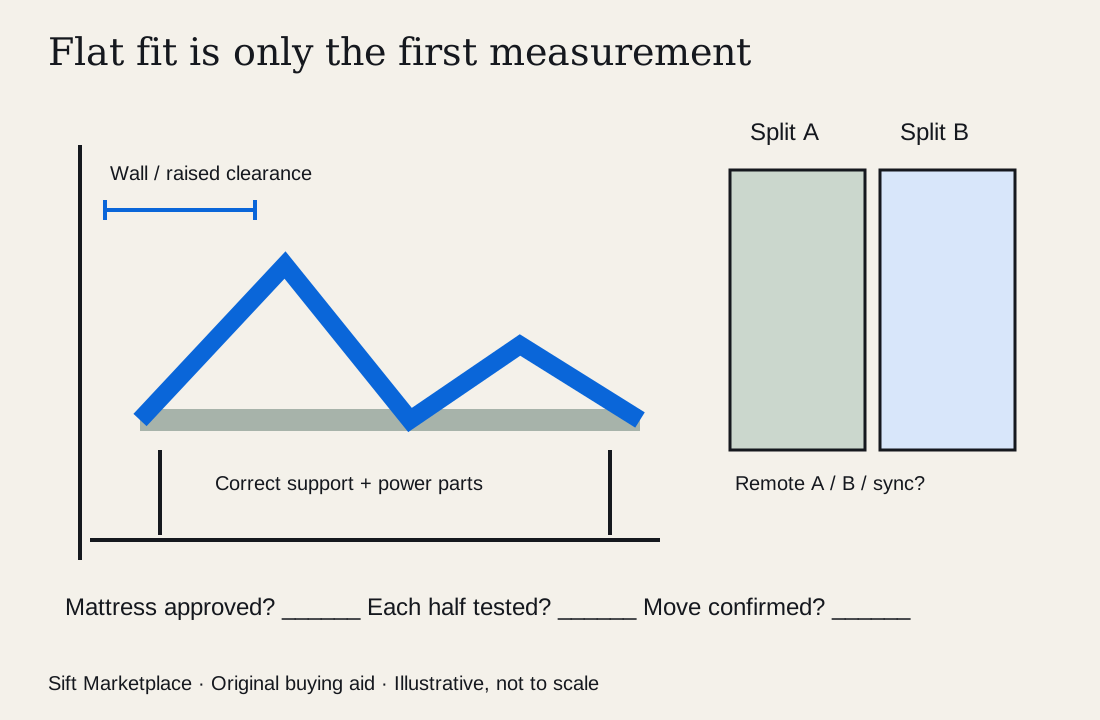
Identify whether the offer is one complete base, two independently controlled halves or a synchronized pair. “King adjustable” may describe several arrangements. Record both base labels and the included remotes or synchronization components. Confirm that the intended mattress arrangement matches the control arrangement you want.
Measure the flat footprint, raised-motion envelope, access beside the bed, nearby wall or headboard and the outlet location. A bed that fits when flat may crowd a wall, obstruct access or interfere with existing furniture during movement. Use the exact manual rather than guessing from the term “wall-hugger.”
 Enlarge diagram
Inventory the parts that make the base usable
Request the underside model label without asking anyone to lift or crawl beneath an unsupported base. The seller can provide accessible photos or existing records. Obtain the correct owner manual and check its parts list.
| Component | What to establish |
|---|---|
| Platform and frame | Exact dimensions, model and condition |
| Legs or approved support arrangement | Correct count, attachments and usable height |
| Mattress retainer | Required bar or other original retaining system present |
| Remote and controls | Correct model, working buttons and supported pairing |
| Power supply and cables | Exact approved components; no damaged or improvised wiring |
| Split-bed connection | Parts and method needed for independent or synchronized use |
| Optional brackets | Headboard accessory identity and actual inclusion |
The Quest 1.0 manual, for example, identifies a mattress retainer and treats headboard brackets as an optional accessory. Do not assume those details apply to every base. A missing remote can be expensive or unsupported; verify a replacement through the exact model’s support channel before making an offer.
Inspect fabric, frame and accessible connections
Ask about spills, storage, smoke or pets, repairs and recurring error behavior. Inspect the upholstery, seams, exposed frame, leg attachment areas and accessible cable jackets while the base is in the safe state specified by its manual. Look for cracks, distortion, missing supports and evidence of improvised wiring.
Do not open control boxes, repair cables or reach into moving mechanisms. A seller’s claim that an intermittent fault is “just the remote” is not a diagnosis. A replacement remote only solves a confirmed remote problem.
For a base sold with a mattress, evaluate that mattress separately. Do not let a free mattress obscure the cost and transport requirements of the base itself. Decide what you will actually take, and confirm that the seller agrees to separate the bundle if needed.
Observe normal movement with the correct setup
Agree on a demonstration following the exact owner manual, including permitted loading and clearances. Keep people, pets, bedding and objects away from moving and pinch-point areas. The seller should operate ordinary controls without overriding travel limits or forcing a section by hand.
Observe head and foot movement, return to flat and any specific function you value. Check both halves of a split arrangement separately, then the supported synchronization mode if that is part of the purchase. Record which remote controlled which base. Do not assume a remote illuminating proves that its commands reach the correct unit.
| Result | Buying response |
|---|---|
| Relevant movement and return work normally | Continue to mattress, access and complete-cost checks |
| Optional feature cannot be demonstrated | Leave its value unverified |
| Persistent noise, uneven motion or interruption | Obtain a competent service assessment or pass |
| Correct replacement remote confirmed | Price it, then decide how core function will be verified |
| Unknown adapter or altered wiring | Resolve with the maker before operation |
| Only one half works | Do not value the offer as a functioning pair |
A brief movement check cannot establish remaining motor life. Nor does a preset name such as “zero gravity” establish a medical outcome. Buy for verified comfort and intended use; discuss health-related needs with an appropriate clinician rather than relying on a marketplace claim.
Make the move feasible before paying
Record the largest allowed transport section, weight, removable pieces and manufacturer-approved handling. Determine whether the base can be folded or dismantled for transport; do not assume the articulation mechanism is a carrying hinge. Ask a suitable mover for a quote if stairs, tight turns or weight make the move uncertain.
Use the furniture fit checker as a basic dimension aid, then assess turns, handling space and the real route separately. Confirm elevator bookings, parking and who supplies help. Avoid a non-refundable move booking before you know the base fits and functions.
In a hypothetical comparison, a base at $200 needs a confirmed $85 remote, $45 leg set and $120 move: $450. A complete base at $330 with a $100 move totals $430. The apparent $130 saving disappears. These are illustrative figures, and the incomplete base still needs a way to establish function before purchase.
Confirm the agreement
Ask: “Please confirm the model and size of each base, all remotes, power supplies, legs and retainer parts, and any repairs or intermittent faults. Can you demonstrate normal movement and return to flat? I also need the approved transport dimensions and handling instructions.”
Choose the candidate whose mattress fit, complete controls, observation and move all work. Negotiate a known supported omission; pause for unresolved motion or electrical issues. Keep the manual and component photos with the purchase record so first setup follows the correct system.
Sources
- 01Ergomotion Quest 1.0 owner manual
- 02Ergomotion Knowledge articles
- 03Ergomotion Manuals and instructions