Measure first. Move it once.
Quick answer
Enter the furniture’s transport dimensions and the clear width and height of an opening. The checker tests straight-through rectangular orientations with your chosen clearance. It does not model corners, stairs or diagonal manoeuvres, so measure the full route before arranging collection.
Make it yours
Compare the measurements
Check a rectangular item against a clear opening. Measure the item as it will be transported, after any agreed disassembly.
Ready to find your next option?
Sift filters your Marketplace searches, marks every price drop and gives you a second opinion on any listing.
Measure the item as you will carry it
Use the widest and tallest points, including arms, handles or any fixed protrusions. If legs or another part will be removed, confirm that with the seller and measure the remaining shape.
A sofa’s catalogue dimensions may not describe the exact shape being moved. The checker treats the entered dimensions as a rectangular box. It is a first comparison, not a three-dimensional moving simulation.
Measure the clear opening
Measure the space available with the door or vehicle opening in its actual loading position. Include handles, hinges, trim and other obstructions. The number you need is the usable opening, not the nominal door size.
If you are checking a vehicle, enter the available straight depth as well. A piece can pass through the opening and still be too long for the interior.
The clearance field adds space on each side of the relevant dimension. A 32-inch-wide item with 1 inch on each side needs at least 34 inches of clear width in that orientation.
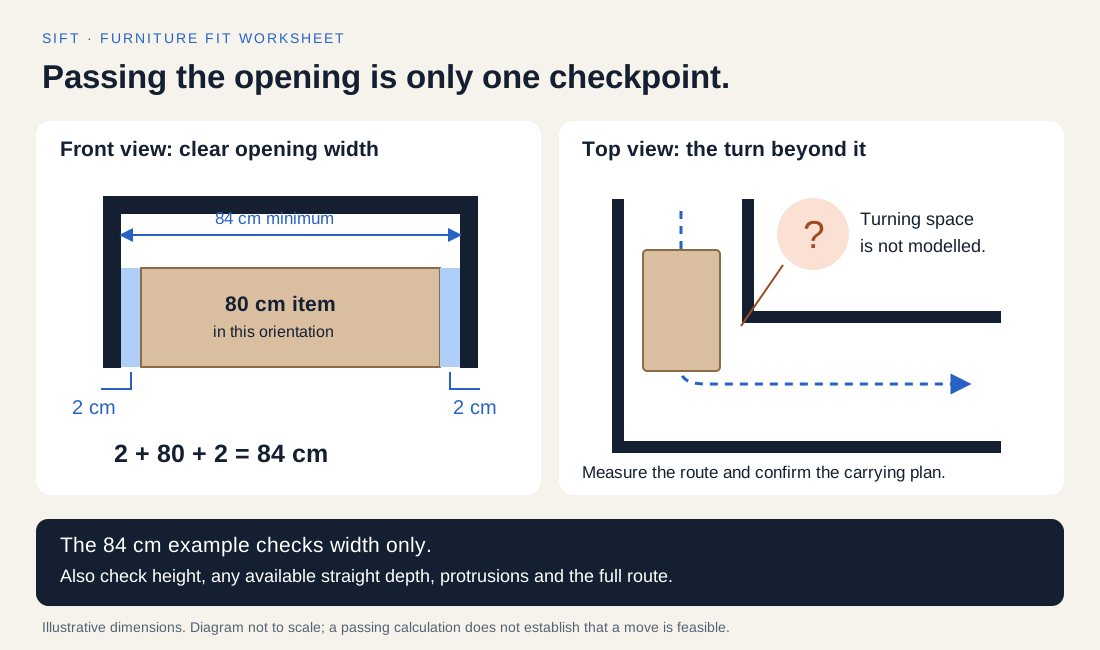
The diagram below uses a separate metric example: an 80 cm-wide item plus 2 cm on each side needs 84 cm. To enter those values, choose Centimeters in the Unit field first. Keep every dimension and clearance in the selected unit.
 Enlarge diagram
Understand the result
The checker tries the item’s width, height and depth in the six possible rectangular orientations. A listed orientation fits only the measurements entered.
“No straight-through orientation” means none of those box orientations passed. It does not establish that a skilled mover could never tilt or dismantle the actual item. Conversely, a passing orientation does not establish that the route is manageable.
| Not included in the check | What to do next |
|---|---|
| A turn into a hallway | Measure the turning space and discuss it with the mover |
| Stairs or a landing | Record dimensions, rails and changes in direction |
| Flexible upholstery | Use actual moving measurements; do not assume compression |
| Weight and lifting | Arrange suitable people, equipment or professional help |
| Removable parts | Confirm removal and reassembly before collection |
Walk the entire route
Check the seller’s exit, loading space, vehicle interior, your entryway and the item’s final position. An item that fits your front door may not fit through the next turn.
For collection without your own vehicle, use the furniture transport guide. Ask for a quote that describes the item, access, floors and required help.
Keep the measurements in the pickup planner, and add delivery or hire costs to the purchase total.