Buy used furniture without a car
Quick answer
Compare seller delivery, a collection provider, hire and a helper by who inspects, carries and accepts the item. Confirm both access routes and the cost of rejection or failed delivery before booking.
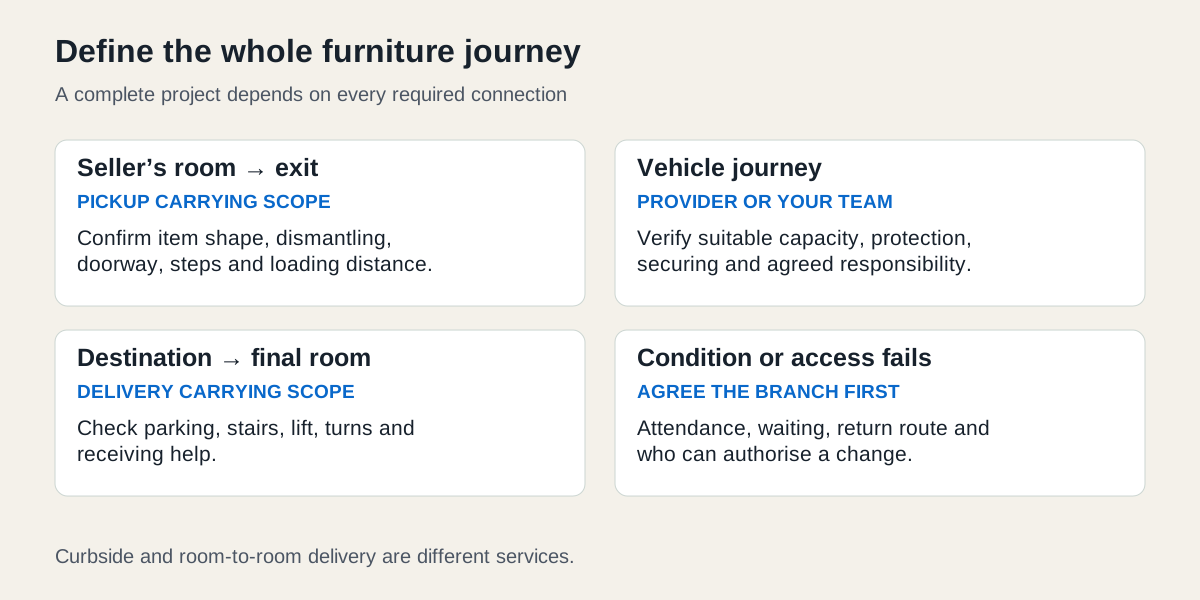 Enlarge diagram
What are your practical transport options?
Choose a transport arrangement with a defined inspection and carrying scope. “Delivery available” may mean curbside drop-off, while you need an item carried through a narrow entry and up stairs. The cheapest suitable option is the one that completes the agreed job after the furniture passes inspection.
| Option | Who inspects and accepts? | Carrying and dismantling | Best question before booking |
|---|---|---|---|
| Seller delivery | You at the agreed destination, under explicit terms | Only what the seller expressly agrees | Where does delivery end, and what happens if condition differs? |
| Collection provider | You beforehand, or a specifically authorised inspector | Whatever the written quote includes | Is condition inspection included, or only transport? |
| Vehicle hire | You or your named collector | You arrange suitable help and equipment | Can the actual item and route be handled within the vehicle’s limits? |
| Friend or helper | Roles agreed between you | Confirm willingness, capacity and practical help | Are we both clear about lifting, time and the possibility of walking away? |
For a seller who brings the item to you, use the detailed seller-delivery agreement guide. For a rental, use planning a van collection. A provider’s transport booking does not automatically make them a furniture inspector or give them authority to accept substitutions.
What measurements do you need?
Measure the item’s transport shape, not only its advertised usable dimensions. Record any removable parts that the manufacturer permits and that the seller agrees to remove. Then measure the narrowest access at both properties, stairs, turns, lift openings and the final position.
Use the furniture fit checker to organise simple measurements. It cannot prove that a large rigid item will turn through a hallway or that a vehicle can carry the load safely. Give the provider photographs and dimensions of the actual route where appropriate, without broadcasting private addresses in public posts.
Manufacturer assembly instructions help identify intended construction. Old glued, damaged or modified furniture may not tolerate dismantling. Confirm who will do it, whether they are competent and what happens if it cannot be done; do not book a smaller vehicle on an unverified assumption.
A complete quote request
This fictional request uses general access descriptions. Exact addresses can be supplied privately when needed to obtain or confirm a booking.
Please quote collection of one inspected solid-wood desk, 48 inches wide × 24 inches deep × 30 inches high. It travels assembled unless we separately confirm otherwise. Pickup is from a ground-floor room in the north end of town, through the pictured front doorway; legal loading space is about 50 feet away. Delivery is to a second-floor apartment in the central area, one flight of stairs, no elevator, with the measured landing and doorway shown. Please quote carrying from the seller’s room to the final room, the number of handlers you supply, protection and securing equipment, parking charges and any waiting fee. Neither household is promising lifting help. Please state what happens if I reject the desk before loading or you judge the access unsuitable.
Ask for the provider’s assumptions and exclusions in writing. Confirm insurance or damage-handling terms directly rather than interpreting “fully insured” as a promise covering every event. If the provider needs a weight or access measurement that you cannot establish, resolve it before booking.
How do you price the complete purchase?
Suppose a used desk is $90, room-to-room collection is $110 and known missing hardware is $20: total $220. A different complete desk with an agreed $70 seller-delivery charge and $130 price totals $200, but only if that delivery scope meets the same requirement. A $160 curbside retail offer is not equivalent if you still need help upstairs.
These are illustrative figures, not quotes. Use listing comparison to keep item, transport and missing-parts costs together. Record carrying scope beside the numbers so you do not compare different services as though they were interchangeable.
What if the furniture fails inspection or fit?
Before booking, obtain the provider’s actual cancellation, attendance, waiting and failed-access terms. In a fictional quote, attendance after dispatch costs $45 even if no furniture is loaded. If the desk fails the buyer’s condition check, the buyer declines it and pays that agreed attendance charge. That is a limited failed-trip cost, not a reason to accept damaged furniture.
If the buyer instead approves loading and the desk cannot pass the destination turn, responsibilities are more complicated. Agree the failed-delivery route beforehand: return to the seller only with their consent, an authorised alternative destination, or another arrangement the provider accepts. Do not assume the driver will store it or that the seller must take it back.
The stronger sequence is to inspect first, verify the access plan and then dispatch transport where scheduling allows. If separate visits are impractical, allow the collector to stop before loading and understand the cost of that choice.
Confirm the handover and finish the move
Reconfirm item availability, provider arrival, both carrying routes and the receiving person. Photograph agreed condition with permission and keep payment and transport records. Check the item on arrival before closing the transport job, following the provider’s reporting terms for any damage.
If suitable carrying help or a viable access route cannot be arranged, choose a smaller item or a different delivery offer. Furniture that cannot reach its intended room has not met the buying brief, regardless of the discount.