Rent a van for Marketplace pickup: check fit, cost and timing
Quick answer
Confirm the item’s transport dimensions and weight, then check the actual rental vehicle’s openings, interior, payload and access clearance. Budget for distance, fuel, equipment, taxes and selected protection as well as the base hire. Leave inspection and return time, and agree what happens if the purchase fails.
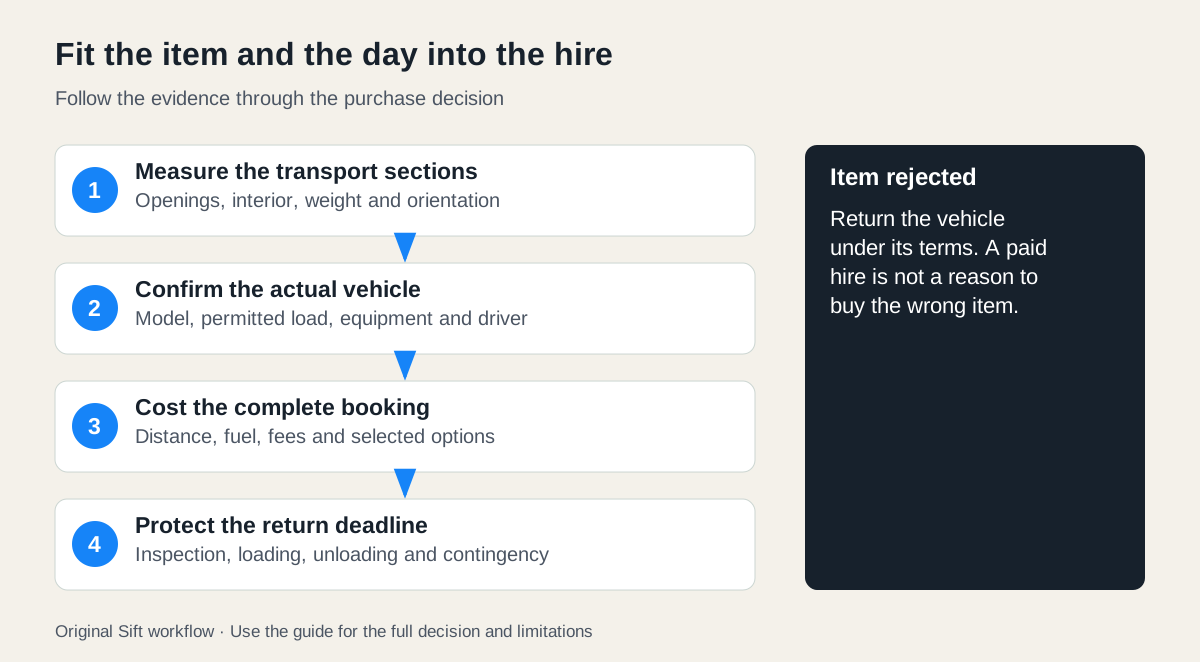 Enlarge diagram
Choose the vehicle after measuring the item
Record the item’s largest transport section, weight where available, required orientation and permitted disassembly. Ask the manufacturer or an appropriate mover when transport requirements are uncertain. The vehicle’s advertised length is not a complete fit check.
Compare the door opening, interior restrictions such as wheel arches, load limits and the room needed for protection and securing. Also check the route out of the seller’s property and into yours. A large cargo space does not solve an impossible stair turn or a load you cannot safely handle.
A van and a small truck are different shapes
U-Haul’s cargo-van page lists approximate interior dimensions of 9 ft 6 in × 5 ft 7 in × 4 ft 8 in and a rear opening of 5 ft 1 in × 4 ft 1 in. Its 10-foot truck page lists a taller opening and explicitly says that model has no loading ramp. Both warn that supplied equipment can vary. Confirm the actual vehicle before relying on these published examples.
In a hypothetical desk collection, the largest section is 60 × 30 × 3 inches after seller-approved disassembly. Those numbers can help shortlist a vehicle, but they do not establish a safe loading arrangement, room for all pieces or payload compliance. The buyer confirms the actual dimensions and suitable securing arrangements with the provider.
| Check | Van | Small truck |
|---|---|---|
| Opening and interior | Verify exact supplied model and obstructions | Verify door and interior separately |
| Loading height or ramp | Do not assume easy lifting | A small truck may have no ramp |
| Route clearance | Check vehicle height against actual access | Higher vehicle may lose a parking option |
| Load and securing | Check rated limits and approved equipment | Larger volume does not mean unlimited payload |
| Driving and parking | Confirm driver eligibility and permitted route | Confirm confidence and suitable loading space |
Build the complete rental estimate
Use the actual reservation and rental agreement. Base rates, distance charging, deposits, fuel requirements, late return and protection options vary by location and booking. Do not treat a website’s starting rate as the final bill or assume personal auto insurance covers a rental cargo vehicle.
A fictional estimate might be $35 base hire, $32 distance charges, $18 fuel, $15 selected equipment, $25 selected protection and $16 taxes/fees: $141. These are arithmetic examples, not U-Haul prices or an insurance recommendation. Obtain the actual inclusions, exclusions, deductible and permitted use before choosing coverage.
If a collection provider quotes $155 for the complete agreed job, compare the $14 difference with driving, collection and return work. The no-car guide helps choose the route; hiring a vehicle is useful only if you can complete the handling and driving safely.
Schedule backwards from the return deadline
For a fictional noon return, allow time for unloading at home, any required fuel stop, travel to the branch and the provider’s return process. Then place the seller visit earlier, with inspection and loading time rather than travel alone.
A plan might reserve 8:00–8:30 for collecting and checking the vehicle, 9:00–9:30 for item inspection, 9:30–10:00 for agreed loading, 10:30–11:00 for unloading and the remaining hour for return tasks and contingency. These are illustrative allowances, not travel predictions. If the seller is available only at 11:00, change the booking or pass; do not remove inspection time to force the plan to fit.
Plan for a purchase that does not happen
Confirm the seller’s availability before collecting the vehicle. Read rental cancellation terms while cancellation is still possible. Once the hire begins, you may owe costs even if the item fails inspection.
If the desk is damaged or larger than described, reject it under your buying criteria. The rental cost is already spent; loading an unsuitable desk adds another problem. A fallback listing is useful only if it has independently confirmed condition, size, timing and price. Do not drive around buying an unplanned replacement to justify the rental.
Follow the provider’s operating and load instructions
Review the rental vehicle’s instructions and obtain suitable help or a professional mover for the item. This guide does not provide a heavy-lifting or load-securing tutorial. Do not exceed limits, carry passengers in cargo space or improvise transport for hazardous goods.
At pickup, inspect the vehicle under the provider’s process and record relevant condition, fuel and distance readings. Confirm the return location and after-hours procedure if applicable. After unloading, retain the final invoice and reconcile it against your estimate.
In the used buying cost calculator, enter the full rental-related amount under collection or delivery. If collecting several items, allocate shared costs once and use the multiple-pickup guide to keep timing and capacity realistic.
Sources
- 01U-Haul Cargo van specifications
- 02U-Haul 10-foot truck specifications
- 03U-Haul Truck user instructions