Plan multiple Marketplace pickups without rushing the checks
Quick answer
Plan each seller window and inspection separately, then test travel, load order and the return deadline together. Decide in advance which stop to drop when a delay makes the remaining checks impossible.
 Enlarge diagram
What information do you need for every stop?
Record the item, seller’s agreed window, approximate area, inspection requirements, loading help, payment arrangement and cancellation contact. Add dimensions, weight information where available, carrying access and the destination for each item. A route is feasible only if the items, people and equipment can travel together within the vehicle’s actual limits.
Use the pickup planner to organise the handover details. Obtain current navigation estimates separately; the worksheet does not calculate live traffic, book a vehicle or reserve sellers’ availability.
A three-stop plan with a hard return deadline
This fictional itinerary uses assumed travel and handling durations. They are examples, not recommended allowances. The buyer has confirmed that the desk, two chairs and boxed monitor fit the assigned vehicle with appropriate securement and protection. The rental return is due at 14:00, and the plan aims to arrive at 13:30.
| Task | Planned time | Constraint |
|---|---|---|
| Collect vehicle and inspect it | 08:30–09:00 | Booking confirmed separately |
| Travel to A | 09:00–09:30 | Assumed 30 minutes |
| A: desk inspection and loading | 09:30–10:00 | Seller window 09:30–10:15 |
| Travel to B | 10:00–10:25 | Assumed 25 minutes |
| B: two chairs, inspect and load | 10:25–10:50 | Seller window 10:15–11:15 |
| Travel to C | 10:50–11:10 | Assumed 20 minutes |
| C: monitor test and protected loading | 11:10–11:35 | Seller window 11:00–12:00 |
| Travel home | 11:35–12:05 | Assumed 30 minutes |
| Unload with arranged help | 12:05–12:45 | Helper confirmed |
| Travel, fuel and return process | 12:45–13:30 | Assumed 45 minutes |
| Return buffer | 13:30–14:00 | 30 minutes before deadline |
The desk is loaded first because the agreed cargo plan places it in a position that would be hard to reach after loading the other items. The monitor is collected last so it can occupy its planned protected space without being repeatedly moved. That is a case-specific loading plan, not a rule to stack fragile items on furniture.
The shortest distance on a map might put C first. That would conflict with C’s later availability and the cargo arrangement. Choose a sequence that satisfies windows, load handling and time, not only mileage. Follow the assigned vehicle’s instructions; U-Haul’s truck guide is one provider example, not a substitute for another vehicle’s limits.
What if the first item is unsuitable?
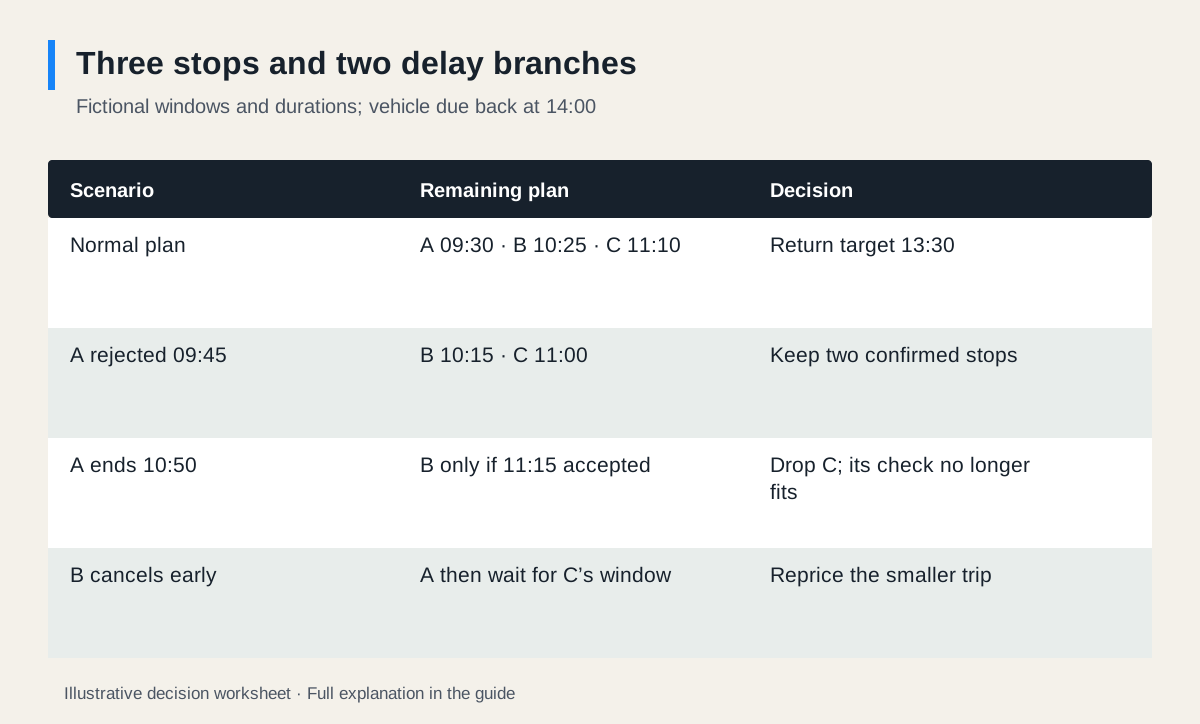
If the desk is rejected promptly at 09:45, the buyer can reach B at 10:10 under the same travel assumption. B is not available until 10:15. Wait only in an appropriate place or ask the seller whether the original window still works. The buyer can finish B at 10:40 and arrive near C at 11:00, keeping C’s agreed window. They return with two purchases and an empty desk allocation. They do not add an unplanned fourth seller merely because some cargo space is free.
A different branch occurs if A’s condition discussion overruns until 10:50 and the desk is rejected then. B would begin at 11:15, finish at 11:40 and leave C starting at 12:00 with no room inside its agreed window for the 25-minute check. The buyer drops C, tells that seller promptly and continues only if B confirms the 11:15 arrival. They do not shorten the monitor test to rescue the route.
If B cannot accept that start, B is dropped too. A seller’s availability is not something the route calculation can extend. Keeping the rental deadline does not justify rushing an inspection or handling an unsuitable load.
What if a seller cancels?
If B cancels before departure, retain A and C only if the remaining trip still makes financial sense. Assume A-to-C travel is now 30 minutes: A ends at 10:00, so arriving at C at 10:30 is too early. Keep the 11:00 appointment or obtain a new agreement. The missing stop saves handling time but does not automatically move C’s window.
Recalculate the shared collection cost across the items you still want. A $120 trip divided over three planned purchases is not automatically “$40 delivery each” after one disappears. If only the monitor remains and a separate suitable delivery costs less, cancel or revise the vehicle booking according to its actual terms.
Confirm the plan on the day
Reconfirm availability before starting, check travel conditions and send meaningful delay updates without sharing other sellers’ private addresses. Let a trusted person know the route and expected return. Keep payment and inspection records separate for each transaction.
Check the load after each stop according to the vehicle and equipment instructions. If an unexpected size, missing helper or access problem invalidates the cargo plan, stop and revise it; remove a purchase from the schedule if necessary. Keep the final vehicle-return evidence and close each seller conversation so nobody is left waiting for an abandoned collection.