How to buy a used air purifier with affordable filters
Quick answer
Match the exact air purifier’s clean air delivery rate to your room and confirm replacement filters are available. Inspect the housing, filter fit and fan at every speed, and plan for fresh filters when their history is uncertain. A running fan or reassuring display does not measure filtration performance. Avoid buying an ozone generator as a household air purifier.
Check room fit before the discount
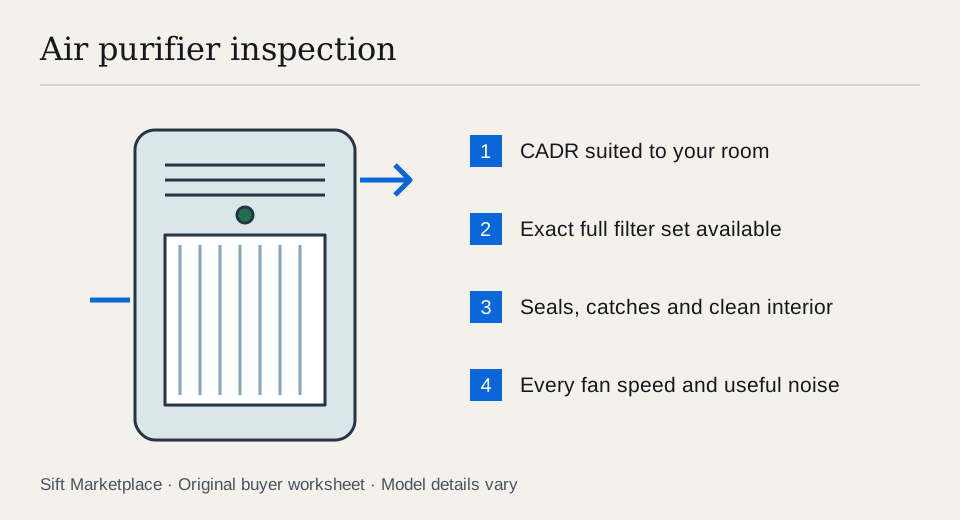
Measure the room and note whether it is an enclosed bedroom or part of a larger open area. Find the exact purifier model and its clean air delivery rate, commonly called CADR. Read the conditions behind the maker’s room-size figure rather than comparing the biggest advertised area across brands.
EPA’s guide recommends a portable cleaner with a CADR appropriate to the room for particle removal. It also distinguishes particle filters from gas-removing media and explains that no device removes all pollutants. The buying implication is to choose for a defined space and purpose, rather than treating a HEPA label as a complete performance description.
Check which fan setting is associated with the published performance. If you cannot tolerate that setting’s noise while sleeping or working, investigate the model’s performance information at a setting you would actually use. A machine left off because it is too loud has little practical value.
Make a placement note: room dimensions, ceiling height, whether doors normally stay open, available outlet and space around intake and outlet. A bedroom rating cannot automatically be extended across an open living area. Follow the unit’s clearance instructions rather than hiding it behind a sofa to make it fit.
For an illustrative room calculation, a 12 ft by 15 ft bedroom has 180 square feet of floor area. That area is a starting input for checking the maker’s CADR/room guidance, not an independent performance guarantee. A larger open adjoining area or unusually high ceiling changes the sizing question. Record the fan setting behind the quoted performance, then listen to that setting before deciding the machine suits nighttime use.
 Enlarge diagram
Find the exact filter set before contacting the seller
Identify every required filter and its part number. Some machines use a combined cartridge; others have a washable prefilter plus separate particle and carbon filters. Check current availability from the maker or a credible compatible supplier and read what is actually included in the listing.
Do not assume a filter with similar dimensions seals or performs correctly. Inspect the manufacturer-specified fitting arrangement and required gaskets. A filter installed backwards or with a gap is not a complete working configuration.
Ask when filters were changed and whether there is a receipt. A reset indicator is a reminder, not a laboratory measurement of remaining filter capacity. If history is uncertain, budget for a new set from the start. Avoid giving an unverified “recently replaced” claim the same value as a known compatible new filter.
Inspect the housing and contamination history
Ask where the purifier was used and whether it has been exposed to smoke, damp conditions or a spill. With power disconnected, have the seller open only the user-accessible filter cover. Look for damaged seals, broken catches, heavy residue, corrosion and persistent odour.
Do not shake or brush a dirty filter during the inspection. Do not wash a particle or carbon filter unless the exact manual explicitly allows it. A washable prefilter does not mean every layer in the cartridge is washable.
Check the power cable, adapter if fitted and housing vents. Avoid a unit with obvious electrical damage or a contaminated interior that cannot be assessed through normal user maintenance. Buying a machine to improve a room is not a reason to accept unknown contamination at any price.
Run the fan and controls through normal use
- Confirm the required filters are fitted. Follow the manual’s rules for operation. Do not bypass a cover interlock or run an unsupported filterless test.
- Start at the lowest speed. Listen for rubbing, ticking and vibration in a quiet setting. Check whether the noise is something you can live with in the intended room.
- Try each fan setting. Confirm the airflow and sound change, without obstructing the intake or outlet.
- Use the controls. Test timers, locks, display dimming and other features you need. Check that buttons respond consistently.
- Observe automatic mode if fitted. Verify that it can be selected and the display operates, but do not spray chemicals or create smoke to challenge a sensor.
- Check app setup where relevant. Have the seller remove their association at the agreed time and verify the supported route for a new owner.
- Leave it running briefly. Watch for shutdowns, unusual heat or a rattle that appears after startup.
This test establishes observable operation. It does not measure CADR, filter leakage or pollutant removal. A green indicator on the machine cannot certify the room’s air quality, and a sensor display alone does not prove the filter is healthy.
Keep the acceptance record in three parts: published room/purpose fit, installed filter identity and observed fan/control operation. A working high-speed fan with an unidentified filter has not answered the second question. A correct new filter inside a unit with a rubbing fan has not answered the third. Passing the normal demonstration does not amount to measuring filtration in the room.
Ask the seller: “Which exact filter set is fitted, when was it installed, and can we hear each speed in a quiet room with the covers closed?” If noise appears only after warming up, retain that result. Negotiate a known missing filter only after confirming its availability and permitted hardware test. Pass when the required filter cannot be obtained, the housing cannot seal properly or an unresolved operating fault prevents an ordinary demonstration.
Treat ozone and sweeping health claims carefully
EPA’s air-cleaner guidance explains air cleaning as one part of managing indoor air, alongside source control and ventilation. Avoid choosing an ozone generator for routine occupied-home air cleaning. For products with ionisation or other additional processes, read the exact manufacturer’s operating information and applicable emissions verification instead of assuming every mode is equally suitable.
Do not pay extra for claims that a purifier guarantees freedom from illness, removes every gas or makes damp-building problems disappear. For a specific health concern or serious indoor contamination, the used appliance listing is not an assessment of the underlying problem.
Compare a fresh-filter total
| Cost item | What to enter |
|---|---|
| Used unit | Agreed asking price |
| Full filter set | Actual compatible part quote |
| Missing adapter | Exact specified replacement |
| Collection | Travel or delivery cost |
| Ongoing filters | Maker’s guidance and your expected use |
| Unresolved fault | Leave unknown instead of inventing a cheap repair |
An illustrative $45 purifier plus a $70 filter set totals $115. A $100 model with a documented new compatible filter could be a better buy, provided it suits the same room and passes the fan test. Those figures are example inputs, not current retail prices. Use the cost calculator with your actual quotes.
Sift, a free Facebook Marketplace filter and scam checker that also works on Kijiji, helps focus searches on Chrome on a computer. Require the model terms that match your filter research, then follow recorded asking prices while comparing the cost of a ready-to-use unit.
Questions people ask
Is a used air purifier worth buying without filters?
Only after pricing the correct complete filter set and confirming it is available. Test the unit as the manufacturer permits, but do not assume it is ready to use until the specified filters are installed correctly.
Does HEPA on a listing tell me the right room size?
No. Filter type and the amount of cleaned air delivered are different questions. EPA recommends a clean air delivery rate suited to the room. Check the exact model and the conditions behind its room-size claim.
Will an air purifier remove every smell and pollutant?
No. EPA says no air cleaner eliminates all indoor pollutants and distinguishes particle filtration from gas filtration. Match the device to the problem while addressing the pollutant source and ventilation where appropriate.