How do you know used bicycle panniers will fit your rack?
Quick answer
Identify each bag’s mounting system and check it against your rack, including tube dimensions, lower retention and pedalling clearance. Inspect the fabric, closure and all fittings. A bag hanging from the top rail is not proof of secure compatible mounting. Confirm every missing insert or rack-side part before comparing the complete cost.
Start with the rack you own
Record rack make/model, tube shape and diameter, usable rail length, lower support geometry and documented load limit. Photograph it from the side and rear. Then identify the bag model and mounting-system generation. “Fits any rack” is not a useful compatibility answer.
ORTLIEB’s mounting systems include different arrangements, some with hardware that stays on the rack. Its FAQ also distinguishes tube shape and hook fit. Apply the exact system instructions to the bag in front of you; do not generalize one hook limit across every generation or accessory.
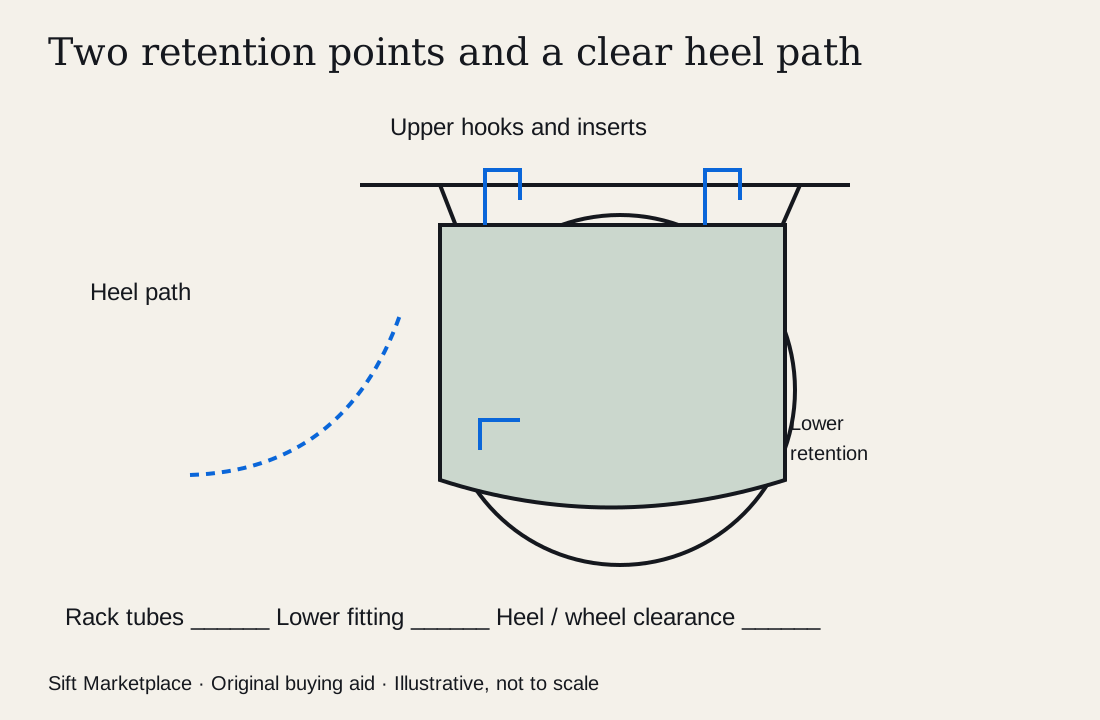
A used bag may have lost the inserts that reduce its hook opening, its lower retention hook, or the rack-side mounting pieces. A complete-looking bag in a photograph can therefore be an incomplete purchase for your bicycle.
 Enlarge diagram
Make a physical fit record
With the seller’s permission and the exact instructions, try the pannier on your compatible rack in a stationary safe setup. Confirm that the upper hooks seat and lock as intended, the lower retention engages correctly and the bag cannot simply swing toward the wheel. Do not compensate for incompatible hardware with improvised ties.
Check heel clearance through ordinary pedal movement, allowing for your shoe size and the bag’s intended loaded shape. Also check tire, brake, cable, light and reflector clearance. A bag that clears when empty may bulge differently when carrying normal items, so use suitable light demonstration contents within the system’s limits.
Record whether the pair can be adjusted for left/right use and whether a top bag, basket or child seat already occupies needed rack space. Do not add the two panniers’ individual capacities and assume the rack or bicycle can carry that total. Use all applicable limits for the complete setup.
Inspect each bag separately
Open it fully and examine the base, corners, seams or welds, back panel, mounting rail and closure. Note abrasion, holes, patches, fabric cracking, coating separation and damaged stiffeners. Ask what it carried and whether anything sharp or leaking was stored inside.
Operate buckles, zippers or roll closures normally. Count straps, hooks, inserts and adjustment hardware for both bags; one good pannier does not establish the other is complete. Look for cracks around the mounting rail and evidence that hardware has pulled through the bag.
Use the maker’s current cleaning and repair guidance. A roll closure, welded seam or special zipper has a specific design; a generic sewing repair can change weather resistance. A brief dry inspection does not certify the original waterproof rating. Do not submerge the bag or perform an improvised pressure test to prove it.
| Finding | Response |
|---|---|
| Both bags fit and retain correctly with useful clearance | Compare full kit and condition |
| Missing exact available hook inserts | Include delivered replacement cost |
| Rack-side mounting kit absent | Price and verify the complete required kit |
| Cracked rail or torn mounting area | Obtain suitable repair assessment or pass |
| Fabric appears sound but weather performance untested | Keep that limitation explicit |
Compare a pair that is ready for your bicycle
Imagine a pair advertised at $80 needs $30 correct inserts/hooks, $40 rack-side fittings and $15 collection: $165. A suitable complete pair at $140 with $15 collection totals $155. These hypothetical costs show why bag-only photos can mislead a comparison.
If your current rack is incompatible, price an appropriate replacement rack and fitting as a separate project before buying the bags. A bargain pannier should not force an unplanned compromise with the bicycle’s mounting or load requirements.
Ask: “What is the exact mounting system, are all inserts and lower hooks included, and does any required hardware remain on your bicycle? Could I try the bags on my rack and inspect the mounting rails?” Use the buying-cost calculator for confirmed fittings and service. Buy when secure fit, usable clearance and fabric condition all suit the trip; negotiate specific missing parts rather than a vague promise of universal compatibility.
Sources
- 01ORTLIEB Quick-Lock systems
- 02ORTLIEB FAQ