How do you buy a used coffee grinder for the coffee you make?
Quick answer
Choose a grinder for your brewing method and ordinary workflow, then verify its exact revision, controls and supported parts. Observe a few normal grind samples using the model’s adjustment instructions. Price a missing hopper, cup or documented service separately; do not assume a burr upgrade will repair an unexplained grinding problem.
Write down the brewing task first
An espresso grinder, a filter-coffee grinder and a blade chopper are not interchangeable merely because they all reduce beans to smaller pieces. Start with the brewer you own, the recipes you normally make, whether you switch methods and how much coffee you prepare at a time. Then look for a model designed to support that task.
If espresso is essential, identify the basket and workflow you intend to use. A listing saying “fine grind” does not establish an adjustment range useful for your equipment. For filter coffee, consider how easily you can change and repeat settings, fit a catch cup and clean the accessible path. A grinder that excels at a workflow you do not use may be an inconvenient purchase.
The Baratza Encore ESP manual, for example, assigns separate espresso and filter ranges within its adjustment scale. Those numbers belong to that model. They are not equivalent recipes for another grinder, and even a recommended starting point still needs adjustment for the coffee and brewer.
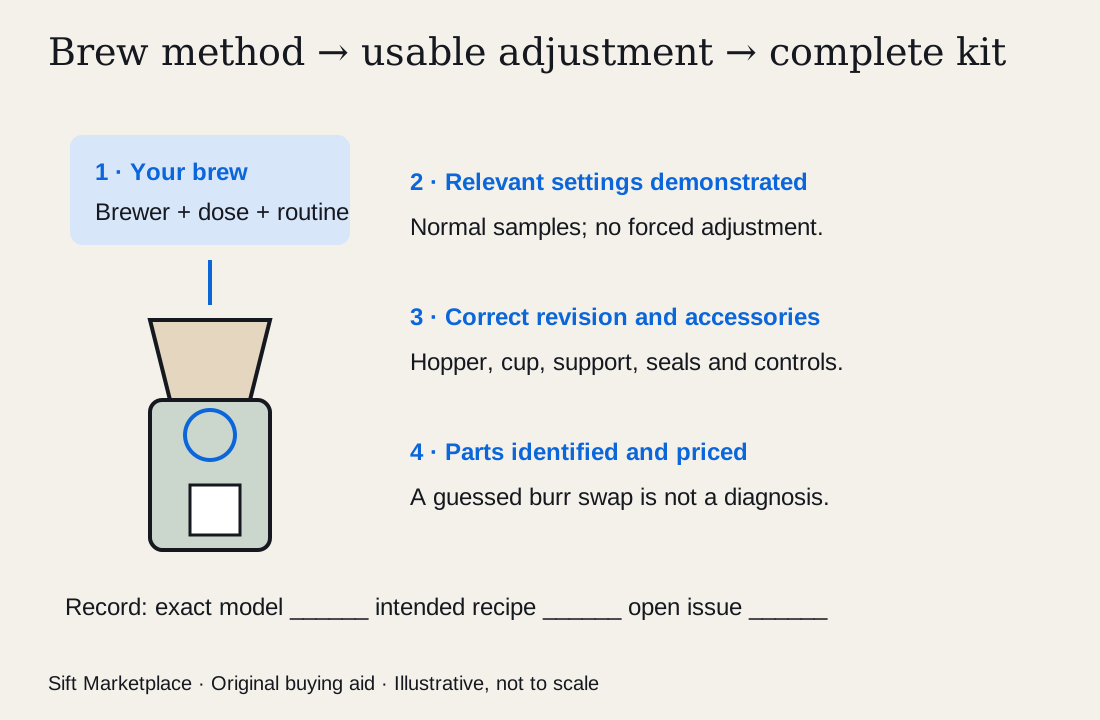 Enlarge diagram
Establish the exact model and what has been changed
Ask for the model/revision label, an overall photo, the hopper and cup or dosing accessories, and the seller’s account of any burr replacement, calibration change or repair. Similar shells may contain different adjustment systems. A listing title that omits “ESP,” “Pro” or another suffix can create a materially different purchase.
Ask what the seller grinds, approximately how often, and why it is being sold. Usage history is context, not a precise burr-life measurement. Avoid assigning a universal replacement interval from age or claimed kilograms of beans. The practical questions are whether the current system operates normally and whether the correct service parts are supported.
For claimed upgrades, request the part identifier and installation record. Do not pay an upgrade premium until you know the parts are appropriate to the exact revision. An unverified aftermarket burr can add uncertainty rather than value.
Inspect the ordinary user-accessible parts
With the grinder unplugged, ask the seller to show the components the owner’s manual allows users to remove for cleaning. Check the hopper, lid, catch cup, adjustment markings, feet and external controls. Look for cracked mounting tabs, damaged threads, missing seals, obvious corrosion or evidence that a part was forced into place.
The burr area should be inspected only within the documented cleaning procedure. Do not power the grinder with protective parts removed, put fingers near moving burrs or open the electrical housing. A seller who knows the model can show ordinary access and correct reassembly; uncertainty is a reason to consult the maker, not improvise.
Coffee residue alone does not establish failure. Equally, a clean exterior does not establish a healthy motor or good burr alignment. Record what you can see and ask about any unexplained smell, jam, intermittent start or grinding change. If an internal fault is suspected, get a service assessment before assigning it a cheap fix.
Baratza’s model-specific support and parts page is a useful example of checking exact replacement components. Confirm current regional availability, shipping and compatibility. A part pictured online is not necessarily in stock or correct for the seller’s revision.
Plan a small, repeatable demonstration
Bring or agree on a small quantity of suitable coffee beans. The point is to observe ordinary operation, not conduct a taste contest at the seller’s kitchen counter. Use the manufacturer’s rules for changing settings, particularly when moving finer. Never force an adjuster that resists.
Choose settings relevant to your intended method. Ask the seller to operate normal controls and produce a sample, then make an allowed adjustment and produce another. Record the coffee used, settings and what changed. If a timed or weighed dosing feature matters, observe that feature with the appropriate container. A scale can help record output; it does not turn the viewing into a laboratory particle analysis.
| Observation | Useful conclusion | What it does not establish |
|---|---|---|
| Starts and stops with ordinary controls | Those controls operated during the visit | Long-term electrical reliability |
| Adjustment changes the sample | The adjustment had an observable effect | Exact burr alignment or particle distribution |
| Intended cup or portafilter fits securely | The accessory workflow is usable | Compatibility with every other accessory |
| Repeated normal doses appear consistent | No obvious inconsistency in that small sample | A certified accuracy specification |
| Persistent stall, rubbing or unexplained noise | An issue needs assessment | A particular failed part or guaranteed repair cost |
For espresso, a grind sample by itself cannot prove that your particular recipe will dial in. If an actual suitable brewing demonstration is possible, record the setup and result without treating one shot as a universal verdict. Otherwise decide whether the remaining uncertainty is acceptable. Do not buy solely on the promise that an inexpensive burr change will make any grinder suitable.
Price the complete workflow
Inventory the hopper and lid, grounds bin or dosing cup, portafilter support where relevant, manufacturer-specified seals and any essential adjustment parts. Optional bellows, decorative knobs and spare cups should not overshadow a missing essential component.
Here is a hypothetical comparison. Grinder A costs $100 but needs a confirmed $35 catch cup and $15 collection: $150. Grinder B costs $140, includes the correct cup and costs $10 to collect: also $150. If both meet the brewing task, condition and demonstrated operation decide between them. An included accessory you do not need should not automatically increase your budget.
Now suppose A also has an unexplained adjustment problem. Do not simply add the advertised price of a burr set and call the uncertainty solved. A qualified diagnosis, parts and labor quote may change the total, or show that another listing is preferable. Use the missing-parts guide for a known absent component and the cost calculator for confirmed costs.
Make an offer around evidence
A useful message is: “I make [brew method] with [brewer]. Please confirm the exact model suffix, included cup/hopper parts, and any burr or adjustment changes. Could we try a small normal grind sample at two relevant settings using the manual’s procedure? Are there intermittent starts, stalls or service records I should know about?”
Buy when the intended use, complete kit, observations and total price align. Negotiate for a known obtainable part or ordinary cosmetic wear. Pause for a service quote when the mechanism behaves unexpectedly; pass if the core brewing task is unsupported or the essential part cannot be sourced.
Before first use, follow the exact model’s care instructions. The manufacturer’s Encore ESP cleaning demonstration illustrates why cleaning is a model-specific procedure. It is not permission to use water, household chemicals or a disassembly method on a different grinder. Sift can help you compare relevant local listings while your brew requirements keep the shortlist focused.
Sources
- 01Baratza: Encore ESP operation manual January 2023 v1.0
- 02Baratza: Encore ESP support and parts
- 03Baratza: Encore ESP cleaning and maintenance