Buying a used item with missing parts
Quick answer
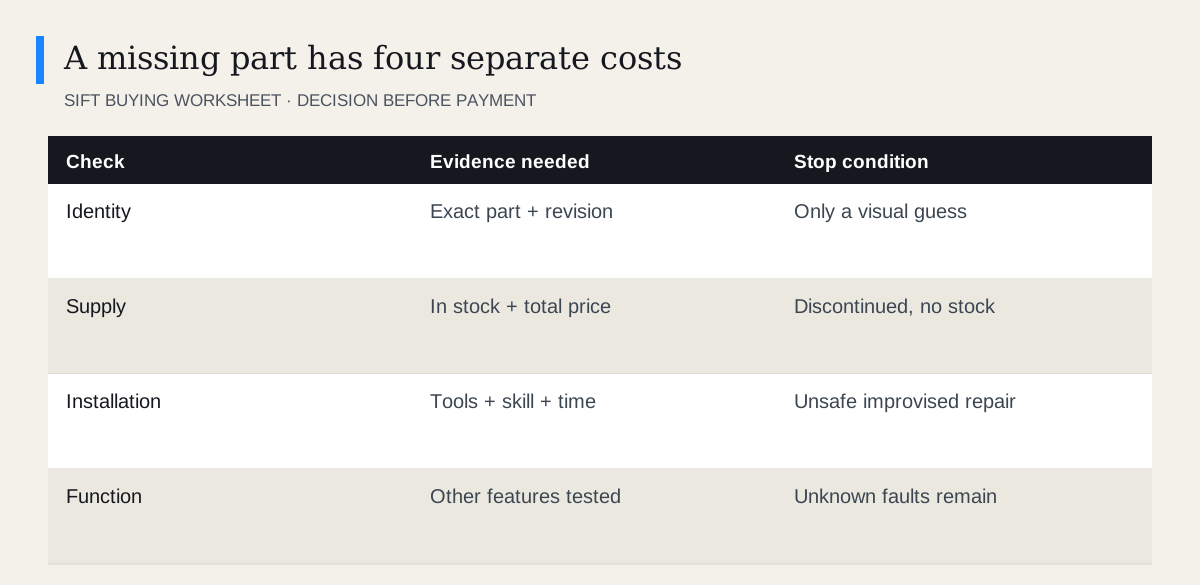
Buy an incomplete used item only after identifying the exact missing parts, confirming compatible replacements and adding their delivered cost to the purchase. A missing remote can be manageable; a missing safety component or structural fitting can stop the purchase. Treat unavailable parts and untested functions as unresolved costs, not assumed easy fixes.
 Enlarge diagram
Is the missing component essential?
Classify it before bargaining. A cosmetic cover, a convenience accessory and a safety component have different consequences. A television may work without its original remote, but some settings could require a compatible replacement. A shelf without the correct support hardware is a different problem.
Read the manufacturer’s manual or parts diagram for the exact model and check CPSC recalls in the US. Confirm the required parts rather than assuming an apparently usable product is complete.
Do not improvise with load-bearing, electrical or child-safety parts because the seller describes them as “just a screw” or “only a strap.”
How do you establish what is actually absent?
- Identify the exact model. Use the label and model identification process.
- List the included components. Ask the seller to lay out loose accessories where practical.
- Compare the manual. Mark absent items separately from damaged ones.
- Check replacement supply. Find the exact part or an explicitly compatible replacement.
- Confirm the rest works. A missing cable can prevent testing and conceal a separate fault.
Do not rely on the original retail box as proof of completeness. Its contents may have changed through several moves or owners. A clear photograph of the included parts is more useful.
What must a replacement quote include?
Include the item price, shipping, tax where applicable, any required matching parts and tools you do not already own. Check whether a replacement is supplied individually or only as a kit.
IKEA’s spare-parts service is a useful starting point for IKEA items, but do not assume every panel, fitting or discontinued component is available. Confirm the relevant part before committing to the used item.
| Cost | Incomplete item | Complete alternative |
|---|---|---|
| Asking price | $80 | $135 |
| Correct replacement | $25 | $0 |
| Shipping and supplies | $15 | $0 |
| Collection | $10 | $10 |
| Known total | $130 | $145 |
The $15 difference may not justify the extra work or uncertainty. These are example numbers, not market prices. Use the buying cost calculator with actual quotes.
What should the seller demonstrate?
Test every function that can reasonably be tested with the included parts. If the missing component prevents a test, describe the affected function as untested. Do not promote “probably works” into “working” in your own notes.
For furniture, check the surrounding joints and holes for damage. Missing hardware after disassembly can be straightforward; stripped holes and cracked panels add a different repair problem. For electronics, a correct power supply matters beyond whether the connector fits.
If the seller can borrow a compatible accessory for a demonstration, agree that clearly. Confirm whether it is included in the purchase so a useful test does not create a misunderstanding.
When should you pass?
Pass when the missing part is safety-critical and the approved replacement cannot be confirmed, when the total exceeds a complete alternative, or when the project depends on several optimistic assumptions.
Also account for your own capacity. A buyer with the right spare part and repair experience has a different opportunity from someone who must source everything and learn the task. Neither should ignore a recall or substitute an unsuitable part.
If your real goal is to salvage components from a broken item, use the separate for-parts buying guide. Here the intended outcome is a complete usable product. Write that outcome down and check whether every necessary step is priced and achievable before you pay.
When does a small missing part change the whole purchase?
Consider an illustrative $70 shelving unit missing two supports. A confirmed $12 replacement set and $15 delivery make the usable cost $97. If the supplier cannot confirm compatibility, $97 is not yet a reliable total: it is a conditional estimate. Ask the seller for the assembly label and photographs of the remaining supports before ordering. If the part is structural and no suitable replacement is available, compare a complete unit instead of improvising a substitute to protect the apparent saving.
Questions people ask
Should I trust “easy replacement” in a listing?
Only after you confirm the exact part, availability, delivered price and installation requirements yourself.
Are generic parts always acceptable?
No. Compatibility includes dimensions, ratings, fit and intended use. Safety and structural components need manufacturer-approved specifications.
Is missing a part the same as broken?
No. A known absent component is a defined gap. An untested item can also have unknown faults, so budget and inspect for that separately.
Sources
- 01IKEA Canada Spare parts
- 02IKEA Assembly instructions
- 03CPSC Recalls