Compare used and new by total ownership cost
Quick answer
Compare the same usable outcome over the same period. Separate immediate cash from annual costs, optional time value and uncertain resale, then test whether a repair or shorter useful life changes the decision.
 Enlarge diagram
What does “the same usable endpoint” mean?
Compare purchases that both do the job you need, in the place and by the date you need them. A used desk awaiting an unavailable bracket is not equivalent to a complete delivered desk. A device with an unsupported service is not equivalent to one that performs the required function.
Start with two totals: cash needed to obtain a usable item, and cost over a stated period of use. Keep each assumption visible. A calculator can show what follows from your numbers; it cannot establish remaining life, predict a repair or guarantee resale.
Which costs should you include?
Acquisition includes the item, delivery or collection, known repairs, missing parts and setup. Ownership adds relevant running or maintenance costs and subtracts resale only when you deliberately choose to model it. If both options require the same expense, include it consistently or state that it is excluded from both.
For example, a used item advertised at $200 plus $45 collection and $30 required parts costs $275 to start. A new equivalent at $300 delivered is only $25 more to acquire. The new item still needs its own suitability, delivery and terms checks.
The FTC’s marketplace guidance recommends checking sellers and transaction details. Compare the actual return and warranty terms, including exclusions and who would pay to move a faulty item. Do not assign a made-up cash value to an assumed guarantee.
A complete ownership scenario
Consider two chairs that a hypothetical buyer has already found suitable. This example uses invented quotations and maintenance allowances to demonstrate the decision; it is not a claim about typical chair prices, failure rates or service needs.
| Input | Used chair | New chair |
|---|---|---|
| Item | $120 | $300 |
| Collection or delivery | $30 | $0 |
| Known initial work | $30 | $0 |
| Ready-to-use cash | $180 | $300 |
| Annual maintenance allowance | $40 | $10 |
| Resale in conservative scenario | $0 | $0 |
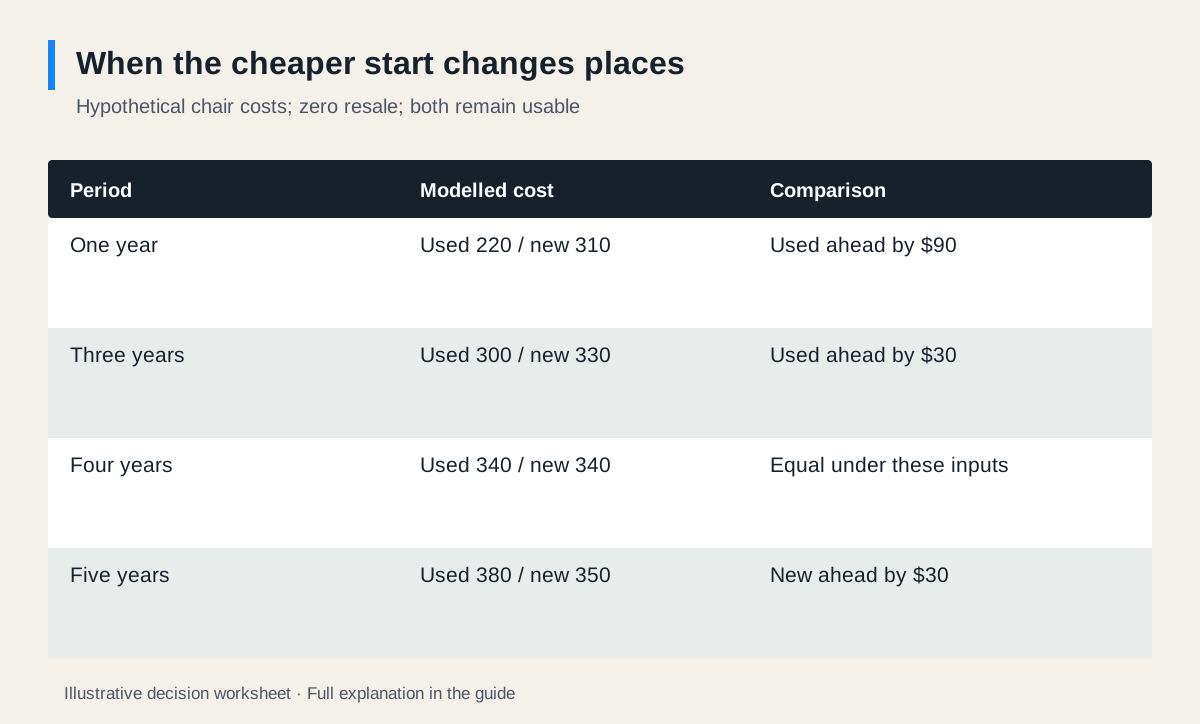
The used chair starts $120 ahead. The annual allowance difference is $30. Under these assumptions, the advantage disappears at four years. Both chairs are assumed to remain usable throughout each period; that is a scenario condition, not a life-expectancy finding.
| Same period for both chairs | Used total | New total | Lower modelled cost |
|---|---|---|---|
| One year | $220 | $310 | Used by $90 |
| Three years | $300 | $330 | Used by $30 |
| Four years | $340 | $340 | Equal |
| Five years | $380 | $350 | New by $30 |
If an additional $100 repair is needed during the first year, the used one-year total becomes $320, exceeding the new $310 total. This is a separate “what if,” not a predicted repair or a probability-weighted cost. If that event would break the household budget, the reserve and fallback matter even when the baseline calculation favours used.
How do you enter the evidence into the calculator?
In the used versus new calculator, enter each item price, delivery, repairs/setup, annual running cost and resale separately. For this comparison, set the years field to the same chosen horizon for both options: one, three or five years. The annual figure is an allocation of the entered total over that period, not an estimate of how long the item will last.
Put a written service quote in known repairs; put an annual allowance in running costs only if you explicitly intend that scenario. Do not enter the same maintenance twice. Run the baseline and the additional-repair case separately. If a chair may not survive five years, the five-year result is conditional; calculate a replacement scenario or shorten the comparison rather than quietly assuming survival.
Use the used buying cost calculator when the immediate question is affordability. Its optional hours and hourly value can show a personal time valuation. If collection takes three hours valued at $20, that adds $60 of personal time value, but it does not increase the cash paid to the seller or mover. Show both figures instead of calling $240 the cash price of the $180 acquisition.
When do running costs matter?
For appliances, use the exact model’s energy information and your relevant local rate. For printers, use compatible consumables and your expected use. For connected equipment, identify the function and subscription required. A brand average or a seller’s old bill is weak evidence for a different model and household.
ENERGY STAR’s refrigerator calculator illustrates how equipment characteristics and electricity rates affect an estimate; actual results vary with use and upkeep. Do not carry its displayed regional default into your own budget without checking it.
What decision rule is practical?
Choose the option that meets the required job, fits the cash budget and remains acceptable under a plausible unfavourable scenario. If used wins for one year but loses for five, the uncertainty is about your horizon and inputs, not arithmetic. A temporary home, an impending move or an uncertain need may make the short horizon more relevant.
Run a zero-resale case even if you hope to sell later. If an optimistic resale assumption is the only reason the purchase looks affordable, you are depending on a future buyer. Keep the cost worksheet with the evidence and update it when a quote, missing part or condition check changes. The useful result is a decision you can explain and revise, not a precise-looking prediction.
Start from the store price
Shopping a store first? On a product page at Amazon, Walmart, Best Buy, Home Depot, Costco, IKEA and more, click Sift and Find it used shows the same thing used on Facebook Marketplace near you, with what you’d save, such as “62% below store”. With Sift Pro it opens by itself on supported stores. Then put both through the numbers above, so the saving still holds once collection, parts and running costs are in.