Check returns before buying a used item
Quick answer
Before paying, establish whether a return is offered, for which reasons, by what deadline and at whose transport cost. Keep the exact terms with the listing. A return policy, a repair warranty and statutory rights are different; silence does not create a voluntary inspection window.
 Enlarge diagram
Ask about the reason you may need to return it
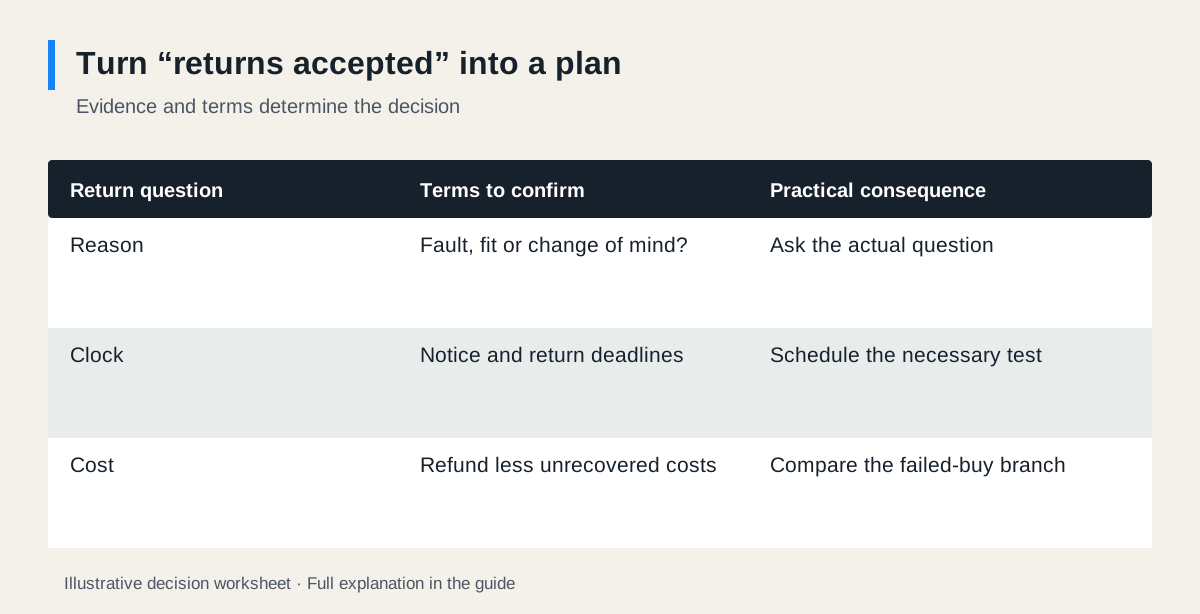
“Can I return it?” can hide several different questions. You may need to check compatibility at home, discover an undisclosed fault, find that the item differs from the listing or simply change your mind. Ask about the relevant reason explicitly.
A seller saying “let me know if there is a problem” has offered communication, not necessarily a refund. “Seven days” still needs a start point, an action required before the deadline and the conditions of return. Get those details while the seller can choose whether to agree.
The FTC’s marketplace guidance warns that protection and refund help vary between marketplaces and transactions. Establish whether your proposed payment and item qualify instead of assuming the platform name provides coverage.
Complete three term sheets
These are illustrative agreements, not standard policies or statements of legal entitlement. They do not remove any mandatory rights that apply.
| Field | Private sale with no voluntary return | Agreed home compatibility check | Retailer policy |
|---|---|---|---|
| Reason covered | None agreed | Named monitor fails the agreed connection test | Copy the actual policy’s permitted reasons |
| Deadline | Not applicable | Notify by 6 p.m. the next day in this example | Record date and whether notice or receipt is required |
| Item condition | Disclosed at inspection | No alterations; same accessories | Confirm use, packaging and accessory conditions |
| Return method | Not agreed | Buyer returns to agreed meeting point | Confirm shop, post or authorised collection |
| Return cost | Not agreed | Buyer’s travel in this example | Identify payer and any permitted fees |
| Remedy | Not agreed | Item-price refund in this example | Refund, exchange, credit or repair as applicable |
| Confirmation | Save the actual agreement | Seller explicitly accepts the terms | Save policy version and receipt |
The middle column is useful only if the seller actually accepts it. Sending terms in a message and receiving no response does not establish agreement. If the seller declines, decide whether an on-site test is sufficient or find another option.
Budget for the return path
Consider a hypothetical $120 monitor with $20 collection cost. The seller agrees to refund the item price after a specified failed compatibility test, but the buyer pays $20 to return it. The unsuccessful purchase leaves $40 of travel spending even if the $120 refund is made in full.
That may be acceptable for an unusual compatibility requirement. It may be poor value when another verified compatible option costs $150 nearby. Compare the failed-purchase branch, not just the best case.
For a delivered appliance, return carrying, disconnection and collection may be much more complicated than the item-price refund. Confirm those responsibilities before delivery. Do not disconnect or move equipment in a way that conflicts with its instructions or requires a qualified professional.
Know which rules you are checking
For Ontario purchases, the province’s official guidance distinguishes voluntary return policies from situations where the law or agreement provides a remedy. A general cooling-off period should not be assumed for an ordinary purchase.
For qualifying UK business distance sales, GOV.UK describes cancellation periods and exceptions. A private transaction or a purchase concluded in person needs its own analysis. Faults, misdescription and change of mind are not interchangeable categories.
If you are elsewhere, use the relevant local consumer authority. The purpose of the term sheet is to record facts and promises, not decide a disputed legal question. Avoid treating “as is” or “final sale” as a complete explanation of every possible right.
Ask one concrete question
For the monitor example:
I need to confirm that this exact monitor works with my laptop through the connection we discussed. Would you agree that I can notify you by 6 p.m. tomorrow if that test fails, return it complete and unaltered at my travel cost, and receive the item price back? Please confirm before I decide whether to buy.
The seller may propose a different scope. Write the final agreement once, clearly, so neither party has to combine fragments from several messages. Record whether delivery fees are included in the refund and how the refund would be made.
Preserve the opportunity to use the policy
Plan the necessary test soon enough to act before the applicable deadline. Keep packaging and accessories where required. Do not modify or repair a disputed item before documenting the issue and checking the relevant process; alteration can complicate the evidence and the policy conditions.
If something arrives damaged, use the delivered-item inspection sequence to preserve the condition record and avoid unsafe use. If the item differs from the agreement, the not-as-described guide helps compare the evidence and request a specific remedy.
If return transport is impossible, the deadline is too short for the necessary test, or the remedy is credit you cannot use, treat the policy as offering less practical value. A written return promise is useful only when you can follow it.