Record a Marketplace purchase: what to save
Quick answer
Save the listing and relevant agreement, then record the exact item, included parts, disclosed condition, price, date and payment confirmation. Keep sensitive details private and collect only what the transaction needs. This practical record is not a universal bill of sale, proof of ownership or substitute for regulated-product documents.
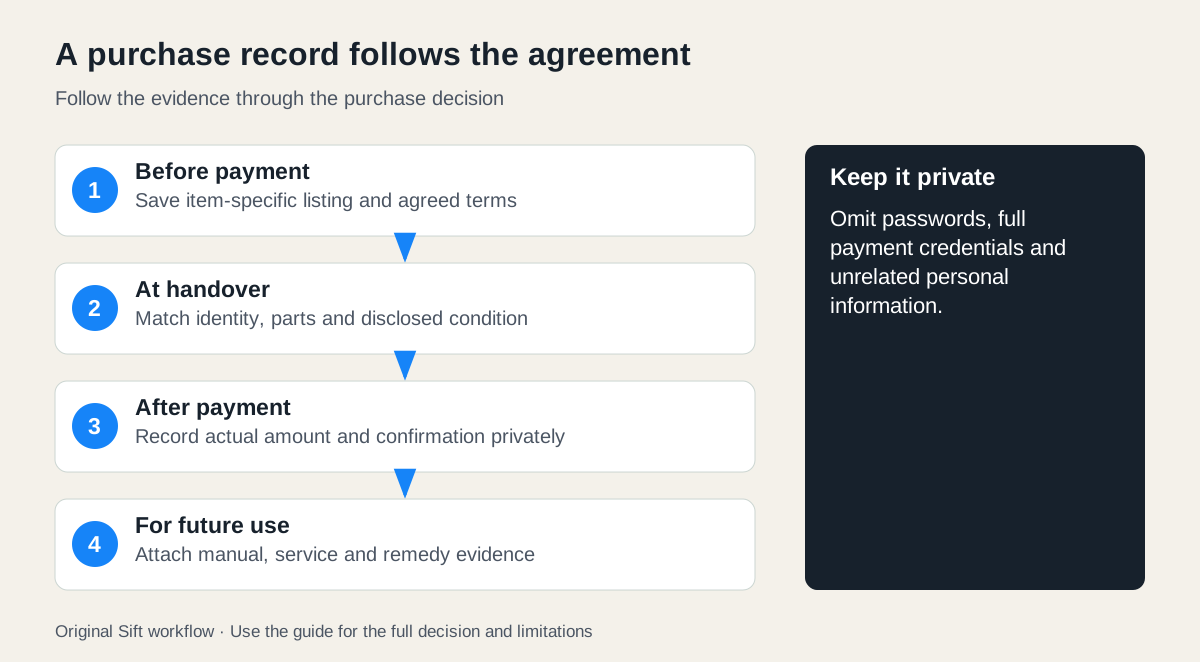 Enlarge diagram
Keep enough to reconstruct the agreement
A useful purchase record should let you answer six questions later: what was offered, what you agreed to buy, what came with it, what condition was disclosed, what you paid and when it changed hands. It should also identify the relevant seller contact or order reference without becoming an unnecessary collection of personal data.
The FTC’s marketplace guidance recommends keeping written seller answers and messages. Your own record brings the important pieces together so that a disappeared listing does not leave only an unexplained payment.
Save evidence through the platform’s ordinary permitted controls or your own transaction notes. Do not record private conversations or photographs of people without appropriate permission, and do not access files left on a used device to learn about its previous owner.
Capture the agreement before the listing changes
Keep the relevant listing title, item photographs, description, price and URL or listing reference. Save only the messages that clarify this transaction: included accessories, faults, collection, delivery, returns and any changes to the price.
If the seller corrects a mistake, record the correction rather than treating an outdated screenshot as the final agreement. “Stand included” followed by “the stand belongs to another monitor; price reduced by $20” is a different purchase from the original listing.
For a business, keep the invoice and terms in the seller’s business name. For a private sale, a clear confirmation message can help both people remember what happened. Whether additional documentation is legally required depends on the product and location.
A completed monitor record
The following is a fictional example. The model name is deliberately generic, and account, address and payment details are omitted.
| Field | Example entry |
|---|---|
| Item | 24-inch monitor, model M24-A, revision 2; label checked at handover |
| Private identifier | Serial recorded in buyer’s private file; omitted from shared summary |
| Included | Original stand, matching power supply and one HDMI cable |
| Disclosed condition | Small mark on lower-left case; no claim that every input was tested |
| Observed demonstration | HDMI picture from agreed laptop; controls worked during short check |
| Not checked | Other input; long-term reliability; colour calibration |
| Price | $110 item price; buyer’s $12 travel separate |
| Terms | No voluntary change-of-mind return agreed; applicable rights not assessed by this note |
| Handover | 18 October 2026, agreed public meeting point |
| Payment | $110 confirmed through agreed method; private transaction reference retained |
| Evidence | Listing copy, accessory photo and final confirmation message |
The “not checked” row is useful. It prevents a later memory of “tested” from expanding into a claim that every function was verified. It also makes the first-day checks more focused.
Confirm changes while both parties are present
If a cable is missing or a new mark appears, resolve it before writing the final record. The agreement might change to include later delivery of the cable, an adjusted price or no purchase. Write which outcome was actually accepted.
A concise confirmation could be:
Confirming today’s purchase: model M24-A revision 2 monitor with stand, power supply and HDMI cable, for $110. The lower-left case mark was disclosed. We observed HDMI operation; the other input was not tested. Payment and handover are complete.
Ask the seller to correct any error. Their acknowledgement can improve the shared record, but it does not create a universal legal guarantee. If a seller will not acknowledge the message, keep your factual notes and consider what other evidence exists.
Keep payment confirmation separate from payment instructions
Retain the amount, date, method and appropriate transaction reference privately. Verify completion through your own payment service or bank interface, not solely a screenshot presented by the other party. Do not place full card numbers, bank credentials, passwords or security codes in the purchase note.
If payment is split between an item and delivery, record both and the party receiving each. If a deposit is involved, note whether it was applied to the price and what the actual cancellation agreement says. An unexplained total makes a later discrepancy harder to resolve.
The record should describe payment, not imply protection that the method does not provide. The returns guide helps keep a voluntary seller promise separate from marketplace or payment eligibility.
Use a private full record and a smaller shared summary
Keep identifiers needed for support or recall checks in a secure place you control. A summary shared with a roommate, gift recipient or transport helper may need only the item, included parts and care information. Remove the seller’s address, unrelated messages and payment references unless the recipient has a genuine need for them.
Store the manual, receipt, confirmed warranty information and later service records with the purchase note. Use a descriptive filename such as “monitor-model-date” so you can find it without searching an entire message history. Choose your own retention period based on warranty, accounting, dispute or product needs rather than a universal rule from this guide.
Know when a generic note is insufficient
Vehicles, registered equipment, regulated goods and some cross-border transactions need their own official documents and processes. A signed note does not prove title, remove a lien, establish authenticity or replace registration requirements. Use the relevant product and jurisdiction guidance before buying.
For a device, documentation also does not remove an account or organisation lock. Complete the authorised handover checks separately. For a recalled product, use the exact notice and remedy evidence through the recall guide.
Let the record support the next action
After arrival, use the unchecked-function row to plan safe normal setup. If something differs, compare the observed condition with the final agreement using used item not as described. Send the smallest evidence set that explains the issue.
The record succeeds when another person can understand this particular transaction without guessing, and when you can retrieve the details without exposing information unrelated to the purchase.