Check a used product against an actual recall notice
Quick answer
Read the exact notice and match every applicable identifier. A product excluded from one recall still needs its own search, and unresolved identity or remedy evidence is a reason to pause the purchase.
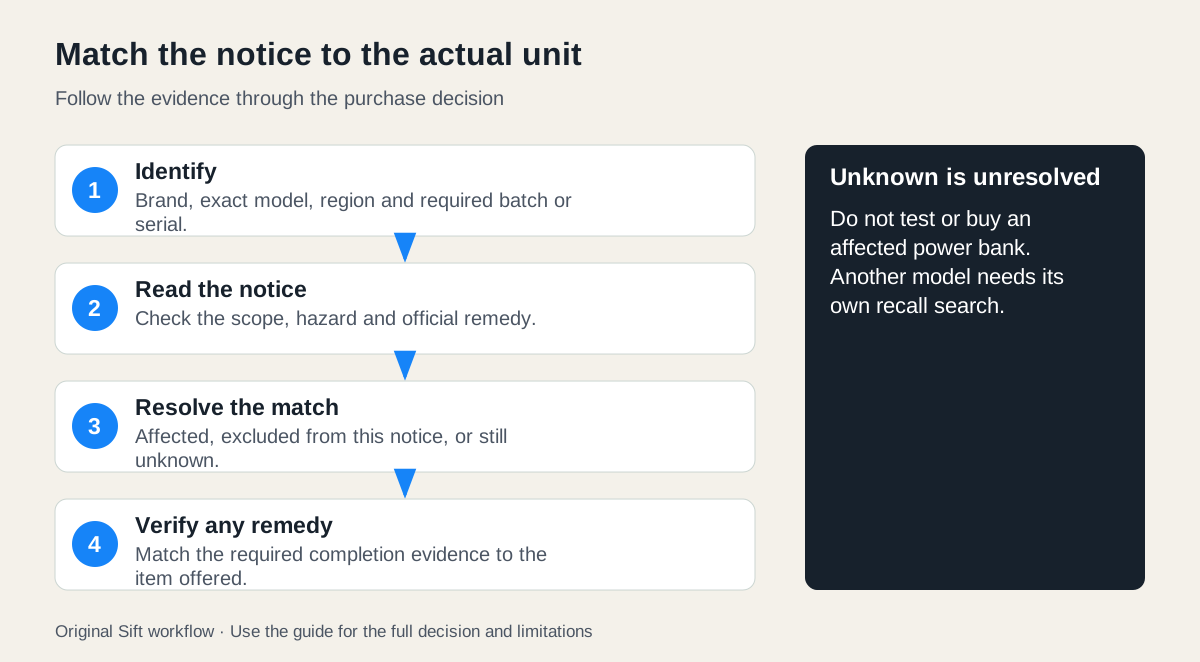 Enlarge diagram
Which recall database should you use?
Start with the country where the product will be used and where it was originally sold. Canada’s recall database and the US CPSC database cover many consumer products; some categories, such as vehicles, have their own responsible authorities. Use the product-check directory to find the relevant route.
Search the brand and exact model, then read the notice itself. A headline, photograph or search result can omit the date, batch, serial or region that determines whether a particular unit is included. An empty search means you found no matching notice with those inputs; it is not a safety certificate.
Read one actual notice all the way through
The CPSC notice dated June 12, 2025 covers Anker PowerCore 10000 power banks, model A1263, sold in the United States with qualifying serial numbers. It identifies an overheating battery hazard that can cause fire and burns. The notice directs owners to stop using affected units and obtain the stated replacement remedy through Anker.
The important match is not simply “Anker” or “10000.” Read the model and serial on the actual unit, then use Anker’s A1263 recall page to check the individual identifier and current process. Anker identifies a manufacturing window of 1 January 2016 through 30 October 2019 and US sales from 1 June 2016 through 31 December 2022. Use the official individual check; do not infer a manufacturing date from a secondhand purchase date.
The CPSC notice requests a photograph showing the model, serial, owner’s name, photograph date and required recall marking. It says a receipt is requested but not required, and disposal must be confirmed before replacement. Anker instructs owners to confirm eligibility before marking or disposing of the unit. Follow the current official instructions, including the required marking and submission steps. A purchaser should not arrange to buy an affected power bank so they can attempt to claim its replacement.
Apply the notice to three candidates
These are hypothetical evidence outcomes, not actual serial-number checks performed by Sift.
| Candidate evidence | Conclusion from this notice | Buying decision |
|---|---|---|
| A1263; US-sale context; official serial check confirms inclusion | Affected by the notice | Do not buy or test-charge it; seller follows the official remedy |
| A clearly different model, such as A1647 | Not the A1263 model named in this particular notice | Search that model separately; other Anker recalls exist |
| A1263 visible, serial unreadable or checker result unresolved | Inclusion cannot be determined | Pause and ask Anker to resolve the identity; do not treat uncertainty as exclusion |
The second row is deliberately narrow. Being excluded from one notice does not mean excluded from every recall. Search the manufacturer’s recall index and the applicable authority for that exact model, rather than copying the A1263 conclusion to another product.
What does a completed remedy establish?
Read what the notice actually provides: repair, replacement, refund or another specified action. “The seller says it was fixed” is not enough to establish the required remedy. For a repair recall, ask for the manufacturer-specified completion evidence linked to the actual unit. For a replacement recall, identify and check the replacement item itself; the old recalled unit has not become an ordinary used product because a replacement was requested.
In this power-bank example, a photograph of a claim submission is not evidence that the power bank offered for sale is a safe replacement. Do not accept a marked recalled unit, an uncompleted promise or a homemade repair as completion of the replacement programme.
The CPSC’s online-sales FAQ says selling recalled products is unlawful in the US and distinguishes products to which the official remedy has been applied. That distinction does not authorise substituting a different repair or ignoring a notice that requires disposal. Read the actual notice and ask the manufacturer or authority if the proposed evidence is unclear.
What if the product crossed a border?
Check both the original market and current destination. A model suffix, serial range or remedy route may differ by country. A seller’s statement that “it was not recalled here” cannot settle a unit originally sold elsewhere. Contact the manufacturer with the full identifiers and region when databases appear inconsistent.
Do not assume a US replacement programme accepts an imported unit in Canada, or that a Canadian search resolves a US-only serial check. The purchase remains pending until the relevant identity and remedy questions are answered.
What else should you inspect?
Recall clearance is one part of the decision. Continue with condition, completeness, instructions, age-related requirements and any product-specific checks. A damaged item can be unsuitable even without a recall. If a battery is swollen, damaged or affected by a recall, do not charge it for a demonstration or put it into ordinary rubbish or general battery recycling. The CPSC notice gives special disposal guidance; confirm acceptance with the appropriate local hazardous-waste service.
Save the notice URL, check date, identifiers used and result with your purchase record. Keep private identifiers private. If the evidence is missing, record “unresolved” rather than “safe.” That wording preserves the difference between a completed check and an assumption.
Sources
- 01CPSC A1263 recall notice June 12 2025
- 02Anker A1263 recall
- 03CPSC online buying/selling FAQ
- 04Canada recall database