Inspect a delivered used item while preserving the evidence
Quick answer
Record the parcel’s exterior, open it carefully, count the agreed contents and photograph any damage or mismatch before using the item. Keep relevant packaging and invoices if there is a problem. Do not power damaged equipment. Contact the sender promptly and follow the applicable carrier or purchase process.
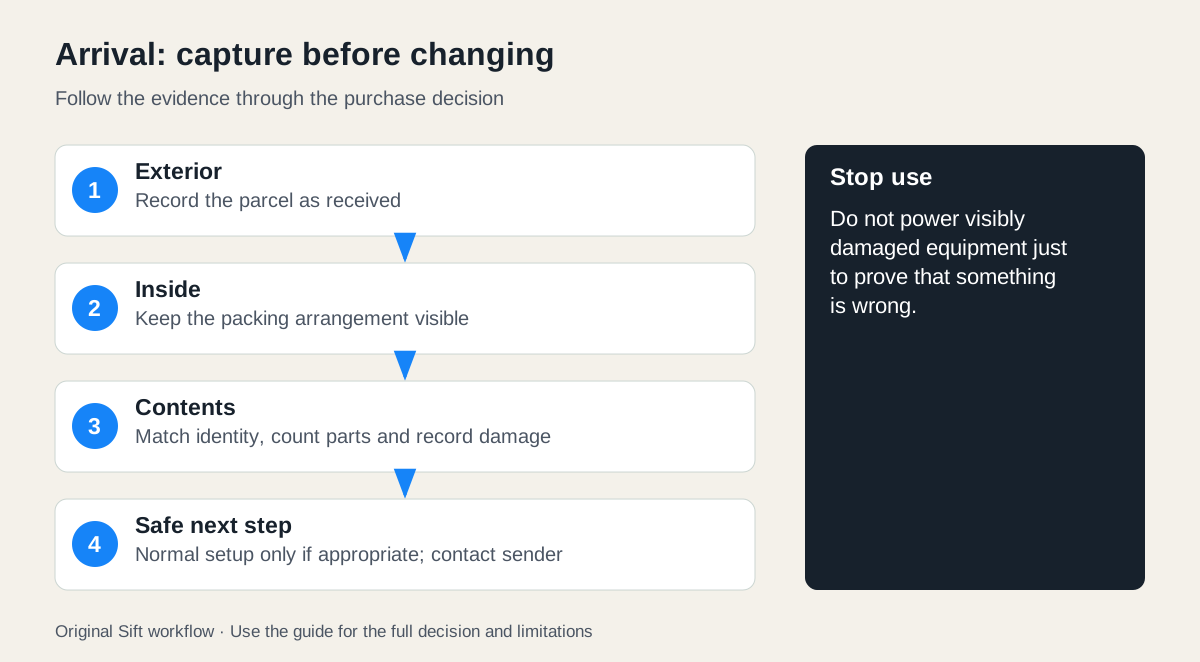 Enlarge diagram
Prepare the agreement, not just a camera
Have the saved description and accessory list available before opening. You need something to compare with what arrived. Clear a suitable area and keep packaging organised so that labels, protective inserts and loose components do not get discarded immediately.
A continuous video can be an optional record if practical, but it does not guarantee a refund or prove every cause of damage. Clear photographs and factual notes may be more useful than a long recording that never shows the item identifier or missing part. Avoid filming bystanders or exposing the full shipping label in anything you share publicly.
Use this checklist when the parcel arrives. The shipping guide covers pre-dispatch agreements, and not as described covers the requested remedy and escalation.
Follow a physical sequence
| Stage | Record | Avoid |
|---|---|---|
| Exterior | Parcel as received, visible damage and relevant label privately | Throwing away the outer box first |
| Opening | Arrangement of internal packaging and item | Cutting blindly near the contents |
| Inventory | Item identity and every promised component | Mixing in your own accessories before counting |
| Condition | Wide context plus close detail of damage | Cleaning, repairing or concealing the affected area |
| Normal setup | Only if safe and permitted by the manual | Powering wet, crushed or visibly damaged equipment |
If the package suggests a leaking, overheating or damaged battery, do not continue ordinary unpacking or testing. Follow the carrier and manufacturer’s safety guidance for the situation and seek appropriate help. A documentation exercise should not increase exposure to a hazard.
A hypothetical audio-interface arrival
The buyer expected a wired interface, its specified power supply and a USB cable. The outer carton arrives with one crushed corner. Before opening, the buyer photographs the whole carton and the affected corner. Inside, the interface has shifted, a control is visibly bent and the power supply is present. The USB cable is missing.
The buyer keeps four observations separate: exterior compression, internal packing arrangement, bent control and absent cable. They do not state that the carrier caused all four. The cable could have been omitted before dispatch; the control’s history is not proven by the exterior alone.
They record the model label and accessories, retain the packaging and do not connect power. A powered demonstration is unnecessary to establish that the control is bent and could create further damage. The sender receives a concise message and the most relevant images.
Write a factual first notification
A useful message for that fictional case is:
The parcel arrived today with the corner compressed. On opening, I found the interface’s control bent and the listed USB cable absent. I have kept the box, packing and contents and have not powered the unit. I am attaching the exterior, packing and item photographs. Please confirm the next steps under our agreement and the shipping service.
This starts the record without deciding whether the problem is transport damage, misdescription or both. If the contents are intact and only the disposable outer carton is marked, document that distinction too.
Canada Post’s damaged-package guidance tells recipients to notify the sender, retain original packaging and take prompt photographs. It specifies that the sender starts the damage investigation and refund request, subject to eligibility and deadlines. Use the exact service’s current process rather than assuming the same role allocation for every carrier.
Preserve evidence without creating a new problem
Keep the item, inner protection, shipping container and relevant paperwork together where safe. Do not alter a disputed component, discard packing because it takes up space, or mail the item back before checking the required authorisation and destination.
If storing the item as received would be unsafe, follow official safety instructions and document what had to change. Evidence retention is not a reason to keep a hazardous item in an inappropriate place. For damaged batteries, normal postal return rules may not apply; Canada Post’s battery rules exclude damaged, defective and recalled batteries from ordinary mailing acceptance.
Photographs should show enough context to identify what they depict. A close-up without a wider image can be difficult to connect to the item. Keep original files and make smaller copies for sharing when necessary; avoid editing out relevant damage or changing the chronology.
Check undamaged items under the correct instructions
If the contents appear suitable for normal setup, confirm the model, included parts and instructions before use. Follow any model-specific assembly, transport, environmental or activation requirements. Do not invent a universal waiting time for all appliances or electronics.
Record the ordinary functions you actually test and any that remain untested. A delivered monitor showing a picture on one input has not thereby passed every port, colour or long-duration test. Use the relevant product buying guide and the first-day orientation to choose the next checks.
End the arrival record with a clear handoff
If everything matches, retain the useful purchase information and recycle packaging when it is no longer needed under the applicable terms. If there is a mismatch, make the advertised-versus-received comparison in the resolution guide.
For suspected transport damage, cooperate with the sender and carrier’s evidence requests while preserving any separate marketplace or payment deadlines. Do not promise yourself compensation based on a video, a signature or an insurance label. The arrival record supports a decision; the relevant process determines the outcome.
Sources
- 01Canada Post Damaged packages
- 02Canada Post Batteries