Arrange shipping for a used item before paying
Quick answer
Confirm that the exact item can travel by the chosen carrier and service, then agree suitable packing, the complete quote and who buys the label. Establish who can make a carrier claim and how buyer and seller will handle loss, damage or failed delivery. Tracking and declared value do not guarantee compensation or marketplace protection.
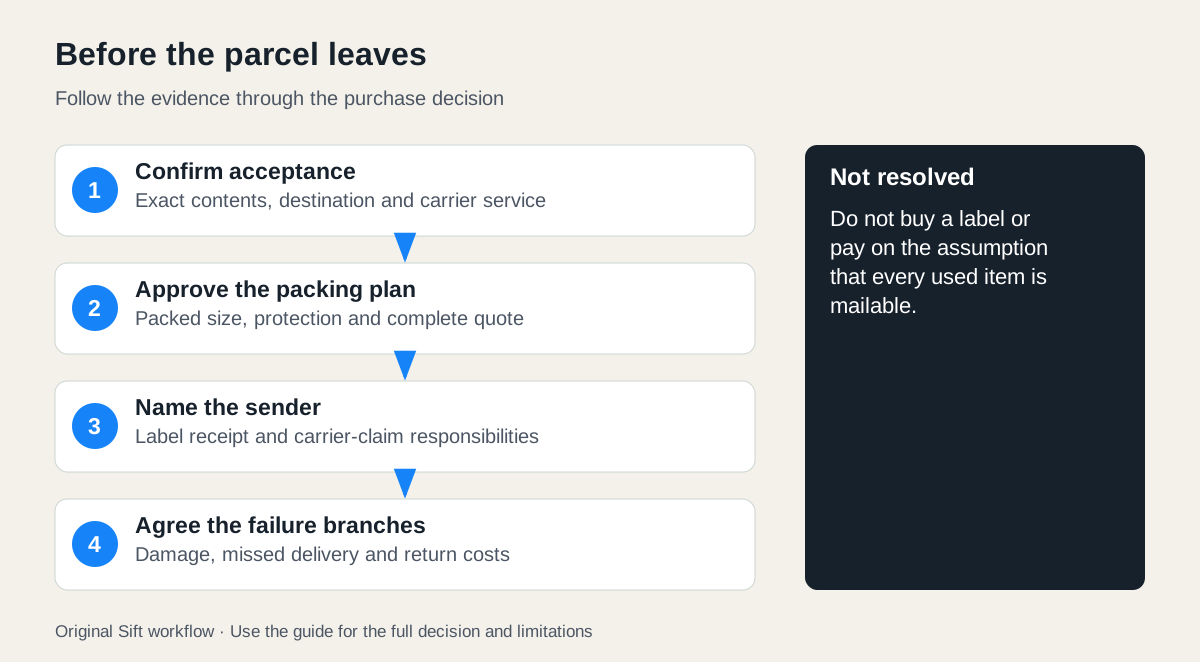 Enlarge diagram
Decide whether shipping suits this purchase
Shipping removes your opportunity to inspect the item in person before paying. It also adds packing quality, carrier acceptance and a second contract to the transaction. Ask whether the item’s condition can be established well enough remotely and whether a local alternative avoids uncertainty you cannot accept.
For fragile, heavy or specialist equipment, obtain an appropriate packing and transport assessment. The seller having a box is not evidence that the item can be shipped safely or covered for damage. A product with a battery, liquid, fuel residue or other restricted contents needs the carrier’s exact rules checked before a label is bought.
Choose the item, route and service together
This guide uses a hypothetical used wired audio interface shipped within Canada as the worked case. It has no battery, and the seller must confirm the actual item and accessories. This avoids assuming that the same shipping plan applies to a laptop, power bank or fuel appliance.
Canada Post’s electronic-goods guidance links damage coverage to acceptable packaging. Its battery guidance has separate restrictions by battery configuration, service and destination and excludes damaged, defective or recalled batteries. Check the current rules for the actual contents; do not use the battery-free example as permission to send another item.
Ask the sender or packing provider to confirm the item’s dimensions, packed weight, packing method and service. Do not understate dimensions or omit contents to reduce the quote.
Put responsibilities in writing
| Task | Agreed owner in the example | Evidence |
|---|---|---|
| Demonstrate condition | Seller | Current item photos and agreed ordinary-function evidence |
| Confirm carrier acceptance | Seller as sender | Chosen service and contents checked |
| Pack | Seller or named packing provider | Packing specification and photographs before closure |
| Buy label | Seller | Receipt and tracking reference retained |
| Receive and inspect | Buyer | Arrival record and packaging retained if a problem appears |
| Start carrier damage process | Sender where carrier rules require | Agreed cooperation and evidence sharing |
| Resolve buyer’s purchase problem | Buyer and seller under applicable terms | Written refund/return arrangement and eligible platform/payment process |
Carrier compensation and a seller’s obligation to the buyer are separate questions. Agree how they will cooperate without making the buyer wait indefinitely for an unrelated process or promising a refund that neither party has accepted.
Canada Post’s damage guidance assigns the investigation/refund request to the sender. That is why the person buying the label matters. Check another carrier’s rules separately; do not assume the recipient can make every claim.
Compare the complete quote with collection
In a hypothetical comparison, the interface is $120. Collection would cost $45, for $165 total. Shipping adds $18 suitable packing and $27 carriage, also $165 before any optional services or applicable extra charges.
Equal totals do not mean equal evidence. Collection permits the agreed in-person check. Shipping may save time but requires confidence in the remote description and packing, plus a workable problem route. The buyer chooses based on those differences rather than treating postage as the only extra cost.
If the seller proposes adding $15 of “insurance,” ask which service or coverage that means, its limit, exclusions and proof-of-value requirements. Canada Post lists non-insurable contents and electronic-packaging limitations. Declaring a high value cannot make excluded damage automatically payable.
Agree what happens if delivery fails
Confirm the address through a trusted transaction channel and check whether the chosen service can deliver there. Decide what happens after a missed delivery, an uncollected parcel, an address error or a return to sender. Ask who pays any additional carriage and whether a second shipment needs a new agreement.
If the item is needed for a fixed event, keep a fallback. An estimated arrival is not a guarantee that setup and inspection will be complete by the deadline. Consider the return journey too: cross-border or restricted contents can make a return more difficult than the original plan suggests.
Use the cross-border guide for a US-to-Canada personal purchase rather than adding generic customs assumptions to this domestic case.
Check payment eligibility independently
Read the payment provider or marketplace rules for the exact transaction before sending money. A tracking number does not establish that a private transfer has purchase protection, and moving a transaction outside an eligible checkout may change what help is available.
Keep the final item description, packing agreement, price breakdown and intended dispatch date with your purchase record. Verify tracking through the carrier’s official site; do not follow an unexpected fee link solely because it mentions your parcel.
Hand off to the arrival checklist
Before dispatch, ask the seller to retain the label receipt and relevant packing evidence. The buyer should be ready to document the exterior, contents and observed condition promptly on arrival. Use inspect delivered used items for that physical sequence.
If shipping eligibility, packaging or responsibility remains unresolved, postpone payment or choose another purchase route. A well-priced item is only a complete offer once it can reach you under terms you understand.
Sources
- 01Canada Post Electronic goods
- 02Canada Post Batteries
- 03Canada Post Damaged packages
- 04Canada Post Non-insurable contents