Buy a used item from the US for delivery to Canada
Quick answer
For a US-to-Canada personal purchase, verify admissibility and exact item identity first. Compare the converted purchase cost, packing, shipping, applicable duties or taxes, carrier clearance fees and a possible return. Mail, courier and accompanied travel have different rules. Declare the purchase accurately; used goods are not automatically exempt.
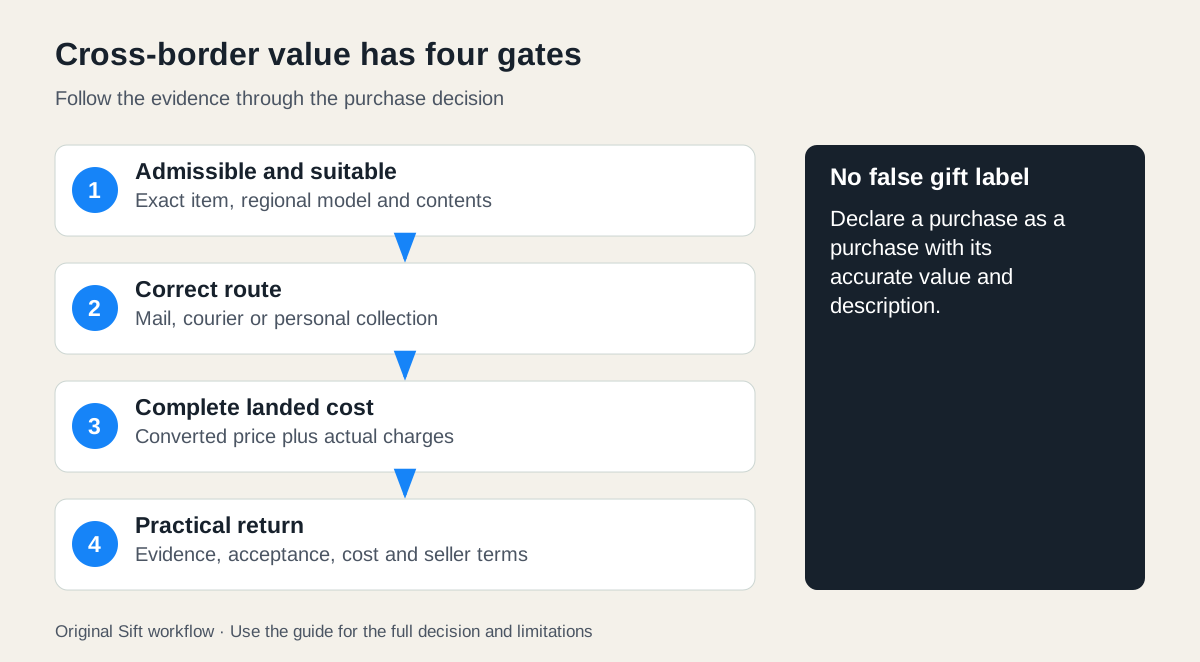 Enlarge diagram
Define the route before estimating the bill
This guide is limited to a personal purchase shipped from the United States to Canada. It is not a guide to commercial imports, moving household effects, vehicle importation or worldwide customs rules. If you collect the item while travelling, use the CBSA’s traveller guidance for that trip rather than the mail or courier assumptions below.
Identify the product, value, country of manufacture where relevant, seller location, destination province and proposed carrier service. An item sent from the US is not necessarily US-origin. A Canadian-looking website does not prove the goods are already in Canada.
The CBSA’s mail and courier guidance explains that admissibility, value, duties, taxes and exemptions need to be established. Current tariff measures can change; verify the product and origin at purchase time instead of applying a general “used goods” or “from America” rate.
Check whether the item may enter and be used
Before comparing costs, check whether the product is prohibited, restricted, recalled or subject to a special import process. For electrical equipment, also verify the regional model, certification and approved supply using buying imported used electronics. Customs release and suitability for your intended use are separate questions.
Confirm carrier acceptance for the exact contents, including batteries or other restricted materials. A seller’s willingness to pack an item does not establish that the carrier will carry it to your destination. If either admissibility or normal use remains unresolved, postpone the purchase.
Keep a truthful description and proof of the price paid. A private seller should not mark a purchase as a gift to obtain an exemption. The CBSA distinguishes qualifying gifts from ordinary purchases; a used item bought for yourself does not become a gift because the seller selects that box.
Mail and courier need different quotes
| Route | Ask for | Keep separate |
|---|---|---|
| Postal shipment | Postal service, accepted contents, packing and delivery arrangements | Import assessment and any applicable postal handling |
| Courier shipment | Exact service, clearance arrangements and complete fee quote | Government duties/taxes versus private brokerage or clearance fees |
| Personal collection | Traveller rules for the actual trip and item | Travel cost, declarations and any applicable exemption |
The CBSA’s casual-courier guidance explicitly distinguishes courier clearance fees from duties and taxes. It also explains a self-accounting option for eligible circumstances. If you want to use that route, confirm the process and practical requirements with the courier and CBSA before dispatch; do not assume it removes every charge or suits every shipment.
Avoid applying a courier threshold to a postal shipment or combining unrelated exemptions. If a threshold or tariff treatment is central to the decision, verify its current conditions from the official source for the exact route.
A complete comparison without pretending to assess tax
Here is a hypothetical CAD planning comparison for an admissible used camera lens after compatibility has been confirmed. The conversion rate and border-charge amounts are placeholders to demonstrate the arithmetic, not current rates or a customs assessment.
| Cost | US postal option | US courier option | Canadian local option |
|---|---|---|---|
| Item, converted to CAD | 200 | 200 | 260 |
| Packing and carriage | 35 | 45 | 15 collection |
| Government charges, hypothetical estimate | 30 | 30 | Included in stated example price |
| Carrier handling or clearance, hypothetical | 10 | 25 | 0 |
| Planned total | 275 | 300 | 275 |
The US headline price is CAD 60 lower, yet the postal example ties the domestic total and the courier example exceeds it. The domestic candidate also permits an agreed in-person inspection. That does not make domestic buying universally better; it shows why the comparison needs the same complete purchase.
Replace the converted price with the amount you would actually pay, including payment conversion charges. Replace border estimates with current item- and route-specific information, and retain a margin for uncertainty you can afford. The used buying cost calculator uses one currency and does not calculate exchange rates or customs rules. Enter the established amounts under transport and other purchase costs.
Include the unsuccessful-purchase branch
If the lens is unsuitable or damaged, a return may require international carriage, carrier acceptance, documentation and a separate process for any duty or tax adjustment. A seller’s item-price refund does not automatically reimburse those expenses.
Before payment, confirm the return address, permitted reason, deadline, authorisation, payer and refund currency. Ask whether a replacement would create another shipment and set of charges. Use the returns guide to make those details concrete.
In the example, an additional hypothetical CAD 40 return shipment would leave substantial unrecovered spending even if the seller refunds CAD 200. If the buyer cannot afford that branch, the apparent saving is not suitable for their budget.
Keep the record through arrival
Save the listing, item identity, seller receipt, currency/payment record, carrier quote, declaration information and any import assessment. Do not accept an understated invoice or an inaccurate contents description. Those documents should describe the actual transaction consistently.
On arrival, follow the delivered-item inspection sequence. If an assessment appears wrong, use the CBSA’s applicable review or adjustment route with the required evidence; do not assume a dispute with the seller changes the border record automatically.
Buy across the border when the exact item, complete cost and failure path are worthwhile. Pass when the required model evidence, admissibility, carrier acceptance or return practicality cannot be established. The extra distance should solve a real availability or value problem, not hide costs behind a lower listing price.