Buying imported used electronics: verify the regional model
Quick answer
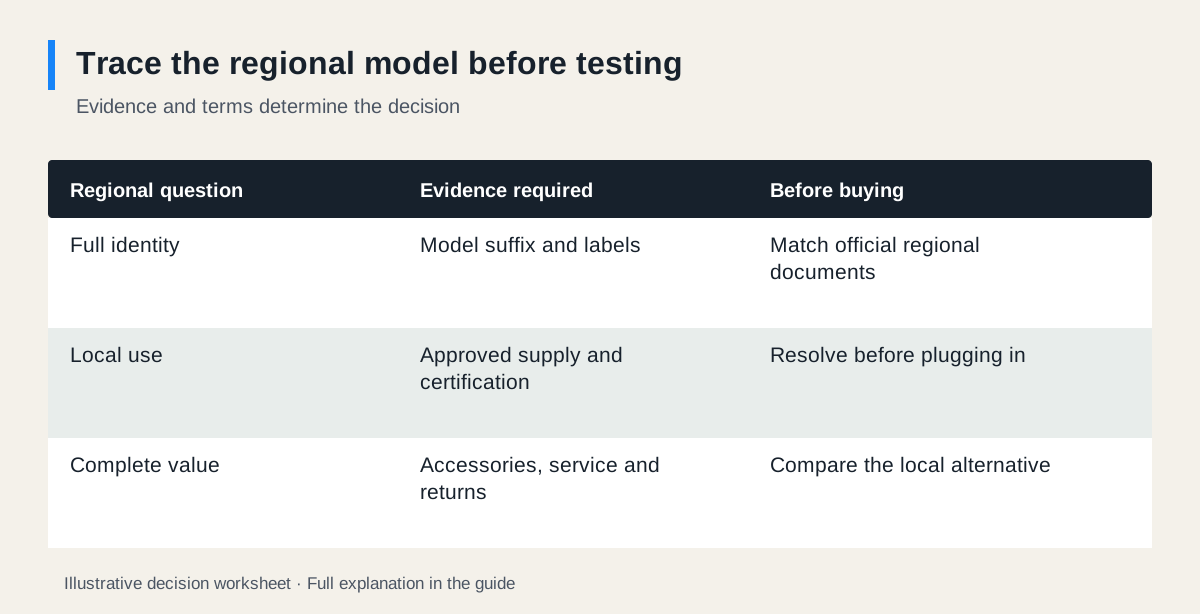
Identify the complete regional model and electrical ratings before considering an imported device. Verify local certification, manufacturer-approved power accessories, required services and repair support. A familiar plug, adapter or product name does not prove suitability. Leave unresolved electrical questions to the manufacturer or a qualified professional.
 Enlarge diagram
An imported device has more than one compatibility question
A seller may describe an item as “the same model, just bought abroad.” The housing and family name can match while the regional suffix, power requirements, radio support, software features or service arrangements differ. Record the exact device and supplied power accessory separately.
Ask for clear photographs of existing accessible labels, including the full model suffix and electrical ratings. Do not ask the seller to open equipment, remove safety covers or expose wiring for a photograph. If the label cannot be safely read, use purchase documents or manufacturer support to establish identity. If the critical match remains unknown, postpone or pass.
For a US purchase, use the electrical-product section of CPSC’s resale guide as a starting point, alongside the exact manufacturer’s local-use instructions. Check relevant certification for the complete product, not a logo on a separate plug. Canadian buyers should use Health Canada’s electrical-shopping guidance. A mark intended for another market is not automatically equivalent.
Follow the complete evidence chain
| Layer | Obtain | Resolve with |
|---|---|---|
| Device identity | Full model and regional suffix | Manufacturer’s regional product record |
| Electrical suitability | Nameplate, supplied adapter model and relevant certification | Manufacturer or qualified local professional |
| Required connections | Exact ports, signal formats or carrier requirements | Device and connected-equipment documentation |
| Online features | Region/account/service availability | Official service support |
| Repairs and accessories | Local service eligibility and exact replacement parts | Manufacturer or authorised service route |
Do not turn the electrical row into an experiment. A travel adapter changes a physical connection; it is not proof that the device, accessory or installation is appropriate. Avoid improvised conversion, replacement plugs, undocumented transformers or bypasses. The buying decision can be “choose a locally supported version.”
A foreign-market audio component example
In this fictional case, a buyer finds an audio component that resembles a local model. It is $90 cheaper than a local alternative. The seller includes an adapter and says it worked abroad. The buyer has not yet verified the regional model, supply arrangement or relevant US certification.
The correct first action is not to plug it in at the meeting. The buyer sends the accessible label details to the manufacturer’s support route and asks whether that exact version and supplied accessory are appropriate for use in the US, whether an approved local accessory exists and whether local service is available.
Three possible outcomes change the decision:
- Suitability and approved accessories are confirmed. Obtain the exact accessory cost and any service limitations, then compare the complete package.
- The manufacturer identifies a different local version or requires work not supported for this unit. Choose another candidate or obtain a professional assessment before purchase.
- The exact suffix or required certification cannot be established. Keep the item off the usable shortlist. A seller’s successful past use does not fill the evidence gap.
Suppose the verified local accessory would hypothetically cost $55 and shipping $20. The original $90 saving falls to $15 before any difference in service or returns. Those figures illustrate the decision; they are not real accessory prices or confirmation that such an accessory exists.
Check services as carefully as plugs
A network-capable device may depend on a region-specific app, supported carrier, broadcast format, account or subscription. List the particular functions you need instead of asking whether the product “works here.”
For a phone, verify the exact model with your intended carrier and the manufacturer’s regional specifications. For a connected appliance, establish whether the required app and service support that regional model under your own account. For a camera or audio device, confirm the actual interface and accessory compatibility in the matching manual.
Do not plan to share the seller’s account, bypass a region restriction or rely on a service that has ended. The support-life guide separates current operation from continuing updates and cloud functions. The account handover guide covers buyer control after a legitimate transfer.
Ask what a warranty claim would involve
“International warranty” needs a product- and country-specific document. Ask which entity would accept the claim, whether the buyer is eligible, what purchase proof is required and where the item must be sent. Shipping a heavy device abroad can change the practical value of a warranty even where coverage exists.
Keep a seller’s service promise separate from the manufacturer’s warranty. Use the manual and warranty workflow to connect the claim to the exact serial/model, original proof and transfer conditions.
Separate an imported local listing from importing it yourself
A device already in your city may still need all the regional checks above. If you are arranging the cross-border purchase yourself, add admissibility, declarations, taxes, carrier restrictions and return logistics using the authorities for your destination. Our US-to-Canada buying guide covers that specific direction; it is not a guide to importing into the US. Do not assume used goods or a private seller remove border obligations.
In the listing comparison tool, enter only confirmed purchase, transport and required accessory costs. Put unresolved electrical or service suitability in the notes, not a guessed cash allowance. Compare a locally supported alternative before investing more time in the imported option.
The purchase is ready only when the exact model, normal use, complete accessories and support path fit your situation. An attractive foreign-market price is the start of that investigation, not its result.
Sources
- 01CPSC Resellers guide to selling safer products
- 02Health Canada Buying electrical products online