Buy “for parts” or “not working” items with a stop plan
Quick answer
Decide whether you need a verified donor component or a repair attempt. Cost success and failure separately, include assessment and disposal, and set the spending and time limits before collecting the item.
 Enlarge diagram
Are you buying a repair or a donor?
A repair project depends on restoring the item. A donor purchase depends on one or more usable components. State which result you need before paying. “Untested,” “probably a fuse” and “easy fix” are descriptions or guesses, not a diagnosis or a guarantee of a valuable part.
A “for parts” label does not resolve a recall. Identify the item and check the actual notice in CPSC recalls in the US, or your local system elsewhere. Do not treat a known safety problem as permission to experiment. Keep electrical, gas, battery, pressure-system and structural work with appropriately qualified people.
Project one: a known external donor component
A fictional buyer needs a removable tray from an already identified storage product. The exact part and donor compatibility have been confirmed from the product’s documentation; no hazardous disassembly is involved. The tray can be examined directly before buying the donor. These are invented costs and identifiers are deliberately not presented as a real manufacturer compatibility claim.
| Donor route | Cost |
|---|---|
| Donor item | $15 |
| Collection | $10 |
| Cleaning/handling | $5 |
| Disposal of unusable remainder | $10 |
| Total for the verified usable tray | $40 |
A confirmed direct replacement costs an illustrative $45 delivered. The donor saves only $5 and requires collection, handling and disposal. The buyer chooses the direct part if that additional work is not worthwhile. There are no assumed resale proceeds from the remainder.
If the seller refuses access to inspect the tray, the useful component is no longer verified. The buyer does not keep calling it a $40 replacement; it becomes a $40 gamble on an unknown part. If the whole amount cannot be lost comfortably, pass. For actual model-to-part evidence, use finding discontinued replacements.
Project two: an unknown-fault repair attempt
A different fictional buyer considers a non-working desktop monitor. They will use a qualified repair service, not open the monitor themselves. A service assessment and all amounts below are hypothetical; obtain a real quote and confirm that the provider handles the exact model before collection.
| Stage | Planned amount |
|---|---|
| Purchase | $20 |
| Collection | $15 |
| Diagnostic assessment | $40 |
| Authorised repair ceiling after assessment | $80 |
| Disposal travel/fee allowance if unsuccessful | $15 |
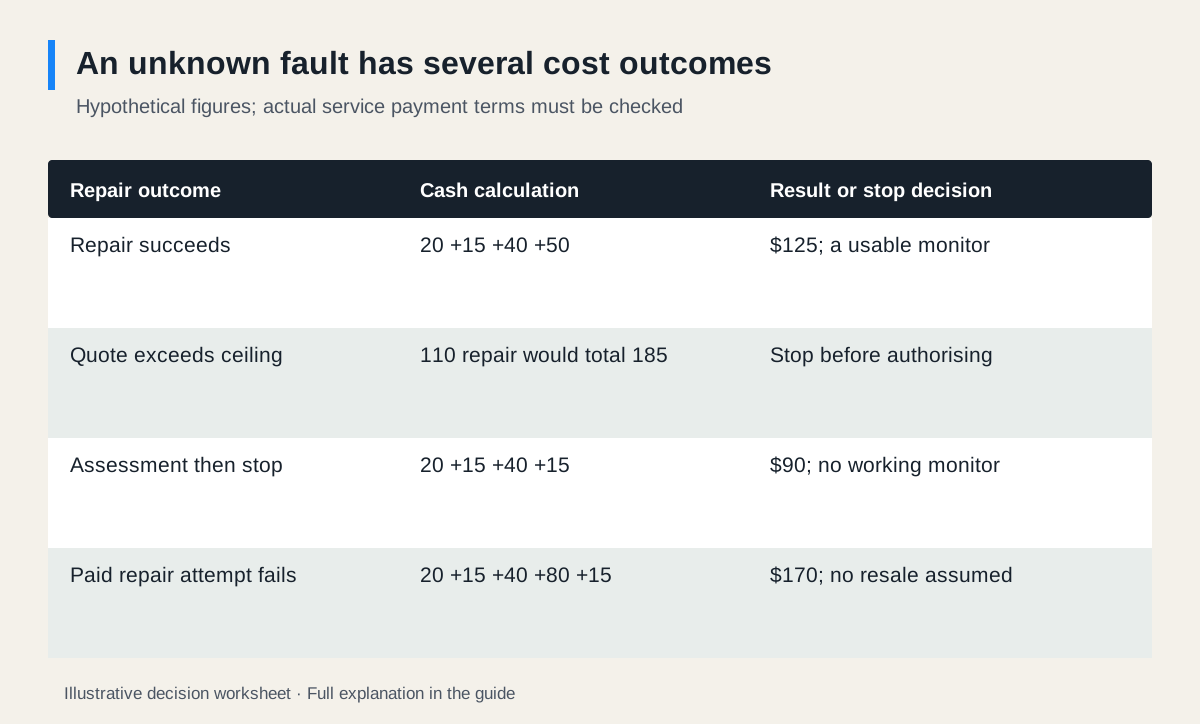
Before buying, the buyer sets a maximum successful-project cash spend of $155 and a deadline of two weeks. They also accept that a failed assessment could leave them $90 out of pocket: 20 +15 +40 +15. The working alternative is a confirmed $140 monitor that meets the same requirements.
| Outcome | Total cash | Decision meaning |
|---|---|---|
| Assessment finds a $50 repair, successfully completed | $125 | $15 below the working alternative, before personal time |
| Assessment finds a $110 repair | $185 if authorised | Exceeds the $155 ceiling; stop rather than authorise |
| Stop after that assessment and dispose appropriately | $90 | No working monitor and no resale assumed |
| $80 repair attempt fails; that fee is payable under agreed terms | $170 including disposal | Exceeds the success budget and must be understood before authorisation |
The final row shows why a repair quote needs an outcome and payment policy, not merely a parts price. Ask whether assessment charges count toward the repair, what is payable if the attempt fails, and whether additional work needs approval. Do not add the assessment twice if the actual quote credits it.
No probability is assigned to these outcomes. The table does not claim an expected profit. If the buyer needs a reliable monitor by Monday, the working alternative may be the better fit even though one successful repair branch is cheaper.
Set the stopping point before collection
Write down the full cash limit, time allowance, deadline, available workspace and disposal route. A sensible rule can be: “One assessment; no work above the stated ceiling; no second donor purchase unless the full project is recalculated.” Money already spent does not make the next repair worthwhile.
Ask the seller what failed, when it last worked, whether it was opened or modified and which parts were removed. Record observations separately from explanations. “Does not turn on in the agreed ordinary test” is evidence; “needs a cheap power board” remains unverified unless supported by a competent diagnosis.
Do not energise damaged electrical equipment, charge a suspect battery or dismantle an item for a speculative demonstration. Let the appropriate specialist decide whether and how it can be assessed.
What about locked electronics and disposal?
An account lock is not an ordinary repair. Apple’s Activation Lock guidance requires release by the authorised owner. Replacing hardware does not establish legitimate ownership transfer. If release cannot be completed, do not build a repair budget around an unofficial bypass.
Confirm a local disposal route before taking ownership. For example, Toronto’s electronic-waste guidance describes municipal routes and the need to remove personal information. Check current accepted items, eligibility and special handling; damaged or recalled batteries may need a different route. Do not promise a charity will accept a non-working item.
A parts purchase is worthwhile when its useful outcome and downside are both understood. If the essential component cannot be tested, the repair ceiling is already near a working alternative or the remainder has nowhere to go, passing is a completed decision, not an unfinished project.