How do you check a used dehumidifier before buying it?
Quick answer
Start with the complete model and serial label and the recall result. Then choose a drainage arrangement that works in your room: bucket, gravity hose or a confirmed pump-equipped model. Observe normal operation under suitable conditions, but do not treat a running fan, a falling display number or a little collected water as proof of rated moisture removal.
Identify the unit before agreeing to a demonstration
A dehumidifier is often listed as “50 pint, works great,” with its brand visible and its model hidden. That is not enough to decide whether to travel. Request a clear label photograph, the full model suffix, serial/date information and pictures of the bucket and rear connections. Check the appropriate country’s recall database and the manufacturer’s remedy information before asking anyone to operate it.
The reason is concrete: CPSC’s August 2023 Gree recall covers listed models sold under several different consumer brands. Searching only the logo can miss the relationship. The notice identifies affected models and a stop-use/refund remedy. It is an example of why the exact unit matters, not a complete list of dehumidifier recalls. Canadian buyers should also use Health Canada’s database.
If a notice applies, follow it. Do not accept “it has never overheated” as a substitute for the specified remedy. If the label is unreadable or a seller cannot establish whether the pictured machine is the one being sold, identity remains unresolved. A lower price does not resolve that uncertainty.
Match the room and the rating method
Write down the intended room, approximate temperature range, moisture problem and drainage location. Is this a seasonally damp basement, a frequently opened utility room or an unheated space? The exact model’s permitted operating conditions matter. Do not assume every compressor dehumidifier is suitable for the coldest part of your home.
Capacity labels also need context. ENERGY STAR explains that portable-dehumidifier testing moved from 80°F to 65°F under the newer procedure, changing the reported capacity for otherwise comparable machines. A used “70 pint” model and a newer “50 pint” model should not be ranked from those numbers alone. Record the rating basis and compare the manufacturer’s guidance for the actual models.
The building problem is separate. An appliance purchase should not be your only plan for an active leak or standing water. If the source of moisture is unclear, resolve that issue rather than buying a larger machine on the assumption that it fixes the cause.
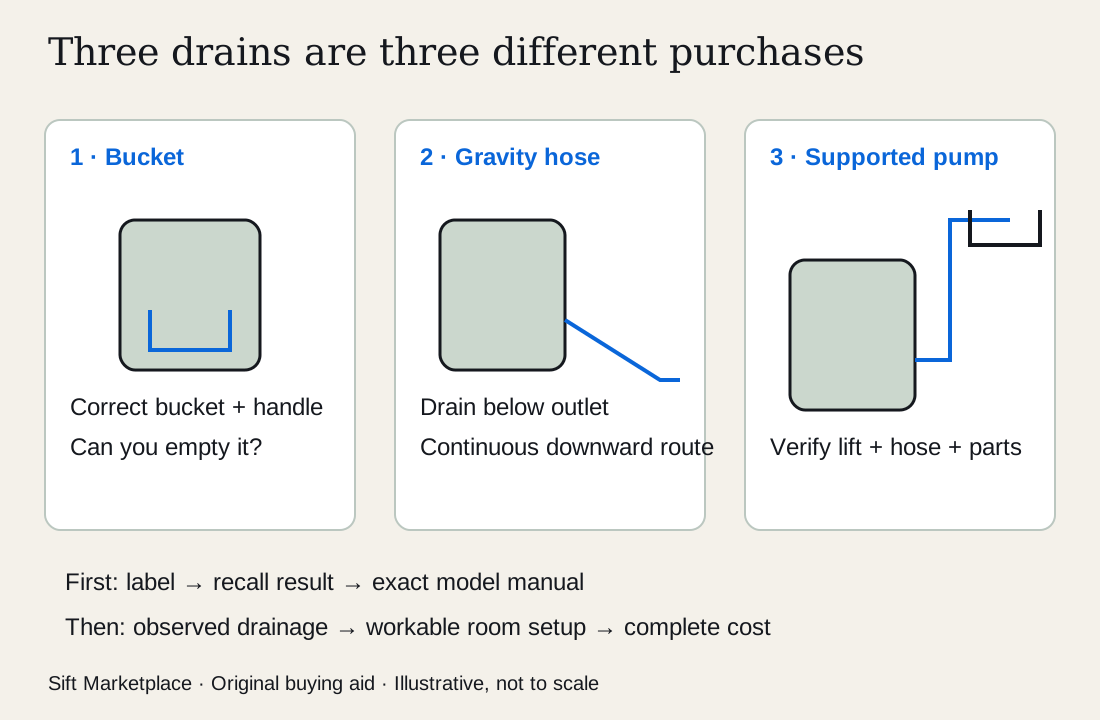
Choose the drainage branch that you can actually use
 Enlarge diagram
| Arrangement | What to confirm | Hidden cost or limitation |
|---|---|---|
| Bucket | Correct intact bucket, handle and model-specific float or shutoff components | You must be able to remove and empty it when needed |
| Gravity hose | Correct fitting and an unobstructed descending path to a suitable drain | A drain above the outlet is not a gravity-drain solution |
| Built-in or separate approved pump arrangement | Exact pump capability, required components, hose and route limits | A “continuous drain” listing does not prove there is a pump |
Midea’s Cube family manual distinguishes gravity and pump arrangements. Its Canadian MAD50S1QWT-A page lists no built-in pump. Use those as an example of suffix-sensitive checking: a similar shape or product-family name is not enough.
Measure the proposed hose route, including its height relationship to the drain. Record what must remain accessible for ordinary cleaning and bucket removal. Do not improvise a raised platform or unsupported pump conversion to rescue an unsuitable listing. Find the approved arrangement first, then price the purchase.
Inspect the removable parts with the power off
Ask the seller to empty and clean the accessible collection parts according to the manual before the visit. Inspect the bucket corners, handle mounts, seating edges, drain cap and hose threads without forcing anything. Missing pieces may be small but essential to proper seating or shutoff.
Look at the accessible filter, external grille, case, cord and plug. Note cracks, persistent contamination, damaged wiring, evidence of water outside its intended path and any modifications. Do not dismantle the refrigeration system or reach through a grille. An unexplained smell or damaged electrical component is a service-assessment issue, not a cleaning allowance.
Ask how it was stored, what settings were normally used, whether the bucket or pump ever overflowed, and whether it displays errors. A useful answer describes the event and any documented service, rather than simply saying “never had a problem.” Record which accessories are included, especially when photographs show a hose belonging to the seller’s permanent setup.
Observe moisture collection without inventing a capacity test
Arrange normal operation in suitable conditions using the exact manual. The seller should demonstrate the drainage mode you plan to rely on if that is practical. A bucket demonstration does not verify a separate pump function.
Record the starting room conditions, mode, setting, observed duration, display behavior, water destination and any error. Do not demand a universal quantity of water in ten minutes: the amount available to remove depends on the environment, and a short viewing is not the manufacturer’s capacity test. A fan running proves less than ordinary dehumidifying operation with water arriving in the intended place.
If the room is already dry, the seller has just moved the appliance, or the visit cannot accommodate a meaningful demonstration, write “not demonstrated.” Arrange another visit or decline if that uncertainty is material. Do not repeatedly change settings or defeat a bucket switch to make the machine run.
| Finding | Decision consequence |
|---|---|
| Exact identity established; applicable recall issue resolved; normal operation observed | Continue to drainage fit and total-cost comparison |
| Bucket cracked; correct replacement confirmed | Price the replacement before making an offer |
| Gravity draining works but your drain is higher | Choose a different supported setup or another model |
| Pump promised but no pump function demonstrated | Keep pump value unverified; do not pay as though it passed |
| Error persists or water escapes unexpectedly | Obtain qualified assessment or pass |
| Label missing or recall identity cannot be established | Stop the purchase until identity is resolved |
A hypothetical basement comparison
Suppose a buyer has a higher utility sink and no suitable lower drain. Listing A costs $90 and has gravity drainage only. Listing B costs $150, includes the correct pump equipment, and would cost $20 to collect. These invented numbers do not make A a $80 saving: A has no confirmed usable automatic drainage route for this buyer.
If the buyer is willing and able to empty a bucket, A might still be a valid alternative. That is a different daily-use choice, and its bucket condition becomes central. If automatic drainage is essential, compare B with other models that actually meet the requirement. Do not insert a guessed pump price into A’s column and assume compatibility.
Use the cost calculator for purchase, collection, confirmed parts and service. Keep unresolved faults visible outside that arithmetic. Check current parts availability and the actual terms of any warranty claim; the original retail warranty is not automatically yours.
Confirm the handover details
A concise seller message is: “Please send the full model label, bucket and rear-connection photos. I need [bucket/gravity/pump] drainage. Which hoses and pump parts are included, has it ever overflowed or displayed an error, and can you demonstrate that drainage mode after we verify the model’s recall status?”
Before collection, follow the model’s emptying, transport and restart guidance. Keep caps and small fittings in a labeled bag. If the purpose is cooling rather than moisture removal, read the portable air-conditioner guide; the installation and expected result differ. Sift can help keep suitable local listings in view while you compare the evidence.