How do you buy a used portable air conditioner that fits your room?
Quick answer
Buy the installation, not just the wheeled unit. Confirm the exact model, window kit, hose fittings, electrical requirements and drainage plan before visiting. Observe correctly installed cooling if possible, then price the missing parts and transport. A fan that runs or a cold air outlet does not establish whole-room performance.
Start at your window, before searching by BTU
A used portable air conditioner can look complete while missing the connector that makes its exhaust usable. A machine that works in the seller’s sliding window may need a different solution for your casement window. Those are buying decisions to settle before a hot afternoon, a long drive and a payment deadline make an incomplete bundle feel acceptable.
Make a one-room brief. Record the room’s floor area, ceiling height, sunny glazing, other heat sources and whether doors can be closed. Identify where the unit could stand without blocking a walkway. Then photograph the window, measure its usable opening and record the available outlet location. Check any tenancy or building conditions affecting window inserts. Do not assume that “portable” means every room is suitable.
This guide covers freestanding, hose-vented room air conditioners. An evaporative cooler, window air conditioner and dehumidifier are different purchases. If the listing shows no hose or outdoor exhaust arrangement, first establish what the product actually is.
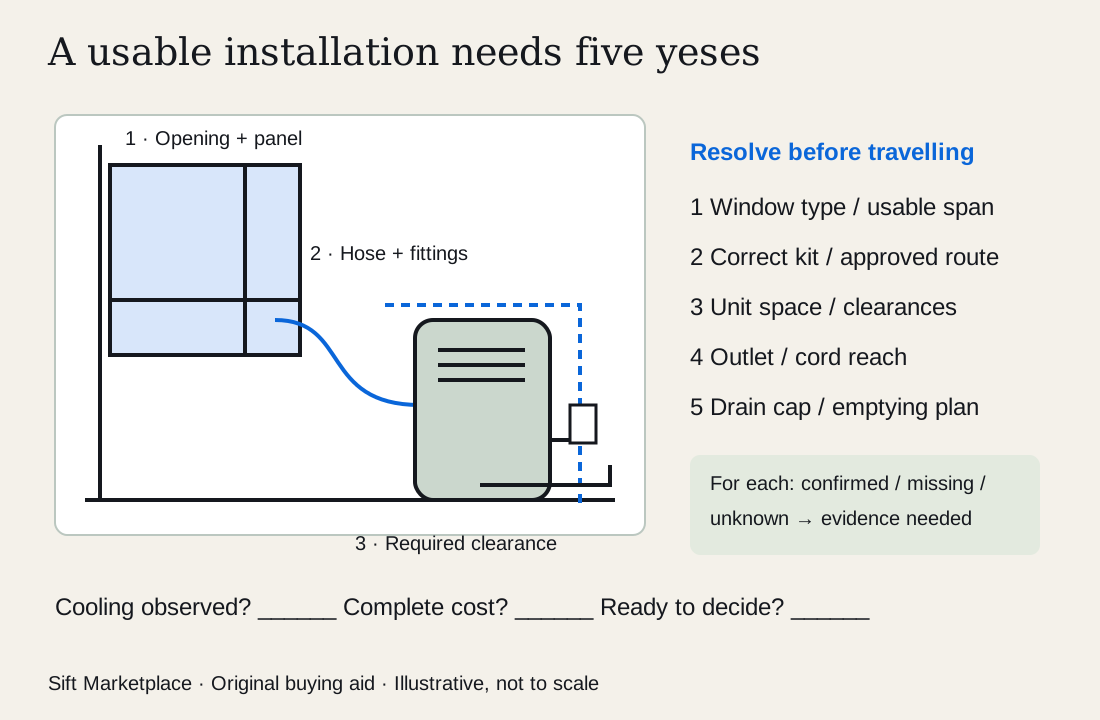 Enlarge diagram
Match the rating and generation to the actual unit
Ask for a readable photograph of the complete rating label, a front and rear view, and all accessories laid out separately. Record the model suffix and serial number privately for the manufacturer’s lookup and any applicable recall check. A listing title copied from a current retail page may describe a later version.
Two cooling numbers are not necessarily two different power settings. For example, Whynter’s current ARC-14S page lists 14,000 BTU under ASHRAE and 9,500 BTU under SACC. Compare the same rating method between candidates. Do not compare the larger advertising number on one listing with the SACC figure on another and call the first more capable. DOE publishes the portable-air-conditioner test framework; it does not turn a seller’s room-size claim into a guarantee for your home.
Use the manual and specifications corresponding to the label, region and generation. Ask the manufacturer if the documents disagree. This matters beyond ratings: Whynter identifies different hose diameters and connector versions within the ARC-14S family. A generic hose described as “fits portable ACs” is not evidence that both ends mate to your particular machine and window panel.
Keep the capacity decision separate from condition. A fully working unit may be poorly suited to a large, sunny open-plan room. Conversely, an appropriate nominal capacity says nothing about the condition of the used unit. Both questions must pass.
Audit the window kit as a connected system
Lay out the installation in order: machine outlet, machine-side connector, hose, window-side connector, panel fixture, adjustable panels and seals. Include the intake path for a dual-hose model. Photograph the parts assembled during the viewing as a record of what was demonstrated and agreed to be included.
| Component | What to establish | What changes the decision |
|---|---|---|
| Window panels | Actual minimum/maximum assembled span and any previous cuts | A shortened panel may fit the seller’s opening but leave yours uncovered |
| Hose or hoses | Correct version, intact body and both end fittings | A hose alone does not replace a missing locking connector |
| Panel fixtures | All tabs, fasteners and closures present | A broken mounting tab needs a supported replacement, not an assumed tape fix |
| Seals and small hardware | What is included and what the manual requires | Small omissions can create another order or trip |
| Window type | Approved arrangement for your opening | A sliding-window kit is not automatic evidence of casement fit |
| Storage extras | Remote, cover and optional filter listed individually | Optional accessories should not conceal missing essential pieces |
Ask for the panel measurements themselves. “Standard window kit” is insufficient, especially if a previous owner trimmed it. If a custom insert is needed, establish a suitable solution and quote before buying; this article is not a cutting or window-modification procedure.
At home, trace the proposed hose route with a tape measure. The shortest straight-line distance may cross a curtain, radiator or desk. Record the route the installed hose would actually take while respecting the model’s length, bend and clearance instructions. A plan that depends on an unapproved extension is not a confirmed fit.
Resolve the outlet and condensate plan
The operating manual controls the electrical setup. As a concrete example, the ARC-14S manual calls for a grounded supply and prohibits a power strip or extension cord. It also specifies ventilation clearance, operating conditions and condensate handling. Those instructions apply to that document’s model; use the correct instructions for the unit being sold.
Write down where your unit would stand, which outlet it would use and whether its supplied cord reaches as intended. If the circuit or outlet is uncertain, ask a qualified electrician before treating that location as available. Do not buy on the assumption that a different plug, adaptor or longer cord will solve the problem.
Drainage deserves its own line in the plan. Identify the relevant drain port, supplied cap and any required hose. Read how the model handles accumulated water in each mode you intend to use. Marketing terms such as self-evaporating do not establish that a used machine will never need attention in your conditions. Determine whether you can carry out the ordinary emptying or drainage arrangement without moving a heavy unit through an obstructed room.
An intact cap matters even if you expect little collected water. A missing remote may be negotiable if all essential functions remain available from the controls; a missing drain closure is a different problem. Ask for part identifiers and availability, rather than assigning all omissions the same small discount.
Arrange a demonstration that can answer your question
Ask the seller to demonstrate normal cooling in its properly installed location, following the relevant manual. Agree on this before travelling. A unit on a driveway with no exhaust kit attached cannot demonstrate the proposed room installation.
With the machine off and unplugged for permitted external inspection, look at the cord, plug, cabinet, hoses, accessible filter and drain closures. Do not remove service panels. Damage to electrical parts, a modified safety plug, unexplained internal repairs or signs of leakage need manufacturer or qualified-service assessment before use. Search the exact identity in Canada’s recall database or the US CPSC database, as appropriate. If a notice applies, establish the required remedy; a seller’s assurance that it still works does not resolve it.
During ordinary operation, record the room conditions, selected mode and set point, and what you actually observed. Did the controls respond? Was the correct exhaust connected? Did the unit remain operating without an unresolved error? Were there unusual noises, vibration, smells or water outside the intended drainage path? Follow the manual’s startup delays rather than repeatedly toggling power to provoke a response.
The useful outcome is a written observation, such as “cooling mode demonstrated in this room with the complete kit; controls and drainage cap present; overnight performance not observed.” Avoid writing “compressor perfect” or “will cool my apartment.” A brief viewing does not measure rated cooling capacity, establish energy consumption or predict the remaining service life.
Interpret what was and was not demonstrated
| Viewing result | What you know | Sensible next step |
|---|---|---|
| Properly installed cooling runs normally | The observed functions worked under those conditions | Continue only if room fit, identity and complete cost also pass |
| Fan runs, but no suitable cooling setup is available | Fan/control evidence only | Arrange another demonstration or keep cooling unverified |
| Unit was recently transported | Startup timing may constrain the viewing | Follow its manual; schedule the test accordingly |
| Persistent error or unexpected shutdown | A material operating issue remains | Get a qualified assessment or pass |
| Missing compatible window fitting | A known incomplete installation | Confirm the exact available part and price before offering |
| Seller suggests a refrigerant “top-up” | A repair explanation has been offered, not established | Obtain qualified diagnosis; do not price it as a routine accessory |
If an incomplete test leaves you uncomfortable, another listing is a valid outcome. A discount is useful when a cost is known and the resulting item still meets your needs. It cannot supply evidence about a sealed system that has not been assessed.
Compare complete usable installations
The following numbers are hypothetical amounts, not current asking-price estimates. Both candidates are assumed suitable for the buyer’s room, with no unresolved safety issue.
| Cost | Listing A: incomplete kit | Listing B: complete kit |
|---|---|---|
| Agreed unit price | 140 | 220 |
| Confirmed compatible kit parts | 75 | 0 |
| Replacement filter selected for this model | 15 | 15 |
| Collection cost | 30 | 20 |
| Total cash needed | 260 | 255 |
Listing B is $5 cheaper to make usable despite its higher purchase price. That calculation does not decide condition: if B cannot demonstrate cooling, the cash total and the unverified function must remain separate entries. If A’s part has not been identified, $75 is only a placeholder; replace it with a quote before making the comparison final.
The used-buying cost calculator has separate inputs for item price, transport, repairs, missing parts and other costs. Enter a genuine service quote under repairs; do not disguise an undiagnosed fault as a certain low-cost repair. Optional time valuation can help compare collection effort, but it is separate from the cash required.
Check the price of a suitable new or supported open-box alternative with its actual delivery and return terms. Do not assume a private sale includes the original warranty. Ask the manufacturer what, if anything, applies to a subsequent owner in your region.
Send a precise message, then make the collection plan
A useful first message could be:
Could you send the full model-label photo and a photo of the hoses, both ends, window panels and drain caps laid out? My window opening is [measured size and type]. Has the panel been cut? I would like to see normal cooling with the complete kit installed before agreeing to buy. Please also confirm any repairs, error codes and exactly which parts are included.
Once the evidence and price work, plan the move using the exact manual. Confirm unit dimensions and weight, stairs, vehicle space, help and a suitable transport orientation. Do not borrow a universal waiting period from a different refrigerator or air-conditioner guide. Keep the kit together and record the agreed inclusions before collection.
For large connected appliances, see the used-appliance guide. If the real task is moisture control rather than cooling, compare a used dehumidifier. Sift’s Marketplace filters can help narrow the listings you review; the room measurements, correct kit and observed operation decide which candidate is useful.
Sources
- 01Whynter ARC-14S product specifications and version-specific accessories
- 02Whynter ARC-14S Instruction Manual
- 03Whynter ARC-14S / ARC-14S2 User Manual V2025
- 04US Department of Energy Portable air conditioners
- 05CPSC Recall lookup
- 06Health Canada Recalls and safety alerts