How do you buy a complete used food processor?
Quick answer
Confirm the base, bowl, lid, pusher and cutting accessories belong together. Check the exact blade against applicable recalls, inspect food-contact parts and observe normal fully guarded operation. A motor that runs does not make an incomplete bundle useful; obtain compatible replacement-part prices before offering.
Choose the food task, then inventory its parts
A processor bought for slicing vegetables needs a different accessory set from one bought mainly for chopping. Write down the two or three tasks you actually want, your ordinary batch size and the storage space available. Do not pay for ten discs if the essential bowl-and-lid assembly is damaged.
“14 cup” describes a nominal bowl size, not an unrestricted capacity for every ingredient. Cuisinart’s DFP-14NYC manual gives different capacities for different tasks. Check your candidate’s instructions for the food and quantity you intend to process. This is particularly useful when a seller describes a compact machine as suitable for large dough batches.
Request the label on the base and a photograph of every removable item laid out. Record the exact model suffix; compare it with the manual’s parts diagram rather than a photograph of a newer product with a similar name.
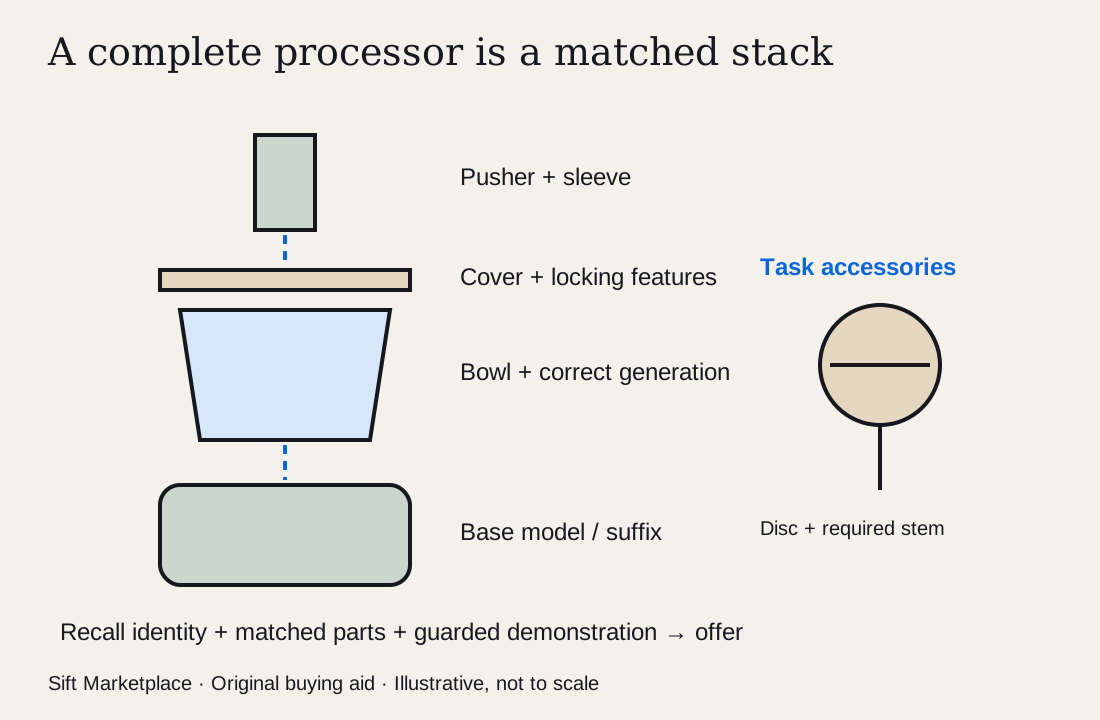 Enlarge diagram
| Your task | Required items to verify for this model | Common omission to resolve |
|---|---|---|
| Chopping or mixing | Correct bowl, cover, pusher and chopping blade | Blade included in a photo but excluded from sale |
| Slicing | Supported slicing disc and its required stem/carrier | Disc present without the detachable stem |
| Shredding | Correct shredding disc and complete guarded feed path | Pusher or sleeve missing |
| Dough | Model-approved blade and quantity | Seller assumes all machines knead the same batch |
| Safe storage and cleaning | Intact removable parts and suitable storage arrangement | Loose sharp discs bundled without protection |
Verify blade identity before operating it
Check applicable recalls using both the machine identity and the accessory description. CPSC’s Cuisinart riveted-blade recall identifies particular model prefixes and a blade construction with four rivets. The required remedy concerns the affected blade. A working motor and a familiar brand name do not establish that the included blade has been replaced.
If the item falls within a notice, follow the current remedy and establish which part is actually included. Ask for the replacement part record or manufacturer confirmation where necessary. Do not demonstrate an affected blade merely to see whether it still looks sound. Do not generalize this one notice into a claim that every old processor is recalled or every newer-looking blade is cleared.
Inspect the mating surfaces and food-contact parts
With the machine unplugged, ask the seller to show normal assembly and disassembly. Look at the bowl rim, handle attachment, base locking points, lid tabs, feed tube and pusher. Cloudiness, scratches, cracks and broken locking features are different findings; record their location rather than calling everything “wear.”
Check accessible seals and any area that traps residue. Ask how it was cleaned and stored. A bowl that smells strongly or has inaccessible contamination may not be a cleaning project you want, even when it is mechanically intact. Do not promise that a dishwasher cycle restores every old plastic part.
Look at blades and discs without running fingers along cutting edges. Note chips, cracks, corrosion, damaged hubs or unknown modifications. Do not try to straighten an accessory during the viewing. Cuisinart’s manual requires the bowl and cover to be secured, hands kept away from moving cutters, and no tampering with the interlock. Apply the corresponding exact-model instructions to the candidate.
A replacement bowl must match more than nominal capacity. Cuisinart’s DLC-005AGTXT1 page lists compatible models explicitly. Use the same model-list approach for the lid, pusher and stem. If a replacement generation requires more than one new piece, cost the whole required assembly.
Ask for an ordinary, fully assembled demonstration
Agree on a small task permitted by the manual, with suitable ingredients and the correct attachments. Have the seller operate the appliance normally with all guards in place. A motor-only run with an improvised interlock bypass is not an acceptable substitute.
Observe whether normal controls start and stop the intended task, the assembly remains seated, and there are unexplained leaks, stalls, noise or smells. Do not deliberately overload the machine to prove motor strength. If slicing is the reason for buying, a chopping demonstration alone leaves the disc-and-stem task unobserved.
Record the limit: one normal task was demonstrated, not every recipe or long-term motor reliability. If the motor does not run, do not accept “just a lid switch” as a diagnosis. Missing guarded parts prevent a useful demonstration until correctly replaced.
Compare a complete processor with the incomplete bargain
In a hypothetical example, listing A is $45, but its confirmed bowl/lid combination costs $70, a required pusher $20 and collection $10. Its total is $145. Listing B is $110 with the complete matched set and $10 collection: $120. These are illustrative amounts, not quoted parts prices.
B is $25 less to make usable. If A’s replacement set is unavailable, the arithmetic is beside the point: it cannot yet do the job. If both are complete, compare actual observed condition, the accessories you need and the cost of an appropriate new alternative. Use the missing-parts guide and cost calculator to keep a known omission separate from an undiagnosed failure.
A suitable offer message is: “I need the chopping blade and slicing disc with its stem. Please confirm the full model and every included part, any cracks or replaced blades, and whether a small normal food demonstration is possible. I will check the applicable recall and part compatibility before visiting.”
Buy when the guarded assembly is complete, the intended task works and the price makes sense. Negotiate a known obtainable accessory or cosmetic issue. Pause for an unresolved recall, damaged safety-related part or unexplained failure. Pack sharp components securely for collection and retain the exact care instructions for first use.
Sources
- 01Cuisinart DFP-14NYC series instruction booklet
- 02Cuisinart Work bowl DLC-005AGTXT1 compatibility
- 03CPSC Cuisinart riveted blade recall