How do you buy a used gas barbecue without guessing about its fuel system?
Quick answer
Read the model and fuel labels before comparing prices. Inspect the cool, unlit grill for structural damage and missing cooking or grease-management parts. Resolve modifications and fuel-system concerns through the manufacturer or a qualified gas professional before use. A cheap replacement grate does not make an uncertain fuel system acceptable.
Establish the fuel and model before making a trip
Ask for the model, serial and fuel labels, the entire grill, the interior while cool, and the storage compartment. Confirm the country version. “Propane or natural gas” is not a meaningful answer unless the exact maker explicitly supports the stated configuration.
Weber’s North American conversion guidance says its grills are designed for a particular fuel and that it does not allow conversions or provide conversion kits. That is Weber’s policy, not a universal rule for every brand. For any candidate, verify the manufacturer’s position rather than accepting “the previous owner changed the hose” as proof of suitability.
If your home has natural gas but the listing is an LP model, first decide whether you want the approved LP arrangement or a different grill. Do not build the purchase around an unsupported conversion. If the fuel identity or modification history cannot be established, pause the purchase.
Check whether the intended location is suitable
Record the available outdoor area, the grill’s dimensions with its lid and shelves in use, and the exact manual’s clearances. Check relevant property or building restrictions before buying for a balcony or shared space. The seller using it somewhere does not establish that the same location or connection is appropriate for you.
For a fixed gas supply, obtain an appropriate qualified installation assessment and quote. For an LP arrangement, confirm the cylinder and supply components required by the manual, and whether an included cylinder can be accepted and used in your region. Do not attribute value to an unidentified or unsuitable cylinder.
This is a purchase guide, not instructions for making gas connections, converting fuel or repairing valves. Any smell of gas, damaged fuel component or uncertain modification should stop the demonstration until handled through the appropriate safety and service route.
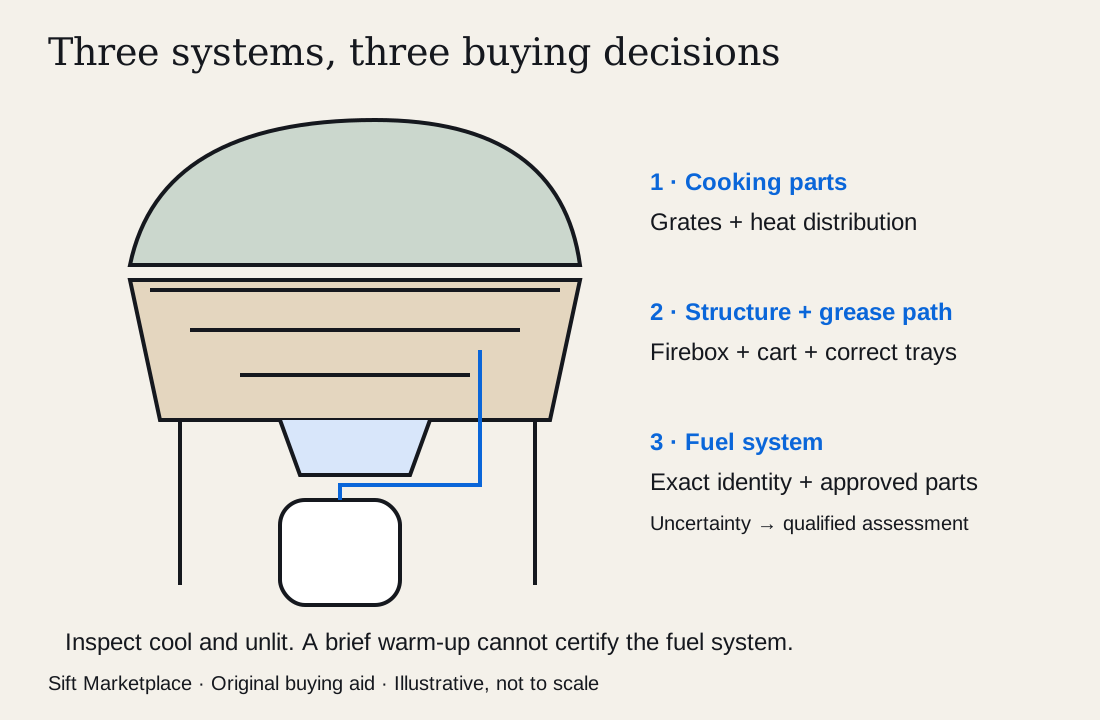
Divide the grill into three inventories
 Enlarge diagram
| System | Parts to identify | What matters for the purchase |
|---|---|---|
| Food support and heat distribution | Grates, warming rack and model-specific heat shields | Correct size, support points and replacement availability |
| Structure and grease handling | Lid, firebox, cart, wheels, catch pan and trays | Sound support and a complete intended grease path |
| Fuel and controls | Correct burners, controls, approved hose/regulator or connection components | Identity, unmodified configuration and qualified assessment when uncertain |
Use Weber’s model/serial lookup or the corresponding maker’s service system to obtain the exact manual and exploded diagram. A broad name such as Spirit or Genesis covers multiple configurations. Do not quote a replacement part against only that family name.
Inspect while the unit is off and cool
Ask the seller to open accessible sections permitted by the manual. Look at the firebox and its support points, lid hinges, cart joints, wheels and shelves. Photograph substantial corrosion, holes, cracks, missing fasteners and bent structural parts. Do not lean heavily on a weakened cart or dismantle components to prove strength.
Food-contact surfaces may be replaceable; structural corrosion can change whether the grill is worth restoring at all. Distinguish surface discoloration from missing metal or a damaged mounting point. If you cannot assess the significance, ask a competent service provider before offering.
Inspect the accessible grease trays and their supports. Identify which tray, liner or pan is absent. A makeshift container somewhere below the grill is not confirmation that the intended collection system is complete. A purchase that requires cleaning should include realistic time and disposal arrangements, without promising that every deposit or odour can be removed.
For fuel components, limit the viewing to identity and visible condition unless a qualified person is assessing them. Do not perform improvised leak tests or attempt to fix damaged hoses. A regional Weber owner guide illustrates why fuel parts and maintenance instructions must match the exact region and model; its details are not interchangeable with a North American grill.
Make service and demonstration separate stages
Ask for maintenance and repair records, including who worked on the fuel system and which parts were fitted. Search the exact identity for applicable recalls, starting with CPSC recalls in the US and Canada’s notices for Canadian products. Establish any required remedy before use.
If identity, condition and setup are suitable, arrange the seller’s ordinary operation following the exact manual in an appropriate outdoor location. Observe controls and the functions you intend to use without reaching into a hot grill or trying to reproduce abnormal conditions. Do not treat a brief warm-up as a comprehensive inspection of burners, valves or gas tightness.
If the unit cannot be demonstrated, price it as unverified only if that is a purchase you knowingly want. If the seller attributes poor operation to “just an igniter,” record the symptom and obtain a service quote. A diagnosis is not established by the low price of the suggested replacement.
Work out whether the parts restore useful value
Consider a hypothetical example. Grill A is $100, with confirmed grates and heat shields at $110, an approved grease-tray replacement at $25 and transport at $35: $270 before any service. Grill B is $240 with those components intact and $30 transport: also $270. These are invented buying figures, not market prices.
A’s restoration work offers no cash saving in that example. If A also has an unresolved fuel modification, adding a guessed service allowance does not make it equivalent to B. Get the assessment first or pass. If a qualified quote establishes safe, supportable work, then compare that complete cost with a suitable alternative.
The cost calculator can record purchase, confirmed repair, missing components and transport. Keep optional accessories such as a cover separate from essential equipment. Check the actual used-owner warranty position with the maker rather than assuming the original coverage transfers.
Agree on exactly what is collected
Ask: “Please send the full fuel/model labels, cool interior and grease-tray photos. Has the fuel system ever been converted or repaired? Which original parts are missing, and can you provide any service records? I need to confirm the approved configuration before arranging a demonstration.”
For collection, let the unit cool fully and arrange the manufacturer-appropriate disconnection and fuel transport with qualified help where needed. Plan the heavy frame, loose grates and fragile side shelves. Read the used-appliance guide for broader purchase-cost reasoning, and keep this grill’s fuel, structure and complete parts as separate decisions.
Sources
- 01Weber Can I convert my gas grill?
- 02Weber Model and serial manual lookup
- 03Weber Grill owner guide 71728
- 04CPSC Recalls
- 05Health Canada Recalls and safety alerts