How do you assess used hockey skates before buying?
Quick answer
Fit both skates using the exact model’s sizing information and appropriate shop advice. Inspect boots, lining, eyelets, holder attachment and runners as one system. Have a qualified skate shop assess questionable structure or remaining serviceability. A sharpening or heat-moulding promise cannot guarantee that a damaged or wrong-size boot becomes suitable.
Begin with the feet that will wear them
Ask for photographs of the size and fit labels inside both skates, plus the model and generation. Compare both labels; a used pair can contain replacement components or mismatched sizes. Hockey Canada’s fitting guide notes that skates fit differently from shoes. Do not buy solely from your street-shoe size or a universal “size down” rule.
Use the manufacturer’s actual skate fit guide and, where needed, a competent skate fitter. Wear the socks and suitable footbeds you plan to use when trying both boots. Check heel hold, toe position, width, volume and pressure as part of the whole fit. A label only narrows the candidates.
For a growing player, do not assume excessive spare space is a bargain. For a custom or pro-stock pair, establish whose modifications and dimensions are present. A premium model built or altered for another foot may be less suitable than a simpler correct fit.
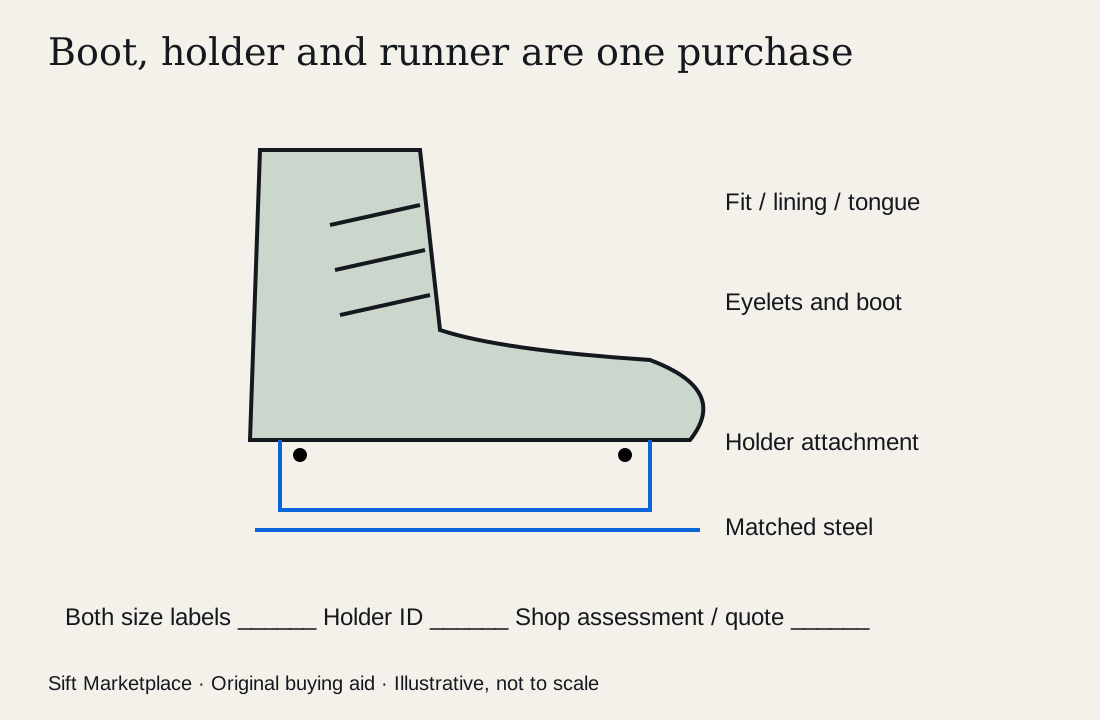 Enlarge diagram
Inspect the boot before pricing the steel
Look at both sides, heel, toe cap, tongue, tendon area, sole and lining. Note tears, compressed or missing padding, separating layers, damaged eyelets and repairs. Ask about drying, storage, heat moulding and previous structural work. Persistent odour is a cleaning-history question; it is not the only condition issue.
Lace them normally for the fit check without overtightening to disguise movement. Do not aggressively flex the boot to prove stiffness or attempt heat treatment at the seller’s home. Whether a particular skate can be moulded again, and whether it is worth doing, is a model-and-condition question for a suitable shop.
A deep crack, separating sole or movement at a holder attachment deserves assessment before skating. “Just needs a rivet” is a seller’s proposed explanation until a competent shop confirms the surrounding material can support the repair.
Match holders and runners exactly
Record the holder model and marked size on each skate, runner identity and any replacement history. BAUER’s steel and holder guidance shows distinct systems; brand alone does not establish that spare steel will fit. Confirm exact compatibility with the maker or shop.
Inspect visible holder cracks, attachment condition, runner damage and signs of mismatched parts. Do not remove or refit unfamiliar quick-release runners just to experiment. Ask the seller or shop to demonstrate any normal permitted mechanism correctly.
Have a shop judge sharpening needs, remaining usable steel, blade condition and whether profiling or replacement is appropriate for you. Do not invent a universal minimum blade height from a photograph. A fresh sharpening does not establish holder integrity or correct boot fit.
| Result | Response |
|---|---|
| Correct fit, intact structure and serviceable matched components | Compare complete ready-to-skate cost |
| Ordinary sharpening or confirmed lace/footbed replacement | Price that specific work |
| Replacement runners needed and exact parts available | Compare both purchase and fitting/service costs |
| Unexplained holder movement or structural boot damage | Obtain qualified assessment or pass |
| Wrong fit despite a desirable model | Choose another pair |
Include shop work before comparing prices
Imagine Skates A cost $100 and need $90 compatible runners, $25 service and $15 laces: $230. Skates B cost $180 with serviceable steel and need $25 service: $205. These invented figures show why an apparently cheaper boot-only opportunity can cost more.
A quote should distinguish essential work from personal preferences. A preferred profile is not the same as a repair needed to make damaged steel usable. Use the buying-cost calculator for confirmed additions, and do not include a speculative resale value for incompatible spare blades.
Ask: “Could you send both size labels, the holder markings, blade photos and any repair history? Can a skate shop assess fit and the holder attachments before I commit?” Arrange safe handling and blade protection for collection. Buy fit and serviceable construction first; negotiate measurable consumables, and leave uncertain structural repairs out of an impulse bargain.
Sources
- 01Hockey Canada Player equipment fitting guide
- 02BAUER Player skate fit guide
- 03BAUER Steel and holder guide