How do you inspect a used tennis racquet before buying?
Quick answer
Match the exact racquet model, generation and grip size, then inspect the frame, bumper and grommets in bright light. Treat unknown strings as a future restringing cost. Chips in paint and a crack through the frame are different findings; if you cannot tell them apart, have a racquet technician assess it before paying.
Find the specification underneath the name
A familiar colour scheme is not enough to identify a tennis racquet. The same family may include lighter, longer, larger-headed and differently strung versions. Ask for the complete name, generation, grip label and photographs of the specifications inside the throat.
Record head size, unstrung weight where stated, length and string pattern. Do not compare a measured strung weight directly with an unstrung specification. Strings, overgrips, dampeners and added weight change what the scale shows.
Wilson’s selection guide treats weight, head size, string pattern and grip as distinct choices. Use them to narrow your shortlist. A discounted frame that makes your usual stroke uncomfortable is still a poor match.
 Enlarge diagram
Is the handle the right size?
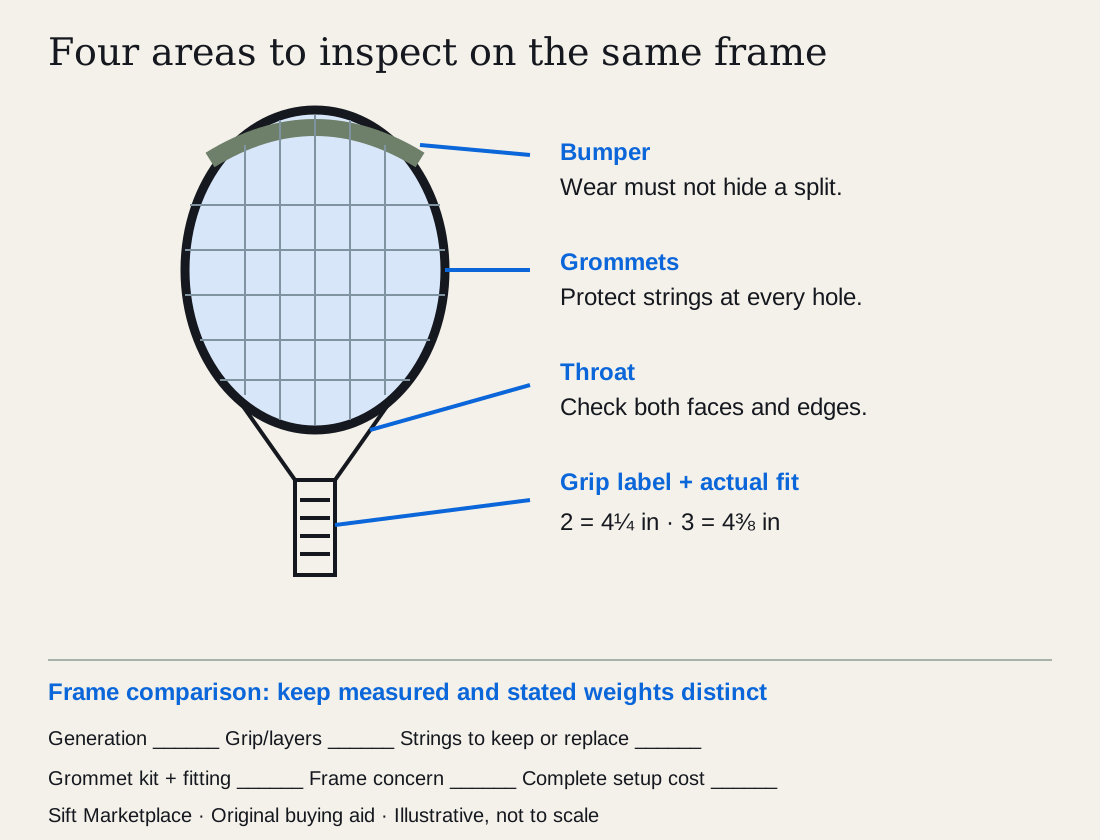
Read the butt-cap label and hold the current grip. An overgrip can disguise the underlying handle. Ask whether the original grip was replaced, extra layers added or the handle modified.
Wilson’s grip-size reference maps size 2 to 4¼ inches and size 3 to 4⅜ inches. These are nominal sizes; your hand and playing preference decide comfort. Try several normal grips rather than squeezing once.
If it is too large, do not assume a shop can make it smaller. Replaceable pallets and conversion options depend on the model. A small fit adjustment may be practical; buying the wrong size and hoping is different.
Inspect the frame before the strings
- Look in good light. Rotate the frame slowly. Ask permission before removing any grip or accessory.
- Check the top bumper. Look for wear through to the frame, lifted sections and damage hidden under tape.
- Follow the hoop. Inspect inner and outer faces around grommet holes. Pay attention to a line continuing across faces or showing separated edges.
- Check the throat. Examine both faces and inside edges. An outside photograph can miss damage here.
- Inspect grommets. Missing or split sleeves can leave strings contacting the frame. Confirm replacement availability for this generation.
- Move it gently. Notice a loose butt cap or unexplained rattle. Ask about added weight, replacement parts and repairs.
Do not flex the frame hard, strike it against your hand or remove the bumper to prove it is sound. A suspected crack calls for a stringer or racquet technician. A frame can hit a ball while having damage you would not knowingly buy.
| Finding | How to treat it |
|---|---|
| Cosmetic scuffs, intact frame | Compare similarly worn examples |
| Worn grip | Budget the replacement you prefer |
| Unknown strings | Allow for restringing |
| Damaged grommets, available kit | Add parts and fitting |
| Suspected frame crack | Pause for assessment or pass |
| Unexplained weight changes | Establish what changed and whether it suits you |
A hitting session answers a different question
If a safe court session is practical, use it to judge comfort and playability. It does not replace inspection. The seller’s strings may make a suitable frame feel unusually stiff, lively or dead.
Ask for string make, gauge, installation date and tension if known. Do not rely on a string-bed tap to recover an exact installation tension. If you already know the setup you prefer, price the racquet assuming you will install it.
For a pair, compare full labels and grip sizes separately. Matching paint can conceal different versions. Previous modifications can make otherwise identical frames feel different. A buyer needing a matched competition pair may want a shop to measure weight, balance and swingweight.
Compare two frames with a completed setup record
A specification sheet helps prevent a familiar paint scheme from becoming the deciding factor. Copy the markings from each actual racquet, then record the state in which you tried it.
| Field | Record |
|---|---|
| Identity | Full model, generation, length and string pattern |
| Handle | Butt-cap size, current grip layers and any modification |
| Weight evidence | Manufacturer’s unstrung figure or a measured strung figure, clearly labeled |
| Condition | Hoop/throat findings, bumper wear and exact grommet-kit availability |
| Current strings | Type, gauge, installation information and whether you would keep them |
| Intended setup | Your chosen grip, strings, fitting labor and collection cost |
Suppose a frame is $65 but needs $45 stringing, $10 grip and a confirmed $25 grommet installation: $145, before collection. A $95 alternative with suitable intact grommets still needs the same $45 stringing and $10 grip, totaling $150. The first saves only $5. These are hypothetical figures. A suspected crack on the first frame would outweigh that small saving; a documented cosmetic scuff may not.
For a matched pair, repeat the record for both frames. Ask a racquet technician to assess relevant measurements if matching is important to your play. Do not assume identical retail specifications or matching paint establish identical current balance after years of grip changes and added weight.
Wilson’s grip guide is a starting reference, not a reason to buy a handle that feels wrong. A seller message can be precise: “Please show both throat specification panels and the butt cap, and confirm added weight or handle changes. I will price my own string setup; could you show the bumper and any suspicious marks close up?”
Compare the same useful specification
Begin with the current new price or remaining stock for the exact version where available. Compare used examples with the same grip size, generation and condition. Asking prices show expectations; they do not establish what another buyer paid.
Add a grip, grommets, stringing and travel before deciding whether the saving matters. The used buying cost calculator keeps those costs visible. Avoid a universal percentage discount: a worn grip and a questionable frame are different conditions.
Keep a short candidate record: full model, grip, frame findings, string allowance and total. If you cannot resolve a photograph of a suspicious mark, put “needs inspection” in the record rather than calling it cosmetic.
Search with and without the grip number. Sellers often omit specifications from titles. Sift runs on a computer and can track prices it sees while you compare. Keep your specifications beside the shortlist so a price drop does not distract from a fit problem.
Questions people ask
Are paint chips on a racquet a problem?
A paint chip can be cosmetic, but photographs may not show whether damage continues into the frame. Inspect the head, throat and grommet holes. A suspected structural crack needs a knowledgeable assessment, not an assurance that it still plays.
Can I change the grip size?
You can sometimes build a grip up, but reducing it or changing a handle pallet depends on the model. Do not buy an oversized handle assuming it is easy to make smaller. Try the grip before committing.
Are recent strings worth paying extra for?
Only if their type, tension, age and use suit you. The seller’s preferred setup may be wrong for you. If the details are unknown, compare it as a frame and budget your own stringing.