What should you check on a used table tennis table?
Quick answer
Identify whether the table is built for indoor or outdoor use, then inspect the playing surface, folding locks, legs and wheels. Test bounce at several positions with the same ball and check both halves are supported correctly. Measure the open table, folded storage footprint and transport route; a table that fits the room may still be impossible to move there.
Decide where the table will live
Indoor and outdoor tables are different constructions. Do not treat an indoor model with a cover as an outdoor table. Cornilleau’s guidance distinguishes the materials and environments they are designed for.
Ask for exact model, label and photographs of the top, underside and folded frame. Establish whether it has lived in a damp garage, shed or exposed patio. Cornilleau’s care guidance explains that moisture can damage indoor panels and alter their flatness.
Measure your usable playing area, not merely the table footprint. Leave space for the way you expect to play and check doors, stored furniture and overhead obstacles. A practice corner and a room for active doubles need different space.
 Enlarge diagram
Measure storage and transport before visiting
Ask for folded dimensions, weight and whether the halves separate under the manufacturer’s instructions. Some designs move as one assembly; others have independently mobile halves. Do not assume you can dismantle the frame easily.
Measure vehicle opening, stairs, corridor turns and the destination doorway. Include the people and equipment needed to control the load. A table on casters is not automatically safe to roll down a slope or across rough ground.
Get a moving quote if the route is difficult. A free table with a damaged top or expensive stair carry may cost more than a sound local option.
Inspect the playing surfaces
- View each top from a low angle. Look for waves, swelling, lifted edges and damage around screws.
- Check corners and centre edges. Impacts here can split or separate the panel.
- Inspect the underside. Look for damp staining, loose brackets, missing fasteners and makeshift reinforcement.
- Set it up as instructed. Make sure the frame and feet are in their intended positions before judging level.
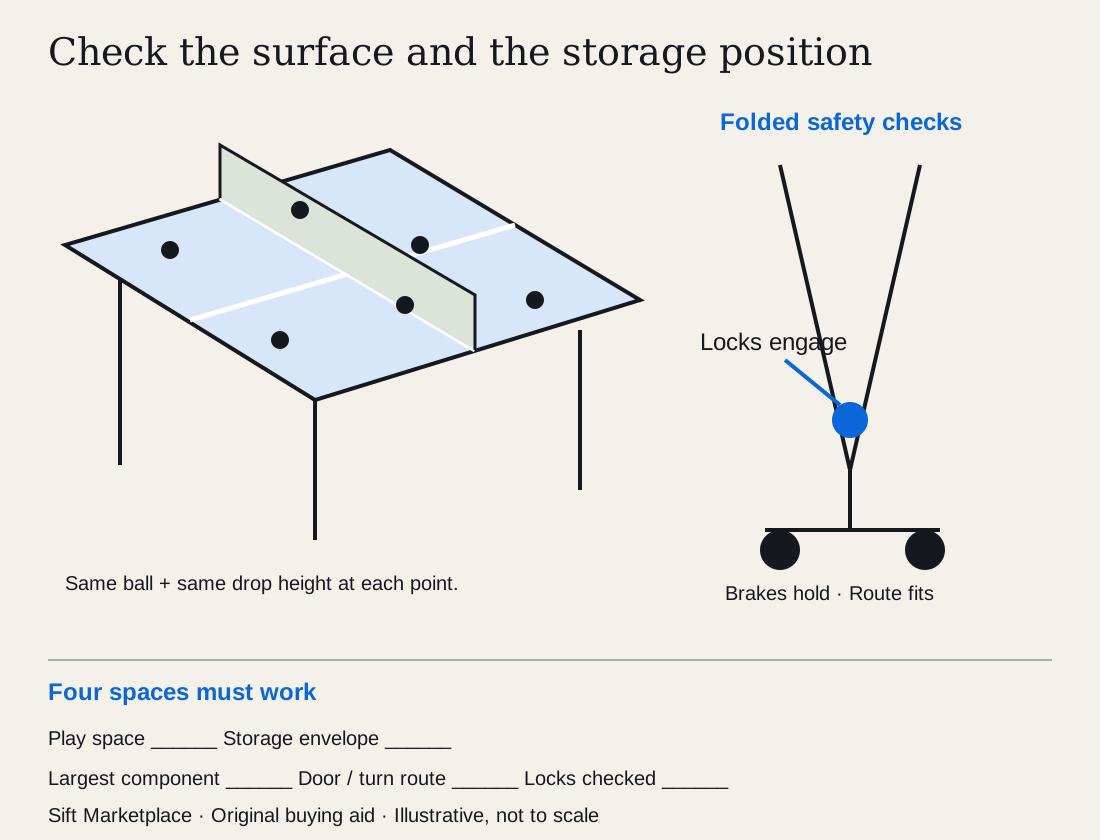
- Compare bounce. Drop the same suitable ball from the same modest height at several locations. Listen and watch for marked differences.
- Inspect the net mounting. Check posts, clamps and adjustment parts without overtightening them.
The bounce check is a comparison, not a laboratory certification. A different ball or drop height can mislead. A consistent dead area or visible swelling is more meaningful than a small difference in your hand drop.
| Finding | What to establish |
|---|---|
| Table rocks on an uneven floor | Whether normal foot adjustment resolves it |
| Swollen panel edge | Material damage, not merely levelling |
| Loose net | Correct clamp and tension components |
| Markedly uneven bounce | Surface or support problem requiring investigation |
| Missing folding latch | Correct safety replacement before use |
| Damaged caster mount | Whether the frame can be repaired properly |
Test folding locks and wheel brakes
Read the model’s folding instructions and have the seller demonstrate. Keep children clear and fingers away from pinch points. Do not release a large panel without knowing how it is supported.
Cornilleau’s safety information treats locking and rolling stability as separate concerns. Check every latch in both playing and storage positions where the design provides them. A panel that stays up only because it leans against a wall is not a functioning storage lock.
Operate wheel brakes and check caster attachment. Move the folded table only as the manual permits. If it feels unstable or a lock fails, stop the demonstration and resolve the fault before transport.
Check what you can actually replace
Nets and some wheel or latch parts may be available by model. A damaged full playing panel can be a very different expense. Ask the manufacturer for current part availability before assuming a repair is simple.
Do not plan to sand, paint or coat a playing surface as a routine buying fix. That can change bounce and friction. For a casual project you may accept that outcome, but compare it as a project rather than as a sound playing table.
Count all braces, net components and adjustment feet. Loose bags of bolts need identification against the manual, not a promise that “everything should be there.”
Compare the installed total
Keep four measurements together: playing footprint, ordinary space around it, folded/storage envelope and the largest transport component. Mark doors, steps and tight turns on the collection route. A folding table may fit the room but fail at a narrow doorway; do not dismantle safety mechanisms merely to make it pass.
Record whether it is an indoor or outdoor model, the condition of both playing halves, and whether the seller demonstrated every required lock and brake normally. Cornilleau’s FAQ distinguishes product care and use; use your actual model’s instructions rather than assuming a cover makes any indoor table suitable for damp storage.
For illustration, a $100 table with $45 confirmed net/parts and $120 transport totals $265. A complete suitable table at $180 with $60 collection totals $240. These invented figures assume sound surfaces and mechanisms; an unassessed swollen panel is not resolved by buying a net.
Use the cost calculator for actual parts and moving quotes. Ask: “Could you show both surfaces and all folding locks, confirm the model and send folded dimensions? I need to verify the route before arranging pickup.” Search “table tennis” and “ping pong,” then compare complete usable tables rather than tabletop thickness alone.
Questions people ask
Can I keep an indoor table in a garage?
Only if the environment meets its storage instructions. Cornilleau warns that indoor surfaces are vulnerable to dampness and unsuitable conditions. An unheated or damp garage is not automatically safe just because it has a roof.
Can a warped top be fixed by levelling the legs?
Levelling can address an uneven floor or frame position, but it does not restore a swollen or warped panel. Check the surface independently. Do not buy a damaged top on the assumption that adjusting feet will cure it.
Does a table need brakes and folding locks?
Follow the safety design and manual for the model. Where brakes and locks are provided, they must function as intended. Missing or defeated safety parts should be resolved before moving, storing or using the table.
Sources
- 01Cornilleau Frequently asked questions
- 02Cornilleau Ping-pong table safety
- 03Cornilleau Table maintenance and protection