How do you buy a used pool table that fits your room?
Quick answer
Measure the playing surface and cue space before inspecting the table. Check rails, cushions, pockets, frame and visible bed condition, then get a professional quote for dismantling, moving, setup and any cloth work. A low asking price can be a poor deal once installation is included. Do not plan to move a slate table intact.
Measure the room before contacting sellers
Measure the usable room at cue height, including columns, furniture, stairs and door swings. A table can fit physically while leaving several shots awkward or impossible.
Ask for the actual playing-surface dimensions and outside dimensions. A nominal “eight-foot” description is not enough to plan a room or a move. Choose the cue length you expect to use and mark the playing surface on the floor with removable tape.
Brunswick’s room guide bases planning on playing area and cue length. Use your actual measurements and a physical cue-position check rather than treating a single room-size label as a guarantee.
 Enlarge diagram
Use a cue-envelope calculation, then check the awkward shots
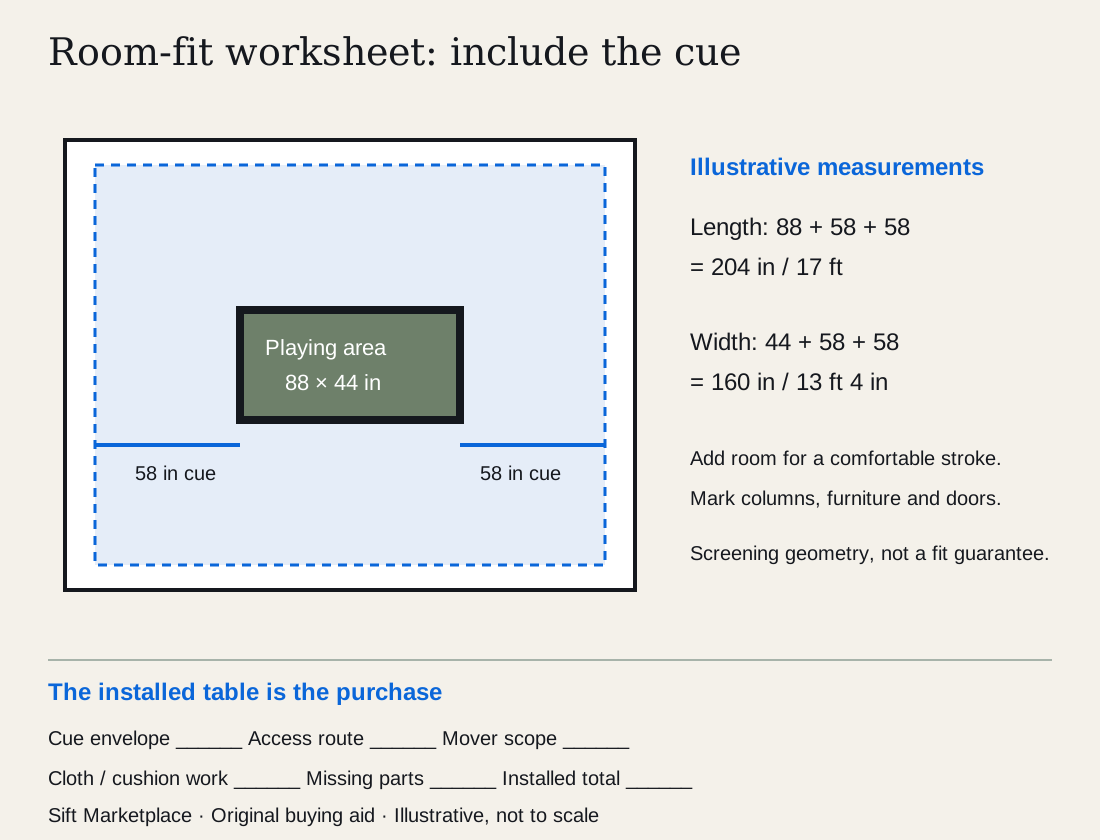
The worksheet’s example starts with a 44 by 88 inch playing surface. Adding 58 inches on each side gives 160 by 204 inches, or 13 feet 4 inches by 17 feet. These are illustrative inputs, not dimensions for every eight-foot table.
That envelope is an initial screen. Add comfortable room for a stroke and movement, and test positions near walls or columns with the actual cue. A short cue can address a specific obstruction but changes the experience; decide whether that compromise is acceptable.
Remember light fixtures, seating and cue storage. A narrow spot behind a column may be more frustrating than a uniformly small room because it interferes with only certain shots.
Identify the table and its construction
Ask for manufacturer, model, approximate age, playing surface and whether the bed is slate or another material. If slate, ask whether it is one piece or sectional and whether there is documentation or a mover familiar with it.
Request pictures of the frame, legs, underside, pockets and rails. Ask about previous moves, water exposure, cloth replacement and cushion work. A recent cloth job can improve appearance without proving the condition underneath.
For a valuable table, arrange assessment by a pool-table technician. Do not remove rails or cloth at a casual viewing. Hidden slate damage and setup quality may require expertise.
Inspect the playing experience
- Look at the frame and legs. Check cracks, loose joints, distorted supports and water damage.
- Examine the cloth. Note tears, heavy wear, stains and loose areas. Ask whether cloth reuse is realistic during the move.
- Check pockets and rail hardware. Look for broken attachments, sharp damage and missing parts.
- Compare cushion response. Roll a suitable ball gently into different cushion sections. Mark sections with noticeably different response for assessment.
- Roll several paths. Use a clean, sound ball. A drift is a symptom to investigate, not a diagnosis of warped slate.
- Check the accessories. Count usable cues, balls, rack and cover separately from the table.
Do not stand, sit or place heavy objects on the table to test its strength. Ordinary play and visual inspection are enough for a buyer’s first pass.
| Finding | Who or what resolves it |
|---|---|
| Worn cloth | Installer’s cloth and fitting quote |
| Inconsistent cushions | Technician assessment and rail-work quote |
| Uneven roll | Setup and bed inspection |
| Damaged pocket | Model-compatible replacement availability |
| Cracked frame or suspected slate damage | Specialist evaluation before purchase |
| Difficult stairs or tight turns | Mover’s route survey |
Obtain the move quote before making the offer
Give a professional mover the model, photos, both addresses’ access details, stairs and any parking constraints. Ask what the quote includes: dismantling, protection, transport, reassembly, levelling, cloth and follow-up adjustment.
Do not assume an ordinary furniture mover handles slate-table setup. A cheap collection-only listing transfers a substantial job to the buyer. Confirm responsibilities if parts are missing or existing damage becomes visible during dismantling.
Keep the seller’s deadline separate from your inspection needs. If removal is urgent, the table may simply be unsuitable for your available moving arrangements.
Compare the installed price
Put the room drawing, table identity and professional moving/setup quote beside one another. Brunswick’s room guide helps assess cue space; the table still needs a workable route and a competent installation plan. Check awkward shots near columns or furniture with a cue-sized object before committing.
Ask the mover to itemize what is included and what may change after dismantling: cloth, cushions, slate condition, missing hardware, stairs, reassembly and levelling. A collection-only price transfers these responsibilities to you. An ordinary furniture-move quote is not necessarily a slate-table setup quote.
In an invented comparison, Table A is free but needs $650 moving/setup, $320 cloth and $140 confirmed parts: $1,110. Table B costs $400 with $650 moving/setup and no quoted additional work: $1,050. Unknown structural or slate damage remains unresolved in both. Compare against a dealer’s stated installed package using the same included services.
Use the cost calculator and preserve the mover’s access assumptions in the listing comparison tool. Ask: “May my table mover assess the construction, access and required work before I commit?” A removal deadline that prevents assessment can make an attractive table unsuitable.
Questions people ask
How much room does an eight-foot pool table need?
Measure the actual playing surface and your cue length. As a screening example, a 44 by 88 inch surface plus a 58 inch cue on each side gives 160 by 204 inches, or 13 feet 4 inches by 17 feet. Add comfortable stroke and movement space and check obstructions; this is not a universal installation minimum.
Can I move a slate pool table without dismantling it?
Do not assume that is safe for the table or movers. Ask a qualified pool-table mover to plan the job for the exact model and route. Slate sections, rails, cloth and frame may need separate handling and professional reassembly.
Does a rolling ball prove the table is level and sound?
No. Ball condition, cloth, dirt, floor level and setup can affect a roll. Compare several paths and seek a technician’s assessment if the table’s value depends on bed condition. A simple roll test cannot inspect hidden slate or frame damage.
Sources
- 01Brunswick Billiards Pool table room-size guide