How do you check whether a used board game is complete?
Quick answer
Identify the exact edition, download its publisher’s component list and count pieces by function. Confirm whether the box is standalone or an expansion. For campaign and legacy games, check what has been written on, opened, removed or permanently changed. A full-looking box and an untouched rulebook do not establish a complete, replayable game.
Identify the box before counting it
Ask for photographs of the front, back and edition information. Record title, publisher, language and printing where it matters. A revised edition can change counts, artwork or expansion compatibility.
Establish what is included: base game, expansion, extension, standalone sequel or bundle. These labels are not interchangeable. The CATAN rulebook library separates editions and expansions. Its 5–6 player extension instructions require components from the base game.
Use the publisher document for the actual box. An inventory for a newer version can incorrectly make an older complete set look incomplete, or overlook a component the newer version requires.
 Enlarge diagram
Ask for an inventory you can verify
Try: “Could you lay out the cards, player pieces and shared components separately, and tell me if anything is missing or substituted?” Add a campaign-specific question where relevant.
For a modest game, a photograph and a short count at pickup may be enough. For a large or expensive game, agree on inspection time. A seller need not spend an evening opening every deck for an uncertain visitor, but you need not pay complete-copy money for an uncounted box.
Ask about smoke, damp storage and spills. Smell and sticky surfaces are hard to judge online. Neat bags help organisation; they do not prove everything is original or undamaged.
Count in a useful order
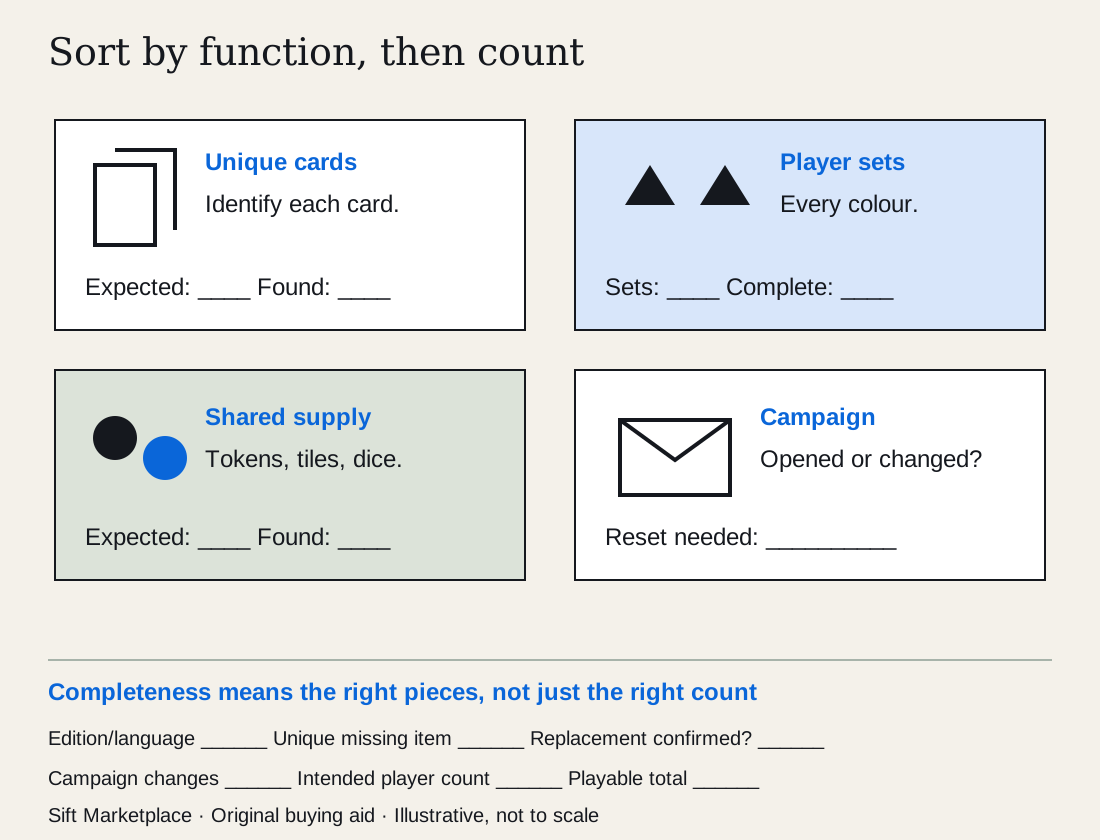
- Read the component list. Make expected-versus-found notes for this edition.
- Check unique pieces. Identify named cards, numbered tiles, hidden-role pieces and special dice. A duplicate does not replace a different missing card.
- Build player sets. Lay out one colour at a time. Mixed expansion pieces can make a colour look complete when it is not.
- Count shared supplies. Group ordinary tokens into manageable piles and note substitutions.
- Inspect boards and screens. Open folds gently. Look for separated hinges, warping and hidden information visible through damage.
- Check scenario material. A downloadable rulebook may solve missing instructions, but not missing game cards or campaign sheets.
Do not open sealed mystery envelopes simply to inspect them. Follow publisher inventory guidance and agree what “unplayed” means without spoiling content.
| Item | Practical question | Decision |
|---|---|---|
| Ordinary scoring marker | Can a substitute preserve play? | May be acceptable if disclosed |
| Unique card | Does the correct replacement exist? | Confirm before paying for completeness |
| Rulebook | Is an official digital copy available? | Often easier to resolve |
| Hidden-role piece | Would a substitute look or feel different? | It may compromise secrecy |
| Expansion board | Can remaining content work without it? | Price only usable content |
| Campaign sticker sheet | Has it been consumed? | Check reset requirements |
Campaign and app-dependent games need another pass
For a campaign game, ask how many sessions were played and what was recorded. Look for marked maps, removed cards, used stickers and opened packs. A campaign that restarts from saved notes differs from a legacy design based on permanent changes.
If an official reset pack exists, check availability and what it replaces. “You can print the missing pieces” is not the same as an available authorised solution. Price the box for the experience you can actually have.
For a required app, check that the official app works on your device and needed content is available through your own account. Do not value the seller’s account or phone as part of the deal. Confirm language support and internet requirements for your intended use.
If you are buying for a group, confirm player count, playtime expectations and reading needs too. An intact game can still be the wrong purchase if it requires more players than you can gather or an expansion your group does not own.
Use an edition-by-component mismatch sheet
Do not stop counting when the total matches the rulebook. In a hypothetical game, a set of 30 numbered cards can still be incomplete if card 12 appears twice and card 18 is absent. That matters more than a missing generic cube if the missing card controls a scenario.
| Component group | Expected in this edition | Found | Decision |
|---|---|---|---|
| Numbered cards | One of each required number | Duplicate 12, missing 18 | Find the exact authorized replacement before calling the game complete |
| Player pieces | Full sets for the intended player count | One colour incomplete | Determine whether your group can play the supported smaller count |
| Rulebook | Correct edition and language | Missing | Use an official copy if available |
| Campaign content | Starting state or documented reset | Stickers already used | Verify an official reset option or buy as an in-progress campaign |
This is an invented inventory example, not a component list for CATAN or another named game. Use the actual publisher’s list, such as CATAN’s edition-specific rule library, for the box in front of you.
A hypothetical $25 copy plus $12 confirmed replacement parts and $8 shipping totals $45. A complete local copy at $40 may be the better playable purchase. If the unique missing card cannot be obtained, the $12 placeholder is invalid; do not treat the first box as complete just because you would like it to be repairable.
Agree on a non-spoiling inventory for sealed campaign content. Ask which envelopes were opened and which permanent changes were made, without reading hidden story material merely to prove it exists. The inventory should preserve the experience the buyer actually wants.
Compare playable copies
Start with the current cost of the exact playable package. Add official replacements, shipping and required expansions. An elaborate organiser does not compensate for missing cards.
A battered box may be fine for family game night and unsuitable for an edition collector. Decide which purchase you are making. In a bundle, list the games you want and give unidentified extras no assumed value.
Use the listing comparison tool to separate edition, completeness and permanent changes. Check the fair-price guide when asking prices vary widely.
Search the title with and without subtitles. Sift’s Marketplace filters reduce unwanted terms on a computer while you watch local listings. Keep your inventory with the shortlist so the next promising box is quick to assess.
Questions people ask
Is a missing piece always a reason to pass?
No. An ordinary scoring marker may have a useful substitute, while a unique card, hidden-role token or scenario page can affect play. Identify what is missing and whether the correct replacement exists before buying.
Can I buy a used legacy game?
Check how far it was played and what changed. Stickers, written sheets, opened envelopes and destroyed cards can prevent a fresh campaign. Some games have official reset options; verify the exact product.
Are expansions playable alone?
Some are standalone, but many require a base game and may need a particular edition. Read the publisher’s requirements. A cheap expansion is not a complete game unless all required content is included.
Sources
- 01CATAN Game rules
- 02CATAN 5–6 player extension rules