How do you buy the right used textbook for your course?
Quick answer
Match the book to your course’s ISBN, edition and format before comparing prices. Ask whether graded work requires a separate online platform, then budget access independently unless the publisher confirms it is usable. Check the title page, copyright page and exercises; a similar cover does not guarantee the same content or assignment numbering.
Get the current course requirement first
Use your instructor’s syllabus or the official course-material list. Record title, author, edition, ISBN and whether the book is required or recommended. Check the section as well as course number; instructors may choose different materials.
Find out whether assessed work happens in a publisher platform. A printed book can provide the reading while providing none of the access needed to submit assignments. Conversely, a digital package may include the reading material already, making print optional.
Ask: “Will this exact edition and format work, and do I need separate online access?” Resolve that before pickup. A seller’s experience in last year’s course is useful context, not approval for your course.
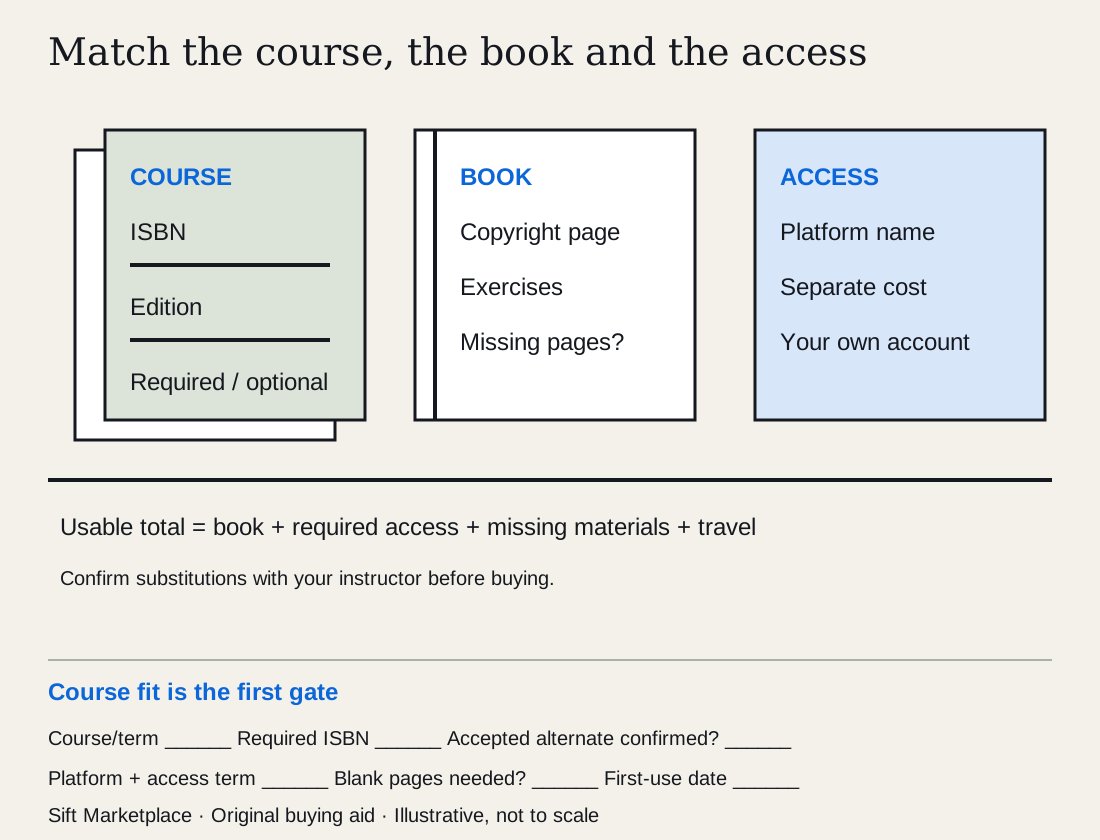 Enlarge diagram
Which photographs establish the edition?
Request the title page, copyright page, back-cover ISBN and representative pages. A stock cover image cannot establish the edition or condition being sold.
Check whether it is a standard student, international, instructor, custom campus or loose-leaf edition. Do not assume interchangeability. A custom edition can omit chapters; loose-leaf copies need a complete page set and a suitable binder.
Distinguish the ISBN on the book from any outer bundle identifier. The listing may describe a package that once included access or a workbook. Ask which items remain, and match them against the course requirement.
Treat online access as a separate purchase
Pearson’s Pearson+ support page says its eTextbook codes redeem once and cannot be shared between students. That is a specific product rule, not proof that every publisher resource works identically.
Elsevier’s used-book guidance distinguishes resources requiring codes from those that do not. Check the instructions for the exact title and platform.
Do not pay extra for “code included” without establishing what it unlocks and whether it remains usable. An unscratched panel is stronger evidence than a loose code, but the platform must still match. Avoid the seller’s login; you need access through your own account under the publisher’s rules.
| Listing | Confirm | Potential extra cost |
|---|---|---|
| Current printed edition | Correct ISBN and complete pages | Required digital access |
| Earlier edition | Instructor accepts it | Agreed supplementary material |
| Loose-leaf copy | All pages and sections present | Binder |
| Book with code | Platform, usability and access term | New access if uncertain |
| Custom campus edition | Current course match | Missing material if a substitute is permitted |
Make a course-to-copy decision sheet
Copy the requirement from the current syllabus or instructor confirmation before messaging. Then compare the actual book and any separate digital requirement on different lines. “Same author” and “used last semester” do not establish that your course accepts it.
| Requirement | Evidence from the course | Evidence from the seller |
|---|---|---|
| Printed text | Title, edition and ISBN or explicitly accepted alternative | Copyright/ISBN photographs from the actual copy |
| Custom content | Campus/course edition and required chapters | Contents pages and completeness |
| Online work | Platform, course enrollment and required access term | Exact code product, if offered; never the seller’s login |
| Workbook/lab use | Whether blank response pages are needed | Representative pages and missing-sheet check |
| Deadline | First required use | Collection or arrival date |
If an earlier edition is proposed, ask the instructor a specific question: “Will ISBN [number] satisfy the readings and assigned problems for [course and term], and is separate [platform] access required?” Get the answer before negotiating. A low book price cannot settle a course-compatibility question.
Elsevier’s used-book guidance distinguishes resources that require a code from those with other registration instructions. Identify the exact resource rather than assuming all digital extras are either free or unusable. If a required code’s usability is uncertain, compare the book with the cost of new authorized access and decide whether you still want it.
For a hypothetical two-book bundle, the correct textbook at $30 may be useful while a previous-term workbook with completed answer pages adds no value to your course. Do not divide the bundle price evenly and call both discounted. Offer around the materials you can actually use, or confirm whether the seller will separate them.
Inspect the pages that study depends on
- Match identifiers. Compare your course notes with the actual title and copyright pages.
- Check binding. Open gently in several places. Look for loose sections, detached covers and pages separating near the spine.
- Inspect exercises. Check representative assigned chapters, problem sets, diagrams and appendices.
- Look for missing material. Workbooks may have completed or removed sheets. Loose-leaf copies need a deliberate section check.
- Assess annotations. Highlighting may be harmless; heavy ink over diagrams or answers throughout a practice book may reduce usefulness.
- Check damp and odour. Warped pages, stuck sheets and a musty smell deserve more attention than a description of “normal wear.”
Blank response areas matter in a language workbook or lab manual. Fold-outs and diagrams matter in an atlas or technical reference. Inspect according to how your course uses the book, not just whether the spine looks tidy.
Work out the real saving
Compare the used book plus required access with the complete current package, legitimate rental options and library access. Include shipping or travel and the date material is needed. A cheap copy arriving after the first assignments is a different offer.
Here is an illustrative calculation, not market pricing: Copy A costs 35 and needs access costing 80. Copy B is a permitted complete package at 100. Copy A totals 115 before travel. Use your own quotes in the used buying cost calculator.
If resale matters, treat it as uncertain. Another edition may appear, your course may change materials, or your copy may suffer wear. Do not subtract hoped-for resale proceeds from the cash you need now.
Keep proof of the edition you agreed to buy and inspect before payment. For a bulk set, match each title individually; one correct textbook does not establish that the rest belong to your course.
Search broadly, verify narrowly
Try title, author and edition as well as ISBN. Sellers may mistype or omit identifiers. The Marketplace search guide helps broaden a query without losing the requirement.
Sift can filter unwanted terms and watch local searches in Chrome, Edge and Brave on a computer. Keep the course requirement beside your shortlist: search filters cannot establish that a code is unused or an instructor accepts an older edition.
Questions people ask
Is an older edition good enough?
Only if your instructor confirms it works for this course. Chapters, page references, exercises and online assignments may differ. Ask about the exact edition rather than relying on someone who took another section or an earlier year.
Can I use a second-hand book’s access code?
It depends on the product, but many codes are single-use. Pearson says Pearson+ eTextbook codes redeem once and cannot be shared. Check the course platform separately; a printed code inside a used book may already be consumed.
Does the ISBN prove the package is complete?
No. A bundle’s outer ISBN may refer to a book plus access, while only the book remains. Match the physical book and required digital component separately, and ask what the seller is actually providing.
Sources
- 01Pearson Pearson+ eTextbook support
- 02Elsevier Can I access resources from used books?