How do you inspect and price used comic books?
Quick answer
Identify the exact title, issue, printing and variant before judging a comic’s price. Inspect the cover, spine, staples and interior completeness with careful handling. Separate a seller’s grade estimate from independent certification, and compare copies with similar condition and restoration status. A sharp cover does not prove every page is present or the book is unrestored.
Identify the exact comic, not the familiar character
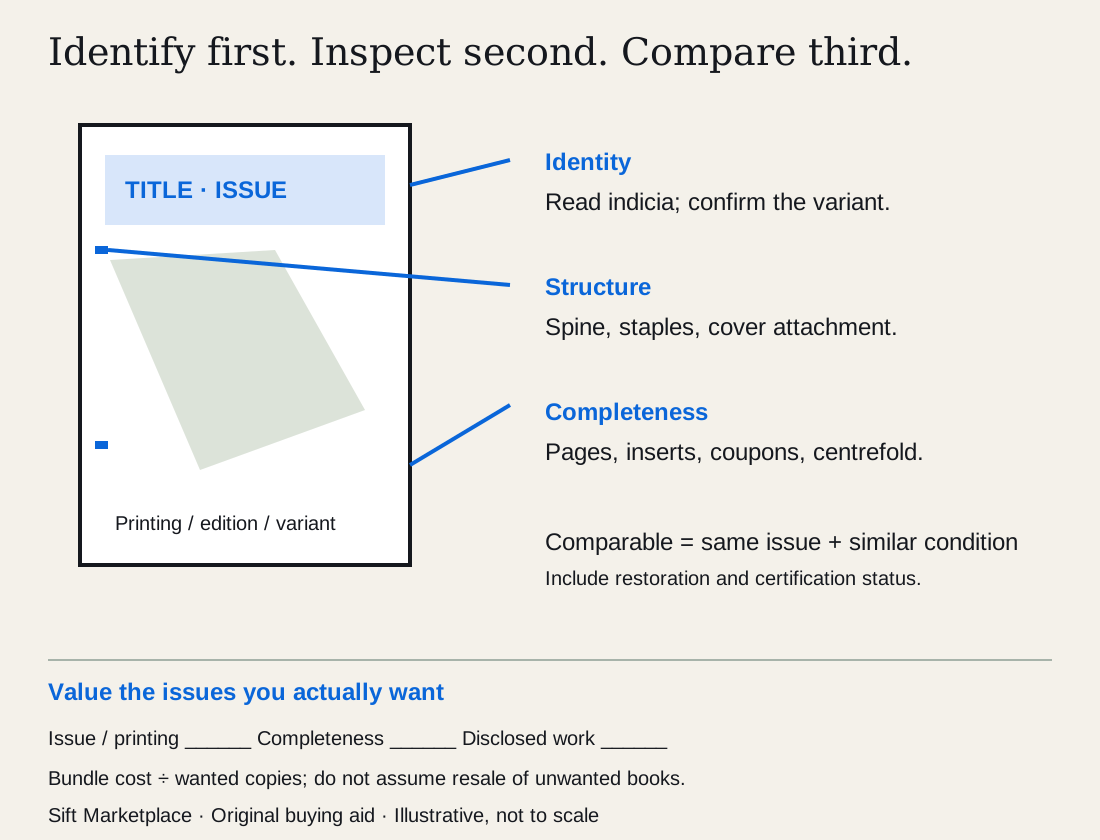
Write down the title, volume or series, issue number, publication date, printing and cover variant. Reprints and facsimile editions can resemble older originals, and a character’s first appearance in one series is not the same item as a later reprint.
Ask for the indicia, the publication information usually printed inside the book, as well as front and back covers. For a variant, confirm the identifying details rather than relying on the listing title. Record language and format too: a collected edition is a different purchase from individual issues.
If the seller cannot identify an expensive book clearly, postpone valuation. You do not need to solve every specialist variant question at the meeting.
 Enlarge diagram
Decide whether you want reading copies or collectible copies
For reading, complete pages, legible printing and an intact enough binding may matter more than minor cover wear. For collecting, small defects, variant identity and disclosed restoration can have a larger effect.
Use CGC’s grading scales to understand the vocabulary, not to award yourself an expert grade from a glance. Page quality, structural condition and cover appearance are related but separate observations.
A seller’s “near mint” or numeric grade is a claim to evaluate. Do not convert it into a confirmed grade in your price notes. Record visible defects in ordinary language: corner crease, spine wear, detached centrefold, staining or missing coupon.
Inspect carefully, with the seller’s permission
Use clean, dry hands and a clean surface. Support the comic rather than forcing it flat, and avoid touching printed areas unnecessarily. If the seller prefers to turn pages, ask them to show the relevant sections.
- Examine both covers. Look for creases, tears, fading, writing, missing pieces and staining.
- Follow the spine. Check splits, rolled alignment, colour-breaking marks and staple areas.
- Inspect attachment. Check whether cover and centrefold remain attached without pulling on them.
- Check completeness. Look for missing pages, cut coupons, removed inserts and interrupted story content.
- Look at the paper. Notice brittleness, moisture damage and odour. Do not bend a corner to test how brittle it is.
- Ask about work done. Record pressing, cleaning, repairs and any known restoration.
Avoid erasers, cleaning fluids, tape removal or attempts to expose hidden restoration during a buying appointment. Valuable or uncertain books deserve specialist assessment.
| Finding | Compare with |
|---|---|
| Complete reading copy with visible wear | Similar complete lower-condition copies |
| Missing coupon or page | Incomplete copies, with the missing content disclosed |
| Suspected colour touch or trimming | Specialist-assessed examples with comparable status |
| Independent graded copy | Same issue, grade, label notes and page quality where relevant |
| Different printing or facsimile | That printing, not the original |
| Seller-assigned grade only | Raw copies with observed condition, allowing uncertainty |
Ask what “restored” or “cleaned” means
CGC’s restoration guidance distinguishes non-additive pressing and dry cleaning from restoration that adds material or changes the book. Trimming and colour touch are not equivalent to ordinary handling wear.
Do not assume you can detect all restoration from photos. A very neat edge, unusual colour or repair may raise a question without proving anything. Ask for disclosure and use a qualified service when the value justifies it.
For encapsulated books, read the entire label and compare the certification details with the grading company’s official record. Inspect the holder for damage or inconsistency. A matching number is useful evidence, not a reason to ignore a suspicious holder or mismatched book.
Build comparisons issue by issue
Create one row per comic you actually want: title/series, issue, printing/variant, language, raw or certified status, completeness, visible defects and disclosed work. A price comparison is useful only after those details match closely enough. Record a seller’s grade as a claim, not a confirmed finding.
An expensive disputed variant, possible trimming or unclear restoration warrants specialist review before assigning collector value.
In a hypothetical bundle, 40 books cost $120, but only 12 are issues you want. If you conservatively assign no recovery value to the unwanted books, the acquisition cost is $10 per wanted book before travel or supplies. A second set of those 12 desired issues at $90 plus $10 collection is $100, or about $8.33 each. Those are invented purchase comparisons, not market prices, and different completeness or restoration can invalidate the comparison.
Do not assume you will resell the unwanted books at the seller’s individual asking prices. Deduct a resale value only when you have a defensible basis and account for the work and uncertainty. For an ordinary reading purchase, a complete matching collected edition may solve the task more simply than an incomplete run with an expensive missing issue.
Use the listing comparison tool to keep exact edition and condition notes beside each candidate, and the fair-price guide to distinguish asking evidence from completed sales. Ask: “Could you send the indicia, front/back and disclosed defects or restoration for these specific issues? Which inserts or pages are missing?” Handle valuable books only with the seller’s agreement; do not clean or flatten them at the meeting.
Questions people ask
Can I assign a reliable grade from a photo?
Photos can identify visible defects and narrow a shortlist, but they may hide interior damage, missing pages and restoration. Treat a seller’s numeric grade as an opinion unless the copy has appropriate independent certification, and inspect the actual book.
Does pressing mean a comic was restored?
CGC distinguishes non-additive pressing and dry cleaning from restoration. Its restoration guidance includes treatments such as colour touch, trimming and added material. Ask what was done; do not use the word cleaned as if it describes one uniform process.
Are comics in a bundle worth the seller’s total?
Only after identifying the issues you value and their condition. Common duplicates, incomplete books and unwanted titles should not receive assumed collector value. Itemise notable books and price the remainder according to what you actually want.
Sources
- 01CGC Grading scales
- 02CGC Restoration and conservation FAQs