How do you buy a used acoustic piano without a costly surprise?
Quick answer
Have an independent piano technician assess a used acoustic piano before agreeing to buy or move it. Play every key, ask about tuning and storage history, and obtain specialist moving and service quotes. A polished cabinet or a recent tuning does not establish the condition of the action, pinblock, bridges or soundboard. A free piano still has installation costs.
Make the technician part of the purchase
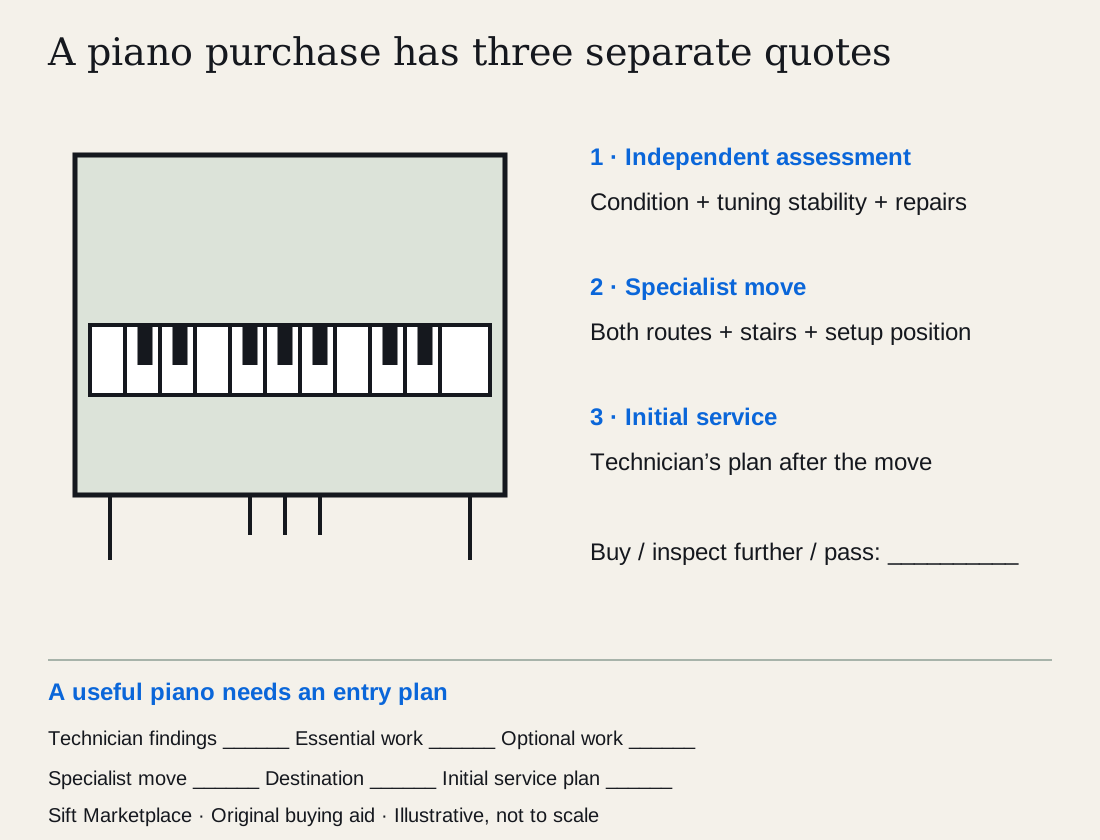
Arrange an independent piano technician before you commit to the instrument or the move. The Piano Technicians Guild recommends an on-site professional evaluation for a private purchase because condition and hidden costs are difficult for a buyer to establish.
Ask the technician for a written assessment covering suitability, tuning stability, action condition and likely work. Agree on the inspection fee and scope. This is separate from the seller’s tuning appointment or a mover’s transport quote.
A competent seller may know their piano well, but their statement that it “only needs tuning” is not a substitute for diagnosis. Keep the purchase conditional on satisfactory assessment if that is your arrangement, and put the terms clearly in writing.
 Enlarge diagram
Identify the instrument and its history
Ask for maker, model and serial number, plus photographs of the whole piano and identifying markings. Use manufacturer resources such as Yamaha’s used-piano guidance to investigate identity and support where relevant.
Ask where it has lived, when it was last tuned and whether there are service records. Basements, garages, long storage periods and past water exposure are useful facts for the technician. Do not turn age alone into a condition grade.
Ask about previous rebuilding, restringing, action work and player-system additions. “Restored” can describe cosmetic refinishing or substantial musical work; obtain the actual work list and provider information.
What can you check yourself?
Your role is to decide whether the instrument interests you and to identify questions for the technician. You do not need to remove panels, move the piano or diagnose internal structures.
- Play every key gently. Listen for missing notes, unusual rattles and keys that return slowly.
- Try soft and louder playing. Notice whether response feels consistent enough for your needs.
- Use the pedals normally. Check for obvious sticking or functions that do not respond.
- Inspect the cabinet. Look for water marks, damage, odour and signs of rough moving.
- Listen to music you know. Tone preference matters once basic condition is satisfactory.
- Write down concerns. Give the technician specific observations rather than guessing their causes.
If you do not play, bring a trusted pianist to judge feel and sound. That person complements the technician; musical preference and mechanical condition are different assessments.
| What you notice | Ask the technician |
|---|---|
| Uneven volume from note to note | Is this regulation, voicing, wear or another issue? |
| Piano is far out of tune | Can it hold the intended pitch and what work is needed? |
| Sticky or noisy keys | What condition is the action in? |
| Visible crack or rust | What is its significance for this instrument? |
| Recent cosmetic restoration | What musical and structural work was done? |
| Player or silent system fitted | Is the additional system supported and functional? |
Ask for a useful condition report
The report should separate essential repairs, routine service and optional improvements. Ask whether the instrument suits the intended player and whether the anticipated work is economically sensible for your purchase.
Do not interpret every visible soundboard line as proof of a ruined piano or every polished surface as proof of health. Pinblock, bridge, soundboard and action questions belong in the professional assessment.
For an imported or unusual model, ask about parts and local service support. Manufacturer identity tools can help with history, but they do not replace examination of the piano in the room.
Get a piano-mover’s quote for both routes
Provide the exact instrument, stairs, turns, doorway dimensions, floor access and parking conditions at collection and destination. Ask what equipment, staffing and insurance arrangements apply to the move.
Choose a specialist piano mover. An upright’s casters are not a general-purpose solution for moving it over thresholds or down stairs. Do not attempt a trial move to see whether it fits.
Decide the destination position before arrival and discuss environmental suitability with the technician. Arrange post-move service according to that professional’s advice rather than assuming a universal waiting period.
Compare total ownership entry cost
Compare the piano that will arrive and be prepared for use: asking price, independent technician assessment, specialist move and the technician’s initial work plan. Keep essential repairs, routine tuning/service and optional improvements in different rows. The Piano Technicians Guild’s buying resources support using qualified help; a seller playing a pleasant piece is not a substitute for the actual condition report.
For a hypothetical example, a free upright needs $140 assessment, $500 specialist moving and $650 confirmed initial work: $1,290. A $700 upright needing $140 assessment, $300 moving and $120 initial service totals $1,260. These invented amounts are not market or service prices. Unassessed major work is not included merely because a tuning allowance has been entered.
Compare dealer offers by the services actually included, and confirm your destination environment and post-move plan with the technician. An old appraisal, age or polished case does not establish current musical condition or collectible value.
Use the cost calculator for confirmed quotes. Ask: “May my technician inspect it, and may a specialist mover assess both access routes before I commit?” Search nearby instruments whose assessment and moving arrangements are feasible, and keep a seller’s urgent removal deadline separate from your ability to complete those checks.
Questions people ask
Is a free piano worth collecting?
Sometimes, but only after condition and moving costs are established. Arrange a technician’s assessment and a piano-mover’s quote first. A free instrument needing major work or a difficult move can cost more than a serviced piano.
Does it only need tuning if every key sounds?
Not necessarily. Keys producing sound do not establish tuning stability, action condition or structural health. Ask a technician to distinguish tuning, regulation, voicing and repair needs before accepting the seller’s diagnosis.
Can I assess a piano from its age and serial number?
Those help identify it, but condition depends heavily on use, environment and maintenance. Have the actual instrument inspected. Serial information cannot tell you whether it will hold tuning or play evenly.
Sources
- 01Piano Technicians Guild Buying a piano
- 02Yamaha Used pianos
- 03Yamaha What to look for when shopping for an acoustic piano