How do you check a used guitar amplifier safely?
Quick answer
Bring a known-working guitar and cable, check the amp’s exact model and power requirements, and listen to every channel and control at sensible volume. Confirm the correct speaker connection before powering a head. Inspect the exterior and service history; leave chassis access, electrical diagnosis and internal repairs to a qualified technician.
Choose the format before the bargain
A small practice combo, a tube combo, a modelling amp and a separate head need different supporting equipment. Decide where you will play, how loud you can be and whether you need headphones, recording output or a particular cabinet.
Ask for the exact model, version, mains-voltage label and serial label. Imported equipment may not match your local supply. A plug adapter does not establish electrical compatibility.
For a head, identify the speaker cabinet, impedance requirements and appropriate speaker cable from the manufacturer’s instructions. Do not power it with an uncertain load or substitute an instrument cable for a required speaker cable. Have the seller arrange a correct working setup.
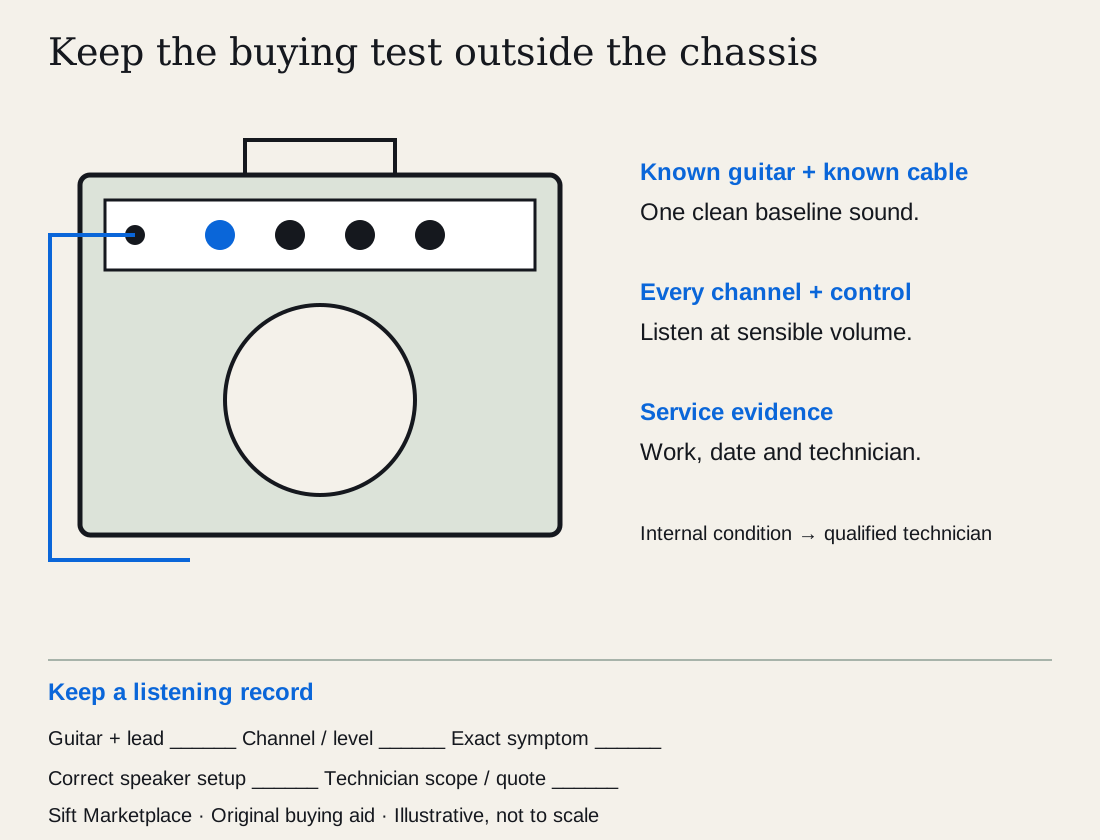 Enlarge diagram
Ask what has been serviced
Request receipts describing repairs, tube replacement, speaker changes and modifications. “Recently retubed” is less informative than a dated record of the work and any checks performed.
Look for repaired cabinet damage, loose handles, missing feet, a damaged power cord or bent jacks. Check whether the speaker and footswitch are original or replacements. A replacement speaker may be useful, but its suitability and condition matter more than a higher retail price.
Use the exact model’s manual for controls and startup. Fender’s Blues Junior IV manual is an example of the operating reference you want available. Do not apply one amp’s standby or speaker instructions to another.
Establish a simple listening baseline
Bring a guitar and cable you know work. Start without pedals so that a noisy battery, patch lead or effect is not mistaken for an amplifier fault. Ask for a space where a reasonable demonstration is possible.
- Inspect before power. Stop if the cord is damaged, the plug is unsafe or the setup has an obvious electrical concern.
- Follow normal startup. Let the seller use the manufacturer’s procedure. Begin with levels low and increase gradually.
- Play a clean reference. Try different notes and dynamics. Listen for rattles, buzzing and unexpected volume changes.
- Test each channel and control. Move knobs through useful ranges at sensible volume. Check switches, reverb and the correct footswitch if included.
- Check the functions you need. Demonstrate headphone, line or USB output only if the model provides them and the necessary equipment is available.
- Play for a short normal session. Note dropouts or changes as it warms. A quick chord does not establish reliable operation over time.
Do not run it at extreme volume, repeatedly strike the cabinet or tap exposed tubes as an improvised diagnosis. Protect hearing and stay within a normal demonstration.
Separate a symptom from a diagnosis
A hum might involve the guitar, cable, power environment or amplifier. Change one known external element at a time with the seller. If the fault persists, keep the cause unresolved until a technician assesses it.
A scratchy knob may need service, but you cannot know the complete repair from the sound alone. Likewise, a speaker rattle can have several causes. Avoid accepting “just a tube” as a firm cost estimate.
Fender’s safety guidance directs internal electronic servicing away from the user. Unplugging does not make opening an amplifier chassis a suitable buying check. Arrange a qualified technician’s inspection for valuable, vintage, modified or questionable equipment.
| Finding | What to do before offering |
|---|---|
| Scuffed covering, sound cabinet | Decide cosmetic value |
| Missing compatible footswitch | Confirm exact model and cost |
| Noisy control | Get a service estimate if it affects use |
| Persistent hum or intermittent output | Treat cause and repair cost as unknown |
| Speaker changed | Verify specification and listen to the result |
| Damaged mains cord or unsafe modification | Do not power it; require professional assessment |
Compare the amplifier you can use
Record the actual listening setup: guitar, known-good lead, speaker/cabinet where applicable, channel, approximate usable level and the symptom observed. A rattle on one note, hiss with gain raised and an intermittent volume drop are different findings. Describe them to a qualified amplifier technician rather than converting them into a tube or speaker diagnosis.
Keep the intended environment in view. A large amplifier that cannot be demonstrated or used at appropriate levels in your home may solve the wrong problem. Confirm which quiet-practice, headphone, recording or effects-loop functions the model actually provides rather than assuming they exist on every amp.
| Evidence | Buying consequence |
|---|---|
| Clean reference and required channels demonstrated | Useful function evidence at those conditions |
| Footswitch-controlled function untested | Keep it unresolved or arrange the correct switch |
| Intermittent output or concerning electrical damage | Qualified assessment before treating it as usable |
| New tubes but no service details | Request what was done; not proof of full service |
| Vintage/originality claim drives price | Obtain specialist evidence beyond ordinary playing condition |
In a hypothetical comparison, a $240 head needs a $170 compatible cabinet, $30 correct cable and $90 accepted service: $530. A suitable $430 combo needing $40 collection totals $470. Actual sound, condition and use still matter; these invented amounts only expose missing components. Use the cost calculator with real quotes.
Ask: “What exact service was performed, are any parts modified, and can we demonstrate the required channels and outputs with a known-good guitar and proper speaker setup?” Search the format you can actually use. Leave internal inspection and repair to qualified technicians; unplugging does not make a tube amp safe to open.
Questions people ask
Is some amplifier hiss normal?
Noise depends on design, gain, guitar, cable and environment. Compare at sensible settings with a known-working cable and guitar. Persistent hum, crackling, sudden volume loss or noise that changes unpredictably needs diagnosis; a brief listening test cannot identify the internal cause.
Can I open a tube amp after unplugging it?
Do not open the chassis as a buying check. Amplifiers can contain hazardous stored voltage after unplugging. Keep inspection external and have a qualified technician assess internal condition and repairs.
Does a new set of tubes mean the amp is serviced?
No. Ask what work was done, by whom and whether there is a receipt. Tubes are only part of the amplifier. A replacement claim does not establish the condition of power supply, controls, sockets or speaker.
Sources
- 01Fender Blues Junior IV owner’s manual
- 02Fender Bassman 100T owner’s manual