How do you test used guitar effects pedals?
Quick answer
Read the pedal’s exact power requirements before connecting anything. Test one pedal at a time with known-working cables, first bypassed and then engaged, and operate every control and footswitch. For digital or stereo pedals, demonstrate the features you need and confirm account or software requirements. A glowing LED is only a power indicator.
Read the bottom label before plugging it in
Ask for the exact model, version and a clear photograph of its power marking. Record voltage, AC or DC, polarity, required current and connector type. If adhesive covers the label, ask the seller to identify the unit through its manual or other markings.
Do not assume every compact pedal uses the same supply. BOSS’s PSA support information specifies the equipment it is intended for; it is not a universal rule for all pedals. Use the exact model’s manual, especially for older or modified units.
Ask whether a supply is included and whether it is correct for your local mains voltage. A power adapter that merely fits the socket is not enough.
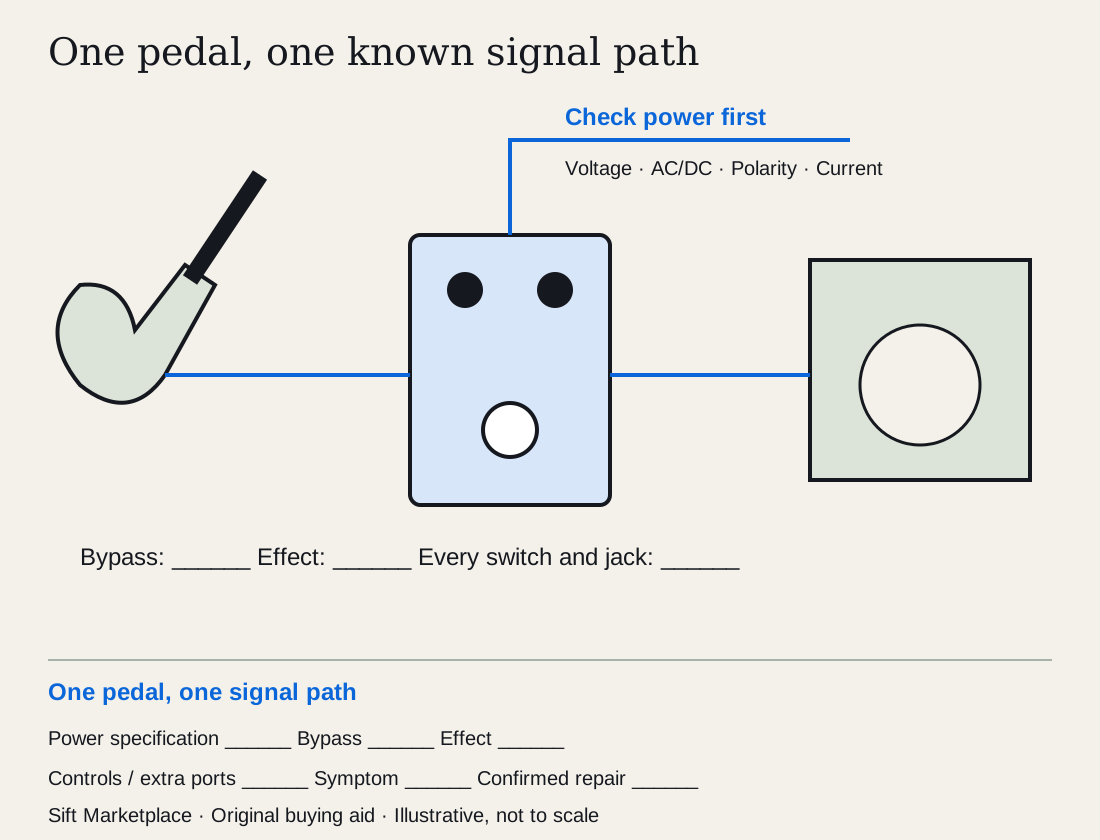 Enlarge diagram
Test one pedal at a time
Bring a known guitar, two reliable cables and a suitable amplifier or other appropriate listening setup. Start at low levels. A whole pedalboard demonstration can conceal which device produces noise or drops the signal.
Ask about repairs, modifications, spills and intermittent switches. Look at the enclosure, jacks, control shafts and battery compartment where present. Corrosion from a leaked battery deserves attention even when the pedal still powers up.
Count included adapters, expression controllers, special cables and removable battery doors. For a compact pedal, a missing rubber pad may be cosmetic; for another model, a missing proprietary power supply may dominate the replacement cost.
Follow the signal from bypass to effect
- Establish the clean sound. Connect the guitar directly to the amp first so you know the baseline works.
- Insert the pedal correctly. Use the labelled input and output and correct power. Some models require an input plug to activate battery operation.
- Check bypass. Listen for unexpected loss, noise or intermittent signal. Bypass designs differ, so do not assume every unit behaves identically with power removed.
- Engage the effect. Start with ordinary settings from the manual. Confirm the effect changes the sound as expected.
- Move every control. Listen for dead ranges, abrupt dropouts and noisy movement. Check switches and alternate modes.
- Operate the footswitch repeatedly in normal use. It should respond consistently without needing an unusual angle or force.
- Test the sockets you need. Include both stereo channels, expression input, MIDI or USB where relevant and supported.
Do not force plugs sideways or spray cleaner into jacks. A gentle ordinary-use test is enough to reveal many intermittent problems without creating damage.
| Finding | What to establish |
|---|---|
| Correct effect, cosmetic chips | Whether appearance matters at the price |
| Switch occasionally fails | Service cost and part availability |
| One stereo channel untested | Demonstrate it before valuing stereo use |
| Wrong or missing supply | Exact replacement and local compatibility |
| Modified circuit or switches | What changed, who did it and whether you want it |
| Battery corrosion | Extent of damage and qualified repair assessment |
Digital pedals need a feature-specific demonstration
For delays, loopers and multi-effects units, test storing and recalling a setting or loop if that matters to your use. Confirm any required storage medium, USB connection and current computer software support.
Ask the seller to show the actual functions rather than scroll through a list of preset names. A preset may use a feature requiring a separate entitlement, external controller or connected application. Check which parts are available through your own account and which transfer processes are officially supported.
If a reset is useful, agree on it after the sound test so the seller can preserve personal settings first. Follow the model’s instructions. A factory reset is not a repair for an unreliable footswitch or damaged jack.
Compare useful condition, not rarity claims
Make a small signal-path record before comparing listings: guitar → known-good lead → one pedal → known-good lead → suitable amplifier. For the pedal, record the exact power specification, bypass result, effect result, control behavior and any required extra port. BOSS’s DS-1 manuals are an example of product-specific instructions; the same enclosure size or voltage label does not establish an interchangeable supply for every pedal.
For example, a delay may pass guitar in bypass and produce repeats, while its tap switch or external-expression input remains untested. A multi-effects unit may play a preset while USB audio or saving user patches has not been demonstrated. Choose which functions matter to your use and mark them separately. Do not let a preset tour replace testing a required switch or connector.
Change one known-good item at a time if a noise or dropout appears during ordinary permitted use. Record the observation without declaring a faulty jack, supply or circuit. If the problem persists, obtain a suitable service quote or treat it as an unresolved project. Do not spray cleaner, resolder or open the pedal during the sale.
In a hypothetical example, a $55 pedal needs $35 confirmed service and $30 suitable power: $120. A working equivalent at $85 needing the same $30 power totals $115. Include patch leads or a required controller in the cost calculator; do not charge yourself for a supply you already own and have confirmed suitable.
For ordinary playing, compare the same revision and useful function. If price depends on circuit originality or collectibility, get appropriate specialist evidence; enclosure colour, a serial-number story and an online asking price do not establish that value. Account-bound preset packs also need their own officially supported access arrangement.
Ask: “Could you send the bottom label and power specification, disclose repairs/modifications, and demonstrate bypass, effect, controls and these extra functions individually?” Search the verified version and compare complete pedalboard needs rather than the number of accessories in the photo.
Questions people ask
Can I use any 9-volt adapter?
No. Match voltage, AC or DC, polarity, connector and sufficient current capacity to the exact pedal’s instructions. Some pedals use unusual supplies, and older versions can differ. A plug that fits does not establish compatibility.
Is Velcro on the bottom a problem?
Usually it is a condition detail, but it can hide labels, missing screws or residue. Ask for readable model and power information. Do not remove adhesive without permission; decide whether the remaining surface condition matters to you.
Should I pay more for downloaded presets?
Only value features you can use through your own supported setup. A seller’s paid account, software entitlement or personal preset collection may not transfer. Confirm the actual hardware functions and any official transfer process before adding value.
Sources
- 01BOSS DS-1 owner’s manuals
- 02BOSS PSA series power adaptor