Buying a used guitar on Facebook Marketplace and Kijiji: what to check
Quick answer
Play the actual guitar before paying, plugged into a suitable amplifier for an electric or acoustic-electric. Check every string and fret, tuning, controls and visible structural condition. Identify the exact model, modifications and repairs, then compare similar-condition sold examples. A serial number helps identification but does not prove authenticity or ownership. Obtain an assessment before treating high action, cracks or repeated faults as a cheap setup.
Ask for the model, history and a playing test
Decide whether you want a first instrument, a dependable working guitar or a collectible example. A first-time player may value comfortable playability and a local setup more than original tuners. A collector may need a much closer originality and provenance assessment. State that purpose before assigning value to a famous name or a box of extras.
Ask for the exact model, claimed year and manufacturing location, clear front/back and headstock photographs, disclosed modifications and any repair or service records. Confirm which case and accessories are included. Ask whether you can tune it and play through a suitable amplifier where relevant. An acoustic-electric needs both an unplugged check and a test of its pickup system.
Bring a tuner, your usual pick, a known-good cable and a suitable small amplifier or arrange an appropriate one. A beginner can bring an experienced player or arrange a technician’s inspection with the seller’s agreement. Choose a setting with enough light and time to hear the guitar; a hurried exchange beside traffic cannot answer the same questions.
 Enlarge diagram
Play each string and fret at ordinary settings
There is no fixed ten-minute routine that proves the whole instrument healthy. Work systematically and record what remains uncertain:
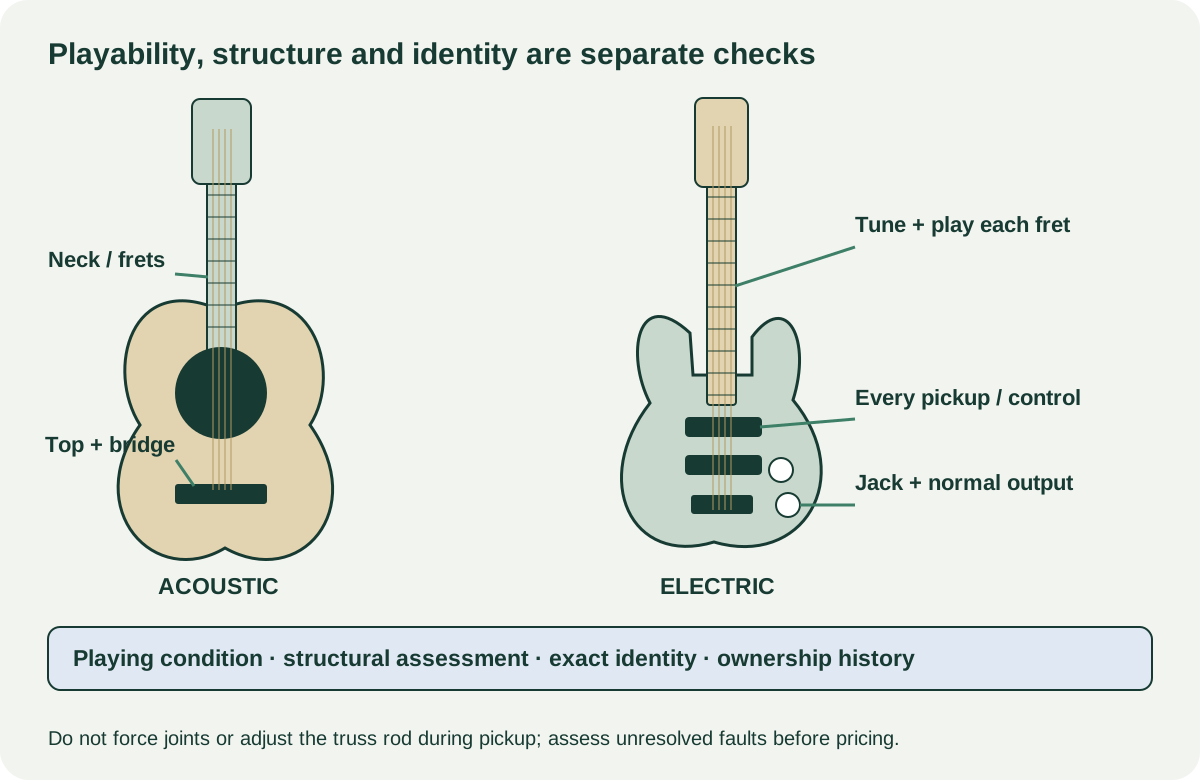
- Inspect before playing. Look for cracks, damaged joints, unusual repairs, loose hardware and rough fret edges. Do not force a joint, flex the neck or push tools beneath a bridge.
- Tune normally. Check the tuners operate and hold while you play. Recheck after a short passage. Drift has several possible causes; it does not identify the repair by itself.
- Play every string open and at each fret. Listen for dead notes, repeated buzzing and sudden changes. Use your ordinary playing pressure and inspect the area of any repeated fault.
- Try familiar chords and passages. Judge comfort, neck shape, string spacing and reach while seated or standing as you normally play.
- Check tuning along the neck. A tuner can expose a concern to investigate, but fretting pressure, strings and setup affect results. Do not diagnose a neck reset from one reading.
- Repeat questionable results. Have the seller correct an ordinary documented setup issue if appropriate, then try again. Keep an unresolved issue in the buying decision.
Visible fret grooves and high strings are useful observations, not repair quotations. A technician can determine whether the required work is an ordinary setup, fret work or a structural repair. Avoid turning the truss rod during pickup to see whether an uncertain problem disappears.
Test electric controls with a simple signal path
Use guitar → known-good cable → suitable amplifier, beginning at a moderate level with a straightforward sound. Heavy effects can hide some noises and make comparison harder. Test each pickup position, volume and tone controls, switches and the output connection through normal use. Check active electronics with a suitable battery following the model’s instructions.
If the signal cuts out, try a known-good cable and input before blaming the guitar. Repeated crackle while turning a control may require cleaning or repair, but the symptom alone does not establish the fix. A seller should demonstrate any claimed simple remedy or disclose the problem as unresolved. Test a tremolo or other moving system only in its normal playing range.
Inspect the neck joint, headstock area, bridge and strap attachments for damage or disclosed repairs. Do not assume a touched-up finish is proof of a broken headstock, or that a tidy finish rules one out. Ask for the repair history and obtain an assessment when the value depends on it. See the amplifier guide if the amp is part of the bundle.
Assess an acoustic’s structure as well as its sound
Look over the top, back, sides, neck joint and bridge in ordinary angled light. Note cracks, gaps, unusual distortion and previous repairs without prying or scraping. Inspect accessible interior areas visually with permission. A visible crack may involve finish, wood or both; a casual inspection cannot always distinguish the repair scope.
Taylor’s humidity guidance explains that moisture can affect wood geometry and action, and that some bellying alone is not a diagnosis. Ask about storage conditions and changes in playability. Do not turn a bulge, sharp fret end or high action into a guaranteed cheap remedy. The exact construction and combination of findings matter.
If an acoustic has high action and little apparent saddle adjustment remaining, ask a technician to assess it before negotiating as though it only needs new strings. Likewise, an unexplained rattle or a possible lifting bridge needs assessment. A well-documented repair can be acceptable at the right value; a seller’s promise that a crack “has never mattered” does not establish its condition.
Separate originality from a familiar logo
Compare the entire guitar with the correct model specification and history. Serial location and format, construction, hardware, finish and documented changes contribute different evidence. Fender’s dating guidance explains why serial and component dates are not always definitive. Do not remove a neck or other parts during a casual viewing to find a date.
A genuine modified guitar, a clearly disclosed instrument assembled from parts and a counterfeit claim are different questions. Record replacements and unexplained features. If a premium depends on originality or a particular vintage, seek an experienced independent assessment before payment. A playable instrument does not automatically deserve the price of an authenticated collectible.
Check the ownership story without treating a lookup as proof
Ask how the seller acquired the guitar and compare its private identifier with any available receipt or service record. A matching serial helps connect paperwork to the instrument but cannot independently prove ownership. An altered identifier, inconsistent account or unexplained restriction on inspection is a reason to pause. Do not treat the absence of an online stolen-item report as clearance.
Price this guitar and the work you can establish
Use sold evidence for the same model, relevant year range, construction, modifications and condition. Reverb’s Price Guide explains its use of completed sales; still check what a comparison includes and whether its condition resembles this guitar. Compare accessible new or serviced alternatives with their actual purchase terms, rather than the seller’s original receipt price.
| Finding | How to use it in the comparison |
|---|---|
| Missing case | Price a suitable replacement you actually need |
| Worn strings or known setup need | Use a real quote and keep the scope clear |
| Unassessed buzz or high action | Leave the repair uncertain until assessed |
| Disclosed structural repair | Compare repaired examples and review the work |
| Collectible identity unverified | Do not assume the claimed premium |
For a hypothetical purchase, a $250 guitar plus a confirmed $90 setup and $40 case totals $380. A $350 alternative needing none of those additions may be cheaper to start playing. If the first guitar has an unexplained neck problem, that $90 setup quote must not silently stand in for its repair. Use actual assessed costs in the buying-cost calculator.
Check warranty terms separately. Taylor’s US/Canada warranty is directed to the original purchaser and ends on transfer under its stated terms. Other instruments and sellers can have different arrangements; do not count transferable cover without evidence.
Agree on the evidence before the handover
Buy after the playing result, required electronics, identity and any material repair questions are clear. Negotiate a confirmed accessory omission or assessed work you accept. Pass when an essential demonstration is refused, ownership concerns remain or a promised simple repair cannot be shown. For advance-payment requests, use the deposit guide.
Match the inspected guitar and accessories again when packing. Use an appropriate case, protect the neck and headstock and follow the instrument’s transport guidance. Keep loose tools from striking it inside the case.
Search the model and the version
Combine exact model terms with common abbreviations, manufacturing variants and left-handed terms where needed. Be careful excluding words such as “case” or “pickup”: they can describe an irrelevant spare part or a useful complete bundle. Keep a short record of each candidate’s playing result, repairs and included parts so appearance does not dominate the comparison.
Follow the shortlist with Sift
Sift is a free Chrome extension for Facebook Marketplace and Kijiji. Use listing-word filters to focus the search and recorded asking prices to follow the guitars worth inspecting. Judge the final purchase by the instrument you played and the condition you can establish.
Questions people ask
Is fret buzz always an expensive repair?
No. Strings, setup, playing style and several kinds of wear or damage can contribute. Test at normal settings and obtain an assessment if it affects your decision. A seller’s claim that a truss-rod adjustment will solve it is not a completed repair.
Does a matching serial number prove a guitar is genuine?
No. Compare the whole instrument with the correct model specification, including modifications and repair history. Serial formats can help narrow identity or age; seek experienced assessment before paying a collectible premium when uncertainty remains.
Should I buy a used acoustic guitar with a crack?
Only if you understand the actual condition, any completed repair and the cost and risk you accept. A disclosed stable repair differs from an open or unexplained crack. Have a qualified guitar technician assess an uncertain structural issue before pricing it as a playable instrument.
Sources
- 01Taylor Guitars Symptoms of a wet guitar
- 02Taylor Guitars Warranty terms
- 03Fender Dating an American-made instrument
- 04Reverb How to use the Reverb Price Guide