How do you buy a used patio umbrella with a suitable base?
Quick answer
Identify the umbrella model and whether it uses a centre pole or cantilever support. Confirm the exact base or mounting system, including required ballast, before valuing the bundle. Inspect the canopy and frame, observe normal opening in suitable conditions and measure the shade and movement area. A heavy-looking base is not proof of compatibility.
Plan the shade where people will sit
Measure the table or seating area and the available space around it. Consider the canopy when open, its tilt or rotation range and the clearance to walls, plants, doors and overhead obstacles. Record where the support can stand without blocking a walkway. A large canopy can shade the right area while putting its base exactly where a chair needs to move.
Decide whether you want a centre-pole umbrella through a suitable table, a freestanding centre-pole design or a cantilever. Those are different support arrangements. Confirm the table opening, pole diameter and manufacturer-approved support; the table alone should not be assumed to stabilize an umbrella.
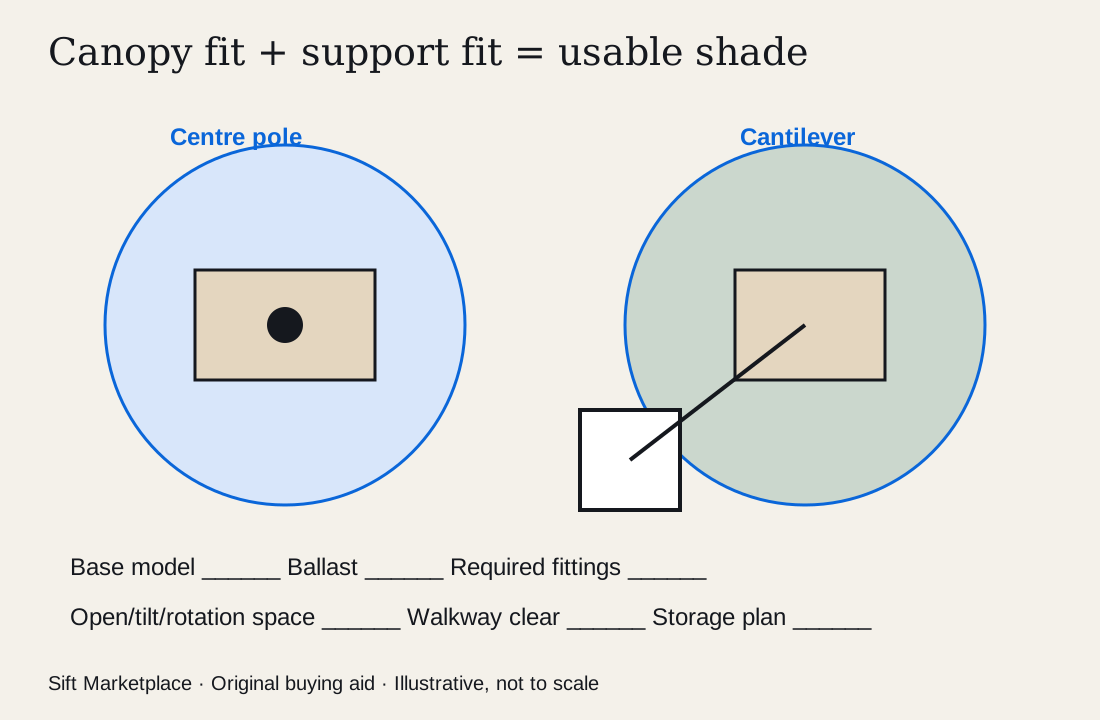 Enlarge diagram
Match the umbrella and support as one system
Ask for the model label, pole or mast dimensions, base label and photographs of all mounting pieces. A cross-shaped stand may be only one component of a ballast system. Confirm whether the seller includes weight containers, covers, fasteners, sleeves and any required rotation hub.
Treasure Garden’s AG25T manual specifies a base requirement for that particular cantilever and directs users to the separate base or mounting instructions. Its BASE-13 guide identifies another set of components. These are examples of model-specific support: do not apply one weight figure to every canopy or improvise a substitute.
Record the actual base parts and whether ballast is present, absent or must be transported separately. If a fixed mount is proposed, establish permission and competent installation advice before buying. Do not treat drilling into a patio, deck or wall as an incidental pickup task.
Inspect fabric and frame separately
With the umbrella safely closed and supported, look at canopy seams, pockets over rib ends, vents and areas that fold repeatedly. Distinguish fading from tears, brittle fabric or damaged attachment points. Ask whether the canopy has been replaced and whether a correct replacement is still available.
Inspect accessible ribs, joints, mast, tilt mechanism, crank and locking parts. Note bends, cracks, missing pins, corrosion and improvised repairs. Do not straighten a rib or operate a damaged lift mechanism to see how much force it takes.
Ask the seller to demonstrate ordinary opening, closing, tilt and rotation only in suitable conditions, with the correct base or mount in place and according to the manual. Keep people clear of the moving canopy. A windy day or incomplete support is a reason to defer, not conduct an improvised stability test.
| Finding | Buying response |
|---|---|
| Faded but intact canopy; frame and controls work | Decide whether appearance suits the price |
| Torn canopy with an exact available replacement | Obtain the complete replacement quote before offering |
| Missing ballast or mounting component | Price the approved full support arrangement |
| Bent mast, cracked joint or unreliable lock | Seek competent assessment or pass |
| No suitable opening demonstration | Keep the mechanism unverified |
Compare a complete shade arrangement
In a hypothetical example, an umbrella costs $70 but needs a confirmed $90 compatible base, $30 ballast and $20 transport: $210. A complete supported alternative at $170 plus $25 transport totals $195. These are invented figures, not manufacturer prices.
The first is not the cheaper usable purchase. If its canopy is discontinued or the support identity is unknown, a guessed replacement allowance does not resolve the problem. Use the cost calculator only for identified components, and compare the actual footprints as well as the totals.
Agree on collection and storage
Ask: “What is the exact umbrella and base model, which weights or mounting pieces are included, and have any ribs or lift parts been repaired? Could you show it opening and closing normally with the correct support?”
Plan canopy length, base weight and safe loading. Follow the manufacturer’s transport, closing and storage instructions; do not promise year-round unattended use from a brief demonstration. Keep small fasteners and sleeves labeled. If furniture is part of the bundle, assess it separately with the used-furniture guide.
Sources
- 01Treasure Garden AG25T manual
- 02Treasure Garden BASE-13 manual