What should you check on a used skateboard or longboard?
Quick answer
Choose a board for your intended riding, then inspect the deck, mounting areas, trucks, wheels and hardware together. Confirm that modifications form a suitable setup. Structural cracks, separation or unexplained damage need a knowledgeable skate shop’s assessment before riding. A short roll does not certify safety or remaining life.
Decide what the board is for
A street skateboard, cruiser, longboard and surf-skate-style setup can behave very differently. Describe your intended use and experience before choosing from photographs. Deck length alone does not establish stability, turn response or suitability.
Record deck model and width, wheelbase, truck model and width, wheel size and any risers or unusual hardware. Sector 9’s complete-board guide treats these as a connected setup. Ask whether the board is original or assembled from separate parts, and which changes the seller made.
This guide concerns unpowered boards. An electric skateboard adds battery, drive, controls, charging and manufacturer support questions; do not treat it as the same purchase with a motor attached.
 Enlarge diagram
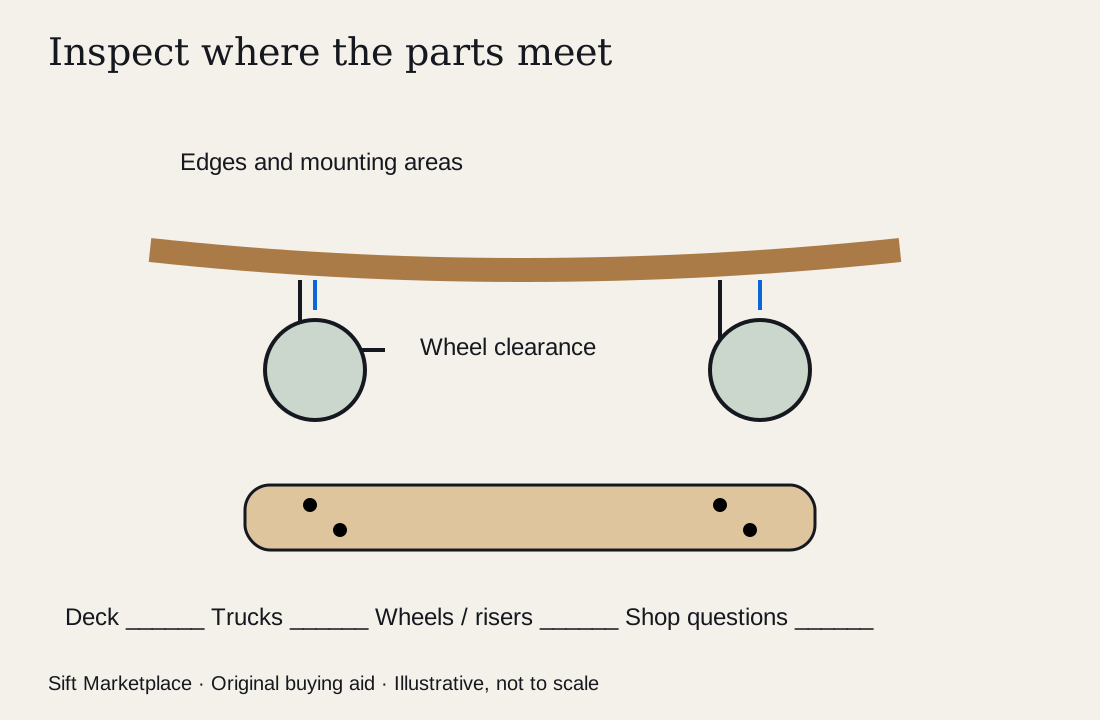
Look closely at deck edges and mounting areas
Inspect the underside, nose, tail, edges and around truck bolts in good light. Note chips, deep cracks, separated layers, soft or distorted areas and repairs. Ask about water exposure, hard impacts and storage. Grip tape can hide the top surface; do not peel it away without permission, but keep obscured damage unresolved.
Cosmetic scuffs are different from a crack through the structure or separation between layers. Sector 9 identifies delamination as a distinct construction issue. That does not establish warranty eligibility for a second owner or prove that a visible split is repairable. Ask a knowledgeable skate shop to assess questionable structure, or choose another board.
Do not bounce on a suspect deck or perform jumps as a strength test. A board surviving a brief test does not establish its remaining life. A glued crack should not be priced as an ordinary cosmetic repair without competent advice.
Inspect the trucks and wheels as a system
Look for cracked or bent truck parts, damaged mounting hardware, missing nuts and worn or distorted bushings. Spin and move parts only in a safe stationary inspection, keeping fingers away from pinch points. Note roughness or unexpected play without claiming which bearing or axle part is responsible.
Inspect wheel condition for chunks, cracks and uneven wear. Verify that all wheels and hardware make sense for the intended setup. A large wheel upgrade can change clearance; Sector 9’s riser guidance illustrates why riser choice affects geometry. Do not prescribe a universal riser size or accept “never gets wheel bite” without evaluating the actual combination.
A competent shop can check setup suitability, hardware and needed consumables before riding. Replacing bearings does not fix a damaged truck, and tightening everything indiscriminately is not an inspection method.
Use an ordinary demonstration only after condition is acceptable
If the setup is sound and suitable, a competent rider may demonstrate ordinary low-consequence operation in an appropriate place with protective equipment. Do not request downhill speed, tricks or hard braking to prove the board. A novice buyer does not need to ride an unfamiliar setup to decide that it is wrong for their needs.
| Finding | Decision |
|---|---|
| Suitable setup and sound assessed structure | Compare complete cost |
| Worn known consumables with confirmed compatible replacements | Negotiate those actual costs |
| Unexplained truck play or doubtful wheel clearance | Obtain shop assessment before use |
| Deck crack, delamination or uncertain structural repair | Pass or seek qualified assessment before considering it |
| Seller cannot identify a modified setup | Treat compatibility as unresolved |
Compare a usable board with a collection of parts
Suppose a board costs $45 and needs $35 confirmed bearings, $30 bushings/hardware and $25 shop work. The hypothetical total is $135. A suitable complete board at $110 plus $20 shop checking totals $130. These invented figures exclude protective equipment needed with either purchase.
Do not assign resale value to branded trucks or wheels until their identity, condition and suitability are clear. Use the cost calculator for the actual quoted parts and service; a cracked deck has no automatically cheap repair allowance.
Ask: “What parts were changed, has the deck been wet or cracked, and can I see all edges and truck mounts? Would you agree to a skate-shop condition check?” Buy a suitable complete setup whose condition supports use, not an exciting original retail price.
Sources
- 01Sector 9 Building a complete skateboard
- 02Sector 9 Riser and wheel-clearance guidance
- 03Sector 9 Warranty