How do you assess a used small motorboat as a complete purchase?
Quick answer
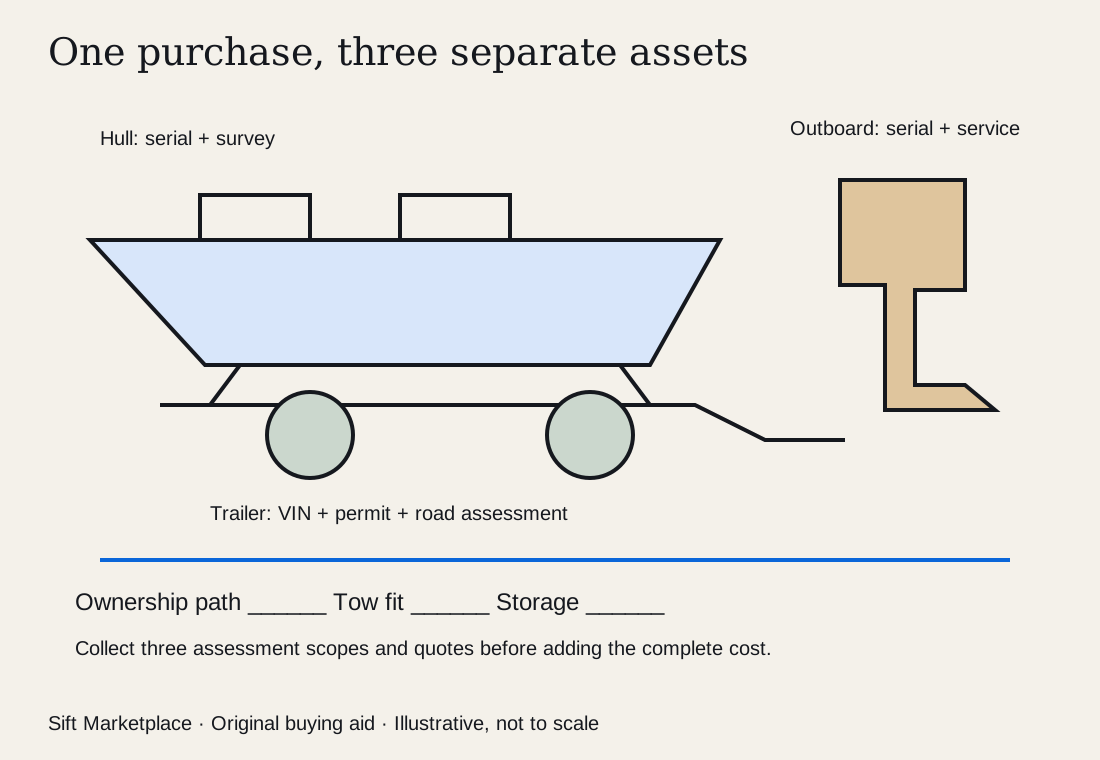
Treat the hull, outboard and trailer as three identified assets. Verify the applicable boat and trailer ownership, registration and transfer requirements, arrange competent hull and engine assessments, and price towing, storage and service before committing. A running outboard, a licence number on the bow and a tidy hull do not establish ownership, seaworthiness or trailer condition.
Define the boat and the jurisdiction
This guide covers the purchase planning for an ordinary small, outboard-powered recreational boat. US buyers should establish state boat and trailer requirements first; a separate Canadian example appears below. Commercial vessels, imports and federally documented vessels need their own specialist and authority guidance.
Write down intended water, passenger/cargo needs, launch access, storage and towing arrangements. Ask a competent marine provider whether the identified hull/engine configuration is appropriate for the intended use and complies with its documented limits. A larger outboard or more seats in a listing is not proof of an approved configuration.
Measure actual storage and access needs with the outboard, trailer tongue and any permitted tilt/storage arrangement considered. A quoted hull length is not the total parked length. Confirm the tow vehicle, hitch and trailer combination through their actual documentation and competent advice; do not use the boat’s dry hull weight as the complete towing weight.
 Enlarge diagram
Make three identity and document records
Request hull maker/model, hull serial number, compliance information where applicable and clear photos of the physical markings. Obtain the outboard’s full model/serial and the trailer’s identity plate/VIN and documents. Ask which accessories and removable equipment are included; a motor pictured on the boat may not be part of the advertised price.
For US buyers, the Coast Guard’s boating FAQs direct numbering and titling questions to the state boating agency. Establish the correct transfer route for the hull and engine, any recorded lender interest and the required ownership documents. Resolve missing or inconsistent identity before treating the purchase as routine. Check the trailer’s separate title/registration requirements with the relevant state motor vehicle agency; the boat’s documents do not automatically cover it.
Canadian example: boat and Ontario trailer documents
Transport Canada’s buying guidance discusses hull serial numbers and compliance notices. These Canadian requirements do not establish a US transfer process.
For a licensed Canadian pleasure craft, consult the current proof-of-ownership requirements and transfer process. As checked on 18 October 2026, that process requires transfer before operation and within 30 days of the ownership change. A number painted on the bow is not a substitute for the required ownership evidence or resolving a registered vessel’s different process.
Treat the trailer separately. Ontario’s trailer page distinguishes a previously Ontario-registered used trailer from one registered elsewhere; for the former it lists the vehicle portion of the permit and bill of sale among the required documents. Confirm the applicable case and resolve missing paperwork with ServiceOntario before paying or towing. Do not assume the boat’s documents cover the trailer.
Commission the right condition assessments
Arrange a competent marine surveyor’s pre-purchase assessment of the hull and systems, with scope matched to the actual boat. Ask what areas can be inspected, whether haul-out/access is needed, what the report will cover and what it excludes.
Separately confirm the outboard assessment with an appropriately qualified engine service provider. A hull survey must not be assumed to include a detailed mechanical examination. Mercury’s support page points owners to model resources and factory-trained dealer service; use the actual engine maker’s equivalent route. Arrange the scope and quote before committing to the boat.
Provide records of engine service, storage/winterization, repairs, impacts, water exposure and modifications. An hour reading and a recent cosmetic detail do not establish mechanical history. Ask the provider to distinguish findings, recommended work and uninspected areas; a report is not a guarantee of every future outcome.
Have a suitable trailer service provider assess road condition, load suitability and required work. Tires, bearings, brakes if fitted, coupling, frame, supports and lights need competent evaluation appropriate to that trailer. Do not improvise a tow home to discover which systems work.
Treat a demonstration as one part of the evidence
If the agreed assessment includes a trial, have it planned and conducted by competent people in lawful, suitable conditions with the appropriate safety equipment and permissions. Agree who is responsible for launching, operation, insurance and costs. This guide supplies no improvised engine-running or boat-handling test.
A seller’s short video can show that an engine ran at that time. It cannot establish the hull’s structure, all engine functions or the trailer’s roadworthiness. Note visible damage, repairs, leaks or concerns and refer them to the appropriate professional without drilling, dismantling or loading suspect structures yourself.
| Asset | Identity/documents | Assessment/cost |
|---|---|---|
| Hull | Serial, model, relevant compliance and ownership record | Marine survey and quoted hull/system work |
| Outboard | Model, serial, included controls/accessories and history | Qualified mechanical assessment and service |
| Trailer | VIN/plate, permit and applicable sale documents | Suitable road-condition assessment and transport plan |
| Whole purchase | Correct included bundle and applicable transfer route | Tow fit, storage, launching and total acquisition cost |
Compare ownership-ready totals
In a hypothetical example, Package A is $4,000, with $450 assessment, $600 confirmed engine work, $350 trailer work, $200 transport and $400 initial storage: $6,000. Package B is $4,900 plus $450 assessment, $200 transport and $400 storage: $5,950. Taxes, applicable transfer costs, safety equipment, insurance and unquoted defects still need their own rows. These are invented figures, not marine-service or market prices.
Use the cost calculator for known acquisition costs, and keep ongoing storage/service costs in your budget as well. Make an inspection-dependent offer through an appropriate documented arrangement if unresolved findings determine the deal.
Does a compliance notice establish current condition? No. Changes and damage can create further questions; obtain the appropriate assessment.
Can I buy first and sort documents later? Resolve the applicable ownership and transfer path beforehand. Missing hull, engine or trailer identity can affect different parts of the transaction.
Ask: “Please send the hull, engine and trailer identities, ownership documents and service history. I want independent marine, engine and trailer assessments and a confirmed transport plan before committing.” Search for a complete, documentable package that fits how you will actually use and store it.
Sources
- 01US Coast Guard Recreational boating FAQs
- 02USAGov State motor vehicle services
- 03Transport Canada Buying a pleasure craft
- 04Transport Canada Before you apply for a PCL
- 05Transport Canada PCL how to apply
- 06Ontario Register a trailer
- 07Mercury Marine Service and support