Buying a used kayak or paddle board: checks, prices and when to buy
Quick answer
Identify the exact craft and its repair/storage history, inspect the accessible hull or inflatable construction, and arrange normal operation or inflation following its manual. Confirm user fit, included equipment, local requirements and a measured transport plan. A short viewing does not establish future air retention or on-water suitability.
A used kayak or paddle board needs to suit your intended water, experience and transport arrangements. Identify the exact craft, ask about repairs and storage, and inspect the accessible condition before comparing complete costs. A short viewing can reveal concerns without establishing every hidden fault or future performance.
Which kind are you buying?
| Type | Areas to inspect | Evidence to request |
|---|---|---|
| Sit-on-top kayak | Scupper areas, seat mounts and accessible hull | Repair history and clear underside photos |
| Sit-inside kayak | Keel, hatches, seat and fitted controls | Visible condition and normal permitted operation |
| Fishing kayak | Seat, mounts and included fittings | Exact accessory inventory and repair history |
| Inflatable kayak or paddle board | Seams, valve, deck pad and fin attachment | Manual-based inflation and any unresolved observations |
| Hard paddle board | Deck, rails, nose and fin box | Construction identity and damage/repair assessment |
| Canoe | Accessible hull, joints, fittings and repairs | Material-specific condition and history |
Plastic kayaks: what to check
Identify the actual material and construction rather than assuming all plastic kayaks have the same repair options. With permission and suitable handling, view the accessible hull in daylight:
- Look around scupper holes, seat attachments and both ends for cracks, repairs or damaged fittings.
- Note scratches, deep gouges or visibly worn areas along the keel without inferring remaining material strength.
- Record dents or unusual distortion and ask about storage, strapping and impacts. Have the maker or a competent repair provider assess whether the condition affects suitability.
- Note fading or chalkiness and ask about sun exposure. Do not press, bend or scratch a patch to test brittleness.
- Inspect hatch seals, accessible bulkheads, foot braces, seat, drain components and handles. Have the seller demonstrate fitted controls only as the manual permits.
Ask about water found inside the hull and how it was investigated. Water presence alone does not establish its entry route or a repair diagnosis. Keep unexplained water or suspected damage unresolved until appropriately assessed.
Composite kayaks and canoes
Inspect accessible surfaces for cracks, exposed material, unusual patches, distortion and previous repairs. Ask what happened and who performed the work. Appearance alone does not establish whether a mark is cosmetic or structural; do not press or flex the hull to diagnose its layers.
For aluminum canoes, note creased dents, damaged joints, corrosion or staining around fasteners and ask about leakage and repairs. For any construction, obtain the maker’s or a competent paddlesport repair provider’s assessment when unresolved condition determines the purchase. The need for assessment depends on the concern and intended use, not an arbitrary asking-price threshold.
Inflatable boards and kayaks: normal inflation and condition
A rolled bundle hides much of an inflatable’s condition. Ask for its exact identity, manual, repair/storage history and all included equipment, then arrange normal inflation following that model’s guidance. iROCKER’s manual portal separates its product instructions; do not copy a different board’s pressure, setup or care requirements.
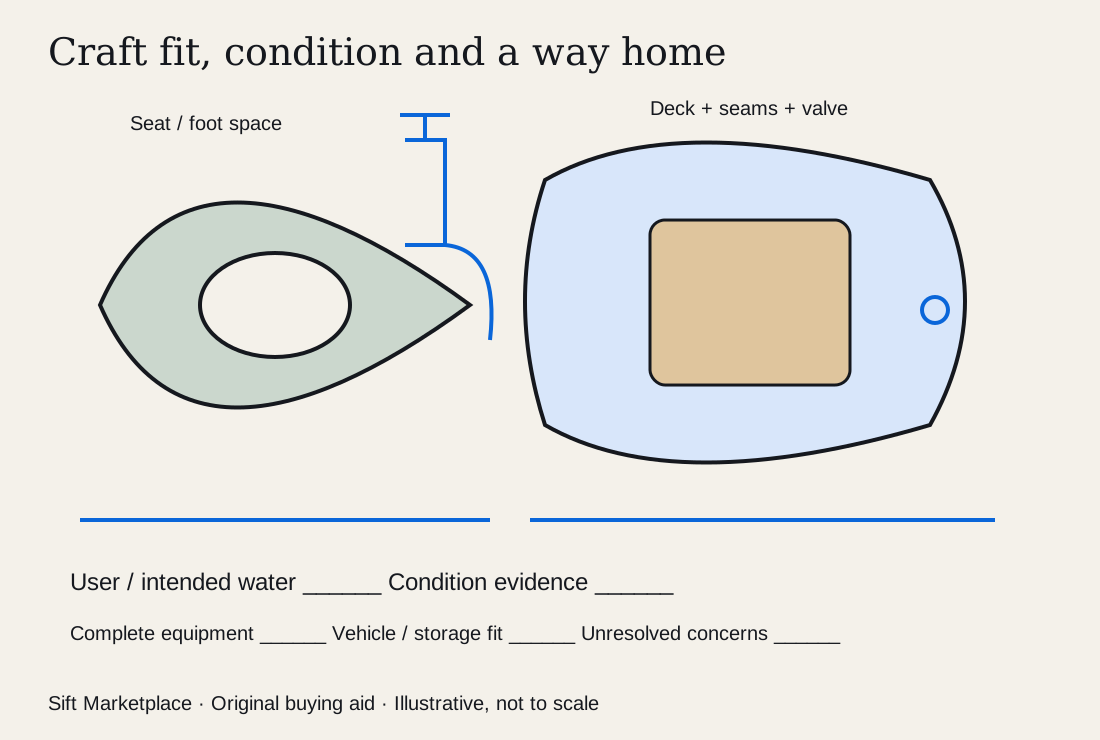
Inspect accessible seams, valve area, deck pad, fin attachment and previous patches. Record normal inflation behavior and any observed pressure change together with conditions and the gauge used. Temperature and measurement differences can affect readings. A short viewing cannot guarantee future air retention, and unexplained loss or distortion needs suitable manufacturer/repair-provider assessment.
Do not overinflate, stand on an unsupported board or conduct an improvised strength test. Apply a leak-check method only if the exact maker permits it. An appropriate on-water demonstration needs a suitable setting, equipment and competence; it is not a condition for every sale viewing.
Inventory the correct pump/adapter, fin, paddle, bag and any required parts. Confirm replacement availability before valuing an incomplete bundle. Check actual warranty eligibility; original-purchaser coverage should not be assumed to transfer.
 Enlarge diagram
Hard paddle boards
Identify the board’s construction and inspect the accessible deck, rails, nose, underside and fin box for damage, distortion and repairs. Record concerns for the maker or a competent repair provider rather than pressing the surface or treating a sound as a diagnosis. Ask about water exposure and previous work. Follow the exact model’s instructions for any vent or plug arrangement; do not tighten or alter an unfamiliar fitting as a generic buying check.
The hull identification number
Ask for the maker/model, physical serial or hull identity and ownership evidence. Photograph the actual marking with the seller’s permission and compare it with the paperwork. If identity appears altered or the story conflicts, resolve it before purchase. A number alone does not establish ownership or condition.
Do you need to register it?
Check the authority for the craft, propulsion, jurisdiction and intended use. Transport Canada’s current owner guidance says most recreational boats with motors of 10 hp/7.5 kW or more require a Pleasure Craft Licence, while registration rules also depend on use. That does not settle every local access permit or a US state’s requirements. Adding a motor can change the questions; check before buying or modifying the craft.
Clean, drain, dry
Ask where the craft was last used and follow the destination authority’s aquatic invasive-species requirements before moving it between waters. Stop Aquatic Hitchhikers explains the clean, drain and dry approach. Required methods and drying periods can vary; a quick towel wipe should not be assumed to satisfy local rules.
What a used kayak or paddle board should cost
Compare exact models or closely suitable alternatives, their demonstrated condition and the included parts. Check current local new/refurbished alternatives rather than an old retail price table. A low-priced large craft can be the wrong purchase if it does not fit your use or transport plan.
In a hypothetical comparison, Board A costs $180 and needs a $65 confirmed compatible pump, $35 fin and $20 collection: $300. A complete suitable Board B at $270 plus $20 collection totals $290. An unassessed leak is not resolved by the accessory total. Keep required suitable safety equipment and other preparation costs in your budget, with actual quotes in the cost calculator.
Ask: “Could you send the exact model, repair/storage history and all included parts, and demonstrate normal inflation/operation as appropriate to the manual? I need to confirm fit and transport before committing.” Use the listing comparison tool for the evidence gaps, not merely capacity and asking price.
When to buy
Compare local candidates over time rather than assuming a particular season guarantees a better price. A rental or demo craft needs the same identity, use-history and condition assessment as a private seller’s boat. Off-season conditions may also limit an appropriate demonstration.
Use the newest-first search guide and saved-search alerts on Kijiji to revisit suitable candidates. A price change or long-visible listing adds context, but does not prove seller urgency or acceptance of an offer. Keep time for assessment and transport planning when a seller has a removal deadline.
For a fishing setup, assess the tackle separately from the boat. The used fishing-rod and reel checklist covers rod guides, reel operation and matching the pair to your intended fishing, so an attractive bundle does not hide unusable equipment.
Fit and getting it home
Match the exact craft to your intended water, experience, body fit and total carried load using its maker’s guidance and suitable paddlesport advice. Length and width are useful dimensions, but simple “wider is safer” or “longer is faster” rules do not establish suitability for an individual craft and user.
Check seating/standing area, foot space, intended gear and documented limits. Confirm you can manage the actual lifting and storage task. Measure the vehicle, permitted carrier/support system and the full craft or folded package, including accessories. Use the exact transport instructions and an appropriate loading plan.
For a powered boat, use the separate small-motorboat purchase guide; hull, outboard, trailer and ownership assessment form a different purchase.
Scams and red flags
Read the actual offer and ask for current photos of the craft, its identity and included parts. A low price, stock image or a change from local inspection to shipping calls for more evidence; none establishes condition or ownership by itself. A reverse image search can help investigate reused photographs without proving their source.
If the seller wants advance payment to hold an unseen craft or pushes you to a different payment/contact route before inspection, use the deposit guide and payment guide. Agree on the viewing, included equipment, price and collection responsibilities before paying. The Marketplace safety guide covers transaction planning.
With Sift on a computer
Sift helps focus nearby craft, filter rental/paddle-only terms you do not want and compare recorded asking-price changes on Facebook Marketplace and Kijiji. Search the suitable type and exact supported models, then use the identity, condition, complete-equipment and transport record to decide which candidates deserve a viewing. Search organization does not establish on-water suitability or condition.
Questions people ask
How do I assess a used inflatable board?
Use the exact model’s manual for normal inflation, conditions and any permitted leak check. Inspect seams, valve, fin attachment and repairs. Unexplained loss or distortion needs assessment; do not stand on an unsupported board or overinflate it.
How much should I pay?
Compare suitable exact models and current local alternatives, then add confirmed missing parts, preparation and collection. Keep unresolved leaks or damage separate rather than assigning a guessed repair allowance.
Does a paddle craft need a licence or permit?
Check the relevant authority for the craft, propulsion, jurisdiction and intended use. A general Canadian motor threshold does not settle every local access permit or a US state’s rules.
Does buying off-season guarantee a better deal?
No. Compare actual local candidates and complete costs over time. Viewing conditions and available demonstrations can also affect the evidence.
Sources
- 01Transport Canada Boat owner responsibilities
- 02iROCKER Product manuals and catalogs
- 03Meta Help Centre About scams on Facebook Marketplace
- 04Meta Help Centre How Purchase Protection works on Facebook Marketplace
- 05Meta Help Centre Sort by distance or new listings on Facebook Marketplace
- 06Code of Federal Regulations 33 CFR 181.29, Hull identification number display (Cornell LII)
- 07Stop Aquatic Hitchhikers Prevention
- 08Confluence Outdoor Perception kayaks
- 09iRocker Inflatable paddle boards
- 10iRocker Warranty
- 11Transport Canada Pleasure craft licensing
- 12Oregon State Marine Board Got your Waterway Access Permit