What should you check on a used fishing rod and reel?
Quick answer
Check the rod and reel separately, then decide whether they belong together. Read the rod’s line and lure ratings, inspect every guide and joint, and test the reel’s handle, bail or spool release and drag with controlled tension. A smooth empty reel does not prove it works under load, and fresh line does not prove the rod is undamaged.
Is the combination right for your fishing?
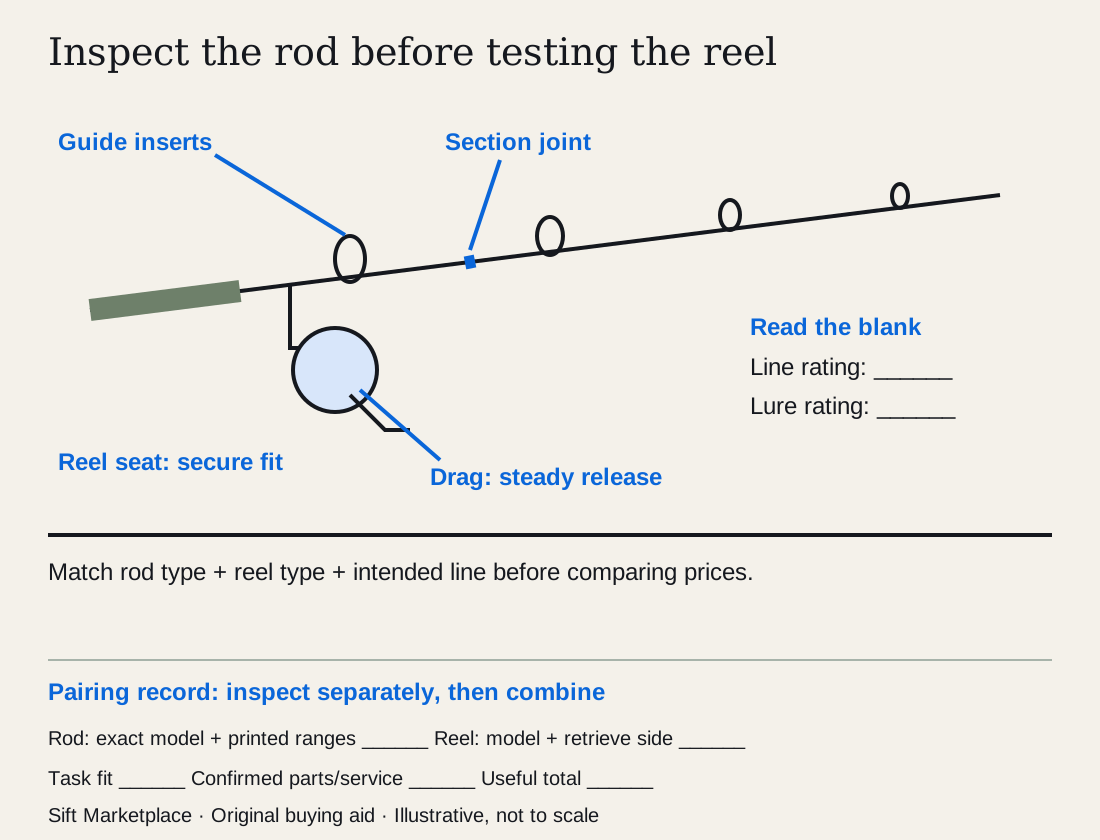
Start with the fish, water and lures you intend to use. A light spinning outfit and a heavy baitcasting outfit are different purchases even when both listings say “fishing combo.” Read the markings on the rod rather than guessing from its length.
Record rod length, number of sections, power, action and printed line and lure ranges where provided. Record the reel’s exact model, size and retrieve orientation. These details help you compare like with like. Reel size numbers are not a universal scale across brands.
For a baitcaster, confirm which hand turns the handle. For a spinning reel, ask whether the handle fits your preferred side and whether the necessary parts are present. If you cannot identify the equipment, request close photographs before setting a price.
 Enlarge diagram
What should you ask before meeting?
Ask whether the equipment was used in salt water, how it was cleaned and stored, and whether the reel has been serviced. A service receipt describes work done; “always maintained” does not identify which parts were inspected.
Find out whether the rod tip or any guide has been replaced. A shortened tip can change the rod’s behaviour and may be hard to notice in a full-length photograph. Ask for a picture of the assembled rod beside its length marking and a close view of the tip.
Check replacement spool, handle or guide availability before assuming it is a cheap fix. Shimano’s maintenance resources separate spinning, baitcasting and electric reels because their components and care differ. Use the exact model’s documents when an inspection raises a question.
Inspect the rod from butt to tip
- Check the grip and butt. Look for loose sections, crumbling material, major splits and missing end caps. Discolouration differs from a grip moving around the blank.
- Look along the blank. Rotate it in good light. Pay attention to exposed fibres, crushed areas and damage near guide feet.
- Inspect each guide. Check the frame, wraps and insert. A gentle cotton-swab pass can reveal a snag where line travels.
- Assemble sectional rods correctly. Ask the seller to demonstrate. Follow the intended insertion depth; some joints have a designed gap. Do not force sections together.
- Fit the intended reel. The seat should hold it without rocking or a stripped locking collar. Confirm the foot actually fits.
- Check the tip without a strength stunt. Do not high-stick the rod, sharply bend it by hand or lift a heavy object. Visual inspection cannot exclude every internal defect.
A suspected blank crack is a reason for specialist assessment or another candidate. A discount does not turn damaged fibres into a sound rod.
What does a reel demonstration tell you?
Turn the handle slowly and at a normal fishing pace. Listen for grinding and repeating rough spots. Check whether handle and spool movement fit the manual’s description; some play is designed in, so compare with the model rather than demanding zero movement.
On a spinning reel, operate the bail by hand, check the line roller and inspect the spool lip for a nick. On a baitcaster, check spool release, re-engagement and braking controls. Do not dismantle it at the meeting.
Test drag with line pulled steadily and safely away from hooks. Keep tension modest and follow the reel instructions. You are checking whether resistance adjusts and releases consistently, not finding its breaking point. Never wrap line tightly around your fingers.
A dry-land demonstration cannot show how every setting behaves during a cast. If a specialised brake system or electric function is central to the price, agree on an appropriate demonstration before travelling. Unverified features remain unknowns.
| Observation | Buying response |
|---|---|
| Old or unidentified line | Budget replacement; inspect the spool with permission |
| Worn grip with sound blank | Decide whether comfort and appearance suit you |
| Cracked guide insert | Confirm replacement cost before fishing |
| Rough reel or grabbing drag | Obtain a service estimate or compare another reel |
| Corroded controls | Investigate serviceability; cleaning may not be sufficient |
| Electric reel without its lead | Confirm the compatible power setup and cost |
Complete a pairing record before valuing the combo
Keep the rod and reel on separate lines until each has passed its own checks. Then verify the combination with the line and lure requirements for your intended fishing. A comfortable-looking reel seat does not establish that the rod’s printed range suits the tackle you will use.
| Part of the decision | Record before offering |
|---|---|
| Rod identity | Full model, length, section count, printed line/lure ranges and any repaired tip |
| Reel identity | Full model, size, retrieve side and required spool/lead parts |
| Intended use | Water type, target task and line/lure setup you plan to use |
| Pairing | Reel foot seats correctly; balance and controls are comfortable |
| Observed condition | Guide/joint findings, ordinary reel operation and modest drag observation |
| Completion costs | Fresh line, confirmed parts, service quote and collection |
For example, suppose a hypothetical bundle is $95. You want the rod but the reel turns on the wrong side for your intended baitcasting use. A suitable separate reel would cost $80 and collection $10. Your useful setup would cost $185 before line or service, even though the advertisement says “complete combo.” Give the unwanted reel no guaranteed resale value. Compare that total with a correctly matched set.
A different $110 combo with the correct pairing might need $20 line and $10 collection, totaling $140. These invented amounts illustrate the decision, not market prices. The lower total remains attractive only if the rod and reel observations are acceptable; a suspected blank crack cannot be repaired by a favorable calculation.
For an older reel needing service, send the exact model and symptom to an appropriate service provider before buying. Shimano’s maintenance resources distinguish reel types; do not apply an electric-reel procedure to a simple spinning reel. A quote should distinguish an inspection charge, confirmed work and any parts whose availability remains unknown.
Compare the usable total
Value rod and reel separately against the same models in similar condition. Include fresh line, known repairs, a missing spool and planned servicing. A large tackle bundle is only valuable if you can identify and use its contents; unknown lures should not hide a poor reel.
Use the listing comparison worksheet to record equipment and demonstrated functions. Keep unknowns visible rather than assigning optimistic values. For local asking-price context, use the fair-price guide.
Search both “rod and reel” and individual model names. Sift’s Marketplace filters narrow local results while you compare. The final decision rests on the equipment, your intended use and what the seller can demonstrate.
Questions people ask
How can I check a used rod for damage?
Examine the blank, guide feet, inserts and joints in good light. Look for cracks, splintered areas and loose fittings. Pass a cotton swab gently around each insert to find snags. Do not sharply bend the tip or lift a weight to test the rod.
Does a long-spinning reel have good bearings?
Free spinning alone is not a condition test. Check rotation, handle play, drag behaviour and the controls appropriate to that reel type. Lubrication can affect how it feels, and a fault may appear only with line tension.
Should I count the line in the asking price?
Treat unknown line as a consumable you may replace. Ask its type, strength and age, but appearance does not establish condition. Price the rod, reel and useful accessories first, then budget fresh line appropriate to your fishing.
Sources
- 01Shimano Reel maintenance guide
- 02Shimano Reel maintenance