How do you buy a used suit that can actually fit?
Quick answer
Check the jacket and trousers together, compare actual measurements with a suit that fits, and try ordinary movement. Ask a tailor to confirm any essential alteration before paying. A size label or spare fabric claim does not guarantee that the garment can be reshaped economically, and matching colour names do not prove a matching suit.
Define the finished outfit
Decide when you need the suit, how formal the occasion is and whether you require a matched jacket and trousers. A separate jacket may be useful on its own, but it should not be valued as half of an easily completed suit unless the exact matching cloth and garment are available.
Request labels from every piece, including size, composition, model or article code where present, and care instructions. Photograph jacket and trousers together in neutral light. Compare colour, weave, pattern and wear; separately bought pieces with the same named colour can still differ visibly.
For a three-piece suit, include the waistcoat’s size, back fabric, fastening and condition. Do not assume all three items are the same tagged size or have had the same alterations.
 Enlarge diagram
Use a measurement record, then a fitting
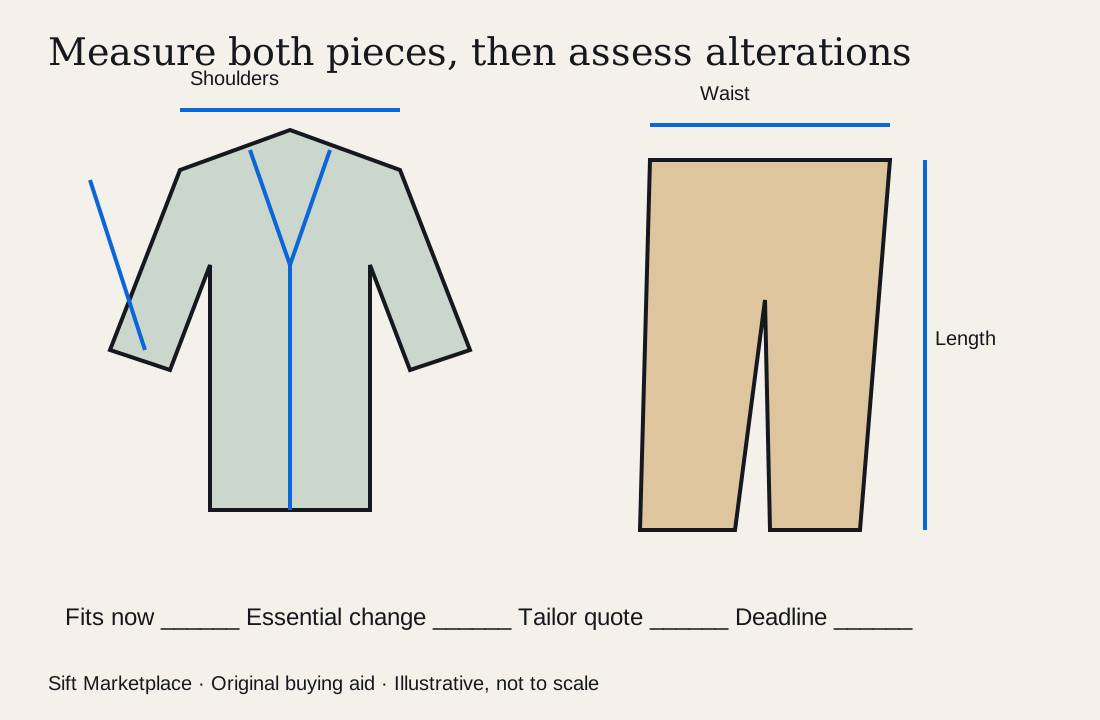
Ask the seller to lay garments flat without stretching and describe where each measurement starts and ends. Record jacket shoulder width, chest width, sleeve length and back length; trousers’ waist laid flat, rise, inseam, thigh and hem width. Compare them with a garment you already wear comfortably, measured the same way. A flat chest width is not a body circumference, so keep the method with the number.
Try the suit with the shirt, shoes and other layers you intend to wear. Button the jacket normally, sit, stand and move your arms gently. Look at collar contact, shoulders, chest, sleeve position and trouser comfort. Decide whether you like the overall proportions before asking how much can be altered.
Suitsupply’s alteration overview lists different operations for jackets and trousers. A secondhand garment needs its own assessment: remaining seam allowance, previous work, buttonhole position, lining and fabric condition can affect what is feasible. Do not use an online list of services as a promise that a particular used suit can be changed.
Separate a quoted alteration from a wish
Make three columns: fits now, desirable adjustment, essential change. Ask a tailor to inspect essential changes before purchase when their feasibility determines the deal. Give the tailor the event date as well as the desired result.
“Let the waist out” needs an assessment of the actual cloth available. “Shorten sleeves” needs the actual cuff construction considered. “Fix the shoulders” is not a small generic line item. Do not pin a fabric area yourself and assume the final shape or cost follows automatically.
If the seller cannot permit a fitting or tailor review, decide whether the available measurements give you enough confidence. A low price may suit a deliberate sewing project, but it does not establish a ready-for-event purchase.
Inspect wear where the outfit works hardest
Check the jacket’s collar, lapels, underarms, elbows, pocket openings and lining. Inspect trousers at the seat, inner thighs, crotch seams, knees, hems and waistband. Look for thinning, shine, holes, staining, odour, pulled seams and earlier repairs. Check zippers, hooks and buttons without pulling forcefully.
A missing ordinary button can be a known replacement; a missing distinctive matching set may change the appearance and cost. Fabric thinning around a repair can limit further work. Ask about cleaning history and obtain appropriate cleaning advice for stains rather than assuming every mark will disappear.
| Finding | Outcome |
|---|---|
| Good overall fit and sound matching cloth | Compare price plus ordinary preparation |
| Small confirmed alteration with time available | Negotiate using the actual quote |
| Essential change not assessed | Keep purchase conditional on feasibility |
| Mismatched cloth or heavily thinned seat | Choose another suit unless that limitation suits your purpose |
| Event arrives before fitting and work can finish | Treat timing as a failed requirement |
Compare the finished cost and deadline
In an invented example, Suit A is $90, with $85 confirmed alterations and $30 appropriate cleaning: $205. Suit B is $160, needs $20 hemming and $25 cleaning: $205. If A’s shoulder change remains unquoted, its total is still incomplete.
Use the cost calculator for purchase, repairs/alterations, transport and other confirmed preparation costs. Keep the completion date beside the total. A useful seller request is: “Could you send both composition labels and matching-piece photos, the flat measurements with their method, and details of previous alterations? I need a fitting before committing.” Buy the fit and cloth you can establish, with a feasible path to the finished outfit.
Sources
- 01Suitsupply Alter your fit