How do you buy a used wedding dress that can fit you?
Quick answer
Buy a used wedding dress by its current measurements and alteration history, not the size on its label. Try it with the shoes and undergarments you expect to wear, inspect every layer and ask a qualified alterations specialist what is feasible. Include cleaning, repairs and fittings before deciding whether the asking price is a saving.
Start with the dress as it exists today
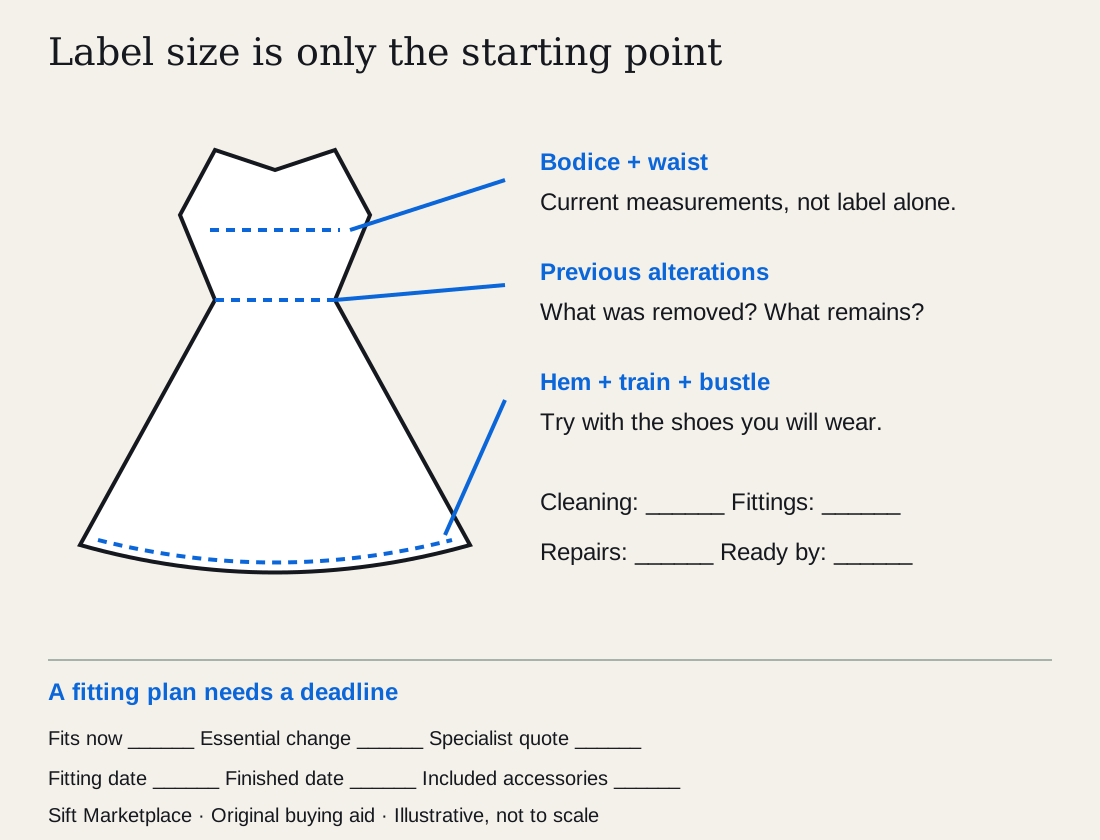
A wedding dress may have been shortened, taken in, reshaped or fitted with cups and a bustle. Its label describes an original size, not necessarily its current shape. Ask for designer, style number, labelled size and a clear account of every alteration.
Request current bust, waist and hip measurements where relevant, along with length information. Agree how measurements were taken; a flat garment measurement is not the same as a body circumference. A fitted bodice, bias-cut skirt and heavily structured gown need different judgement.
David’s Bridal’s alterations guidance explains that style, fabric and seam allowance affect feasibility. Use a qualified specialist’s assessment of the actual dress rather than a general promise that any gown can change several sizes.
 Enlarge diagram
Ask for photographs of the places a portrait misses
Request the underarms, inside neckline, waist seams, zipper or closure, hem underside and train. Ask for photographs in ordinary light without colour-altering filters.
Look for missing beads, torn mesh, pulled threads, makeup marks and discolouration. Inspect outer fabric and lining separately. A clean-looking outer skirt may hide a worn lower lining, and delicate layers can catch on one another.
Ask when it was worn, when it was cleaned, who cleaned it and how it was stored. A receipt provides history, not a guarantee that every mark is gone. If it is boxed or preserved, agree how inspection will happen before travelling.
Arrange a fitting that answers practical questions
Bring the shoes or equivalent heel height and the undergarments you intend to wear. David’s Bridal’s fitting advice highlights why these change hem and fit decisions.
- Check the closure gently. Do not force a zip or strain buttons to make an undersized gown close.
- Assess the bodice. Notice gaping, pressure, misplaced cups and where the waist sits. A dress can close while fitting poorly.
- Sit and move normally. Check comfortable breathing, arm movement and whether the skirt permits the movement you need.
- Check the hem with shoes on. Look at front and sides, not only the train. Confirm what was cut away during earlier alterations.
- Ask for a bustle demonstration. Identify each hook, loop or tie and check whether any attachment is missing.
- Inspect after fitting. With permission, examine seam allowances and alteration work with your specialist. Do not unpick seams at a viewing.
A fitting is a condition and feasibility check. You do not need to commit because the gown photographs beautifully or the seller has another appointment.
| Finding | What to establish before buying |
|---|---|
| Slightly loose bodice | Alteration method, cost and effect on embellishment |
| Too-small waist or bust | Actual remaining seam allowance and feasible result |
| Hem already too short | Whether there is a realistic design solution you want |
| Torn lace or missing beading | Material match and repair quote |
| Train drags with bustle fastened | Adjustment needed and fitting availability |
| Unidentified stain | Appropriate cleaning assessment; removal is uncertain |
Build a complete dress budget
Write a fitting plan with three categories: fits now, desired change and essential change. Record which layer or feature is involved (bodice structure, closure, lace placement, hem, lining or bustle) and who has assessed it. Do not turn a specialist’s general range of alterations into acceptance of your actual dress.
Book the feasibility assessment early enough to influence the purchase. Give the specialist your event date, shoes/heel height, intended undergarments and photos of previous work. Ask whether the design you want can be achieved, how many fittings are needed and when the finished dress can be ready. The David’s Bridal Q&A makes alteration feasibility dependent on the gown and explains why shoes and undergarments matter. It does not promise that any used dress can be changed by a fixed number of sizes.
In a hypothetical comparison, Dress A is $250, with $120 cleaning, $230 confirmed alterations and $50 pressing: $650. Dress B is $450, with $100 cleaning, $60 hemming and $40 pressing: $650. If A still needs unassessed bodice reconstruction, its total is incomplete. If B cannot be finished by your event date, the equal total does not make it a suitable option.
Ask a suitable cleaner to assess unidentified marks before you rely on removal. A cleaning receipt gives useful history but does not describe a later stain or storage damage. For a preserved gown, agree a way to inspect it without treating unopened packaging as proof of condition.
Use the cost calculator for confirmed work, accessories and collection. Keep the appointment and completion dates beside the total. The listing comparison tool can preserve current measurements and included pieces. A nearby fitting with a feasible schedule can be worth more than an apparently cheaper remote dress.
Ask: “What has been cut away or altered, and may my specialist assess the essential changes before I commit? Please confirm which photographed accessories are included.” Buy a credible path to the finished dress you want, rather than a discount from its original retail price.
Confirm what is included and how to bring it home
List the veil, belt, detachable sleeves, straps, garment bag and spare fabric explicitly. Accessories in wedding photos may belong to another person or have been sold separately.
Plan clean transport with room to avoid crushing embellishment. Follow the cleaner’s or maker’s storage advice for the fabric, and keep the gown away from food, dampness and unnecessary handling. Do not assume hanging every heavy dress by narrow shoulder straps is appropriate.
For remote purchases, precise photographs and measurements matter even more because fitting is unavailable. Understand the actual return arrangement before payment. A local fitting can be worth more than a slightly lower distant price.
Search designer and style number, then broaden to silhouette and fabric. Sift’s Marketplace filters help organise local options on a computer. Keep your measurement notes and fitting budget beside the shortlist so a price drop leads to a better decision, not a rushed one.
Questions people ask
Can a wedding dress always be let out?
No. The available seam allowance, previous alterations, fabric and construction determine what is possible. A seller’s original size does not prove there is material left to release. Have an alterations specialist assess the actual dress before buying a too-small gown.
How do I compare a used dress with my height?
Ask how it was hemmed and what shoes the seller wore, but use an actual fitting with your intended shoes. Torso proportions, waist placement and skirt shape affect the result. A hem cannot automatically be restored to its original length.
Should I buy a preserved dress without opening it?
If condition matters to the price, agree on a way to inspect it before paying. A sealed preservation box is not a current condition report. Check any provider instructions before opening and decide explicitly whether you are willing to buy without examining the fabric.
Sources
- 01David’s Bridal Alterations questions answered
- 02David’s Bridal Wedding dress alterations guide