How do you decide whether a used area rug is worth buying?
Quick answer
Unroll the entire rug, inspect its backing and edges, and identify the fibre before deciding whether stains are a cleaning job or a reason to pass. Measure your room and the rug itself. Get a suitable cleaning quote for delicate or unidentified materials; a large discount can disappear when cleaning, transport and a new pad are included.
Measure the space and decide how the rug will be used
Mark the intended footprint with removable tape before browsing. Consider furniture legs, door clearance, heating vents and the path people walk. A listing’s rounded size may include fringe or may simply be an estimate.
Ask for actual width and length, with fringe measured separately where relevant. For a rug under a dining table, allow for chairs being pulled out. For an entry, think about wet shoes and whether the material’s care requirements suit that use.
Check how the rug will get home. A rolled rug is long, and a large thick one can be difficult to carry. Confirm your vehicle’s internal length and a clean way to protect the roll.
 Enlarge diagram
Identify the material before believing a cleaning promise
Ask for the care label and any original purchase information. Wool, synthetic pile, silk, viscose, jute and blends should not be treated as equivalent cleaning jobs. Construction matters too: a woven foundation and a tufted rug with attached backing can fail differently.
“Looks like wool” is not identification. If the label is missing, describe the material as unknown until a rug specialist assesses it. Do not perform a burn test or apply chemicals to someone else’s rug.
The Rug Doctor cleaning instructions exclude several delicate and natural-fibre rugs from their machine process. The practical lesson is to establish a suitable cleaning method before purchase, not to rent a machine and find out afterwards.
Ask to see the whole rug
A tightly rolled rug hides both damage and smell. Arrange a viewing where it can be fully opened on a clean, dry surface. Ask for close photographs of stains in advance so the meeting is not a surprise negotiation.
Find out where it was used, whether pets had access, how it was cleaned and whether it has been stored damp. These answers help target your inspection, but they do not replace looking at the actual material.
For a valuable handmade or collectible rug, get independent expertise on construction, repair and identity. A brand label, seller story or attractive pattern is not enough to establish origin or investment value.
Inspect face, reverse and edges
- Look across the face in even light. Check colour changes, traffic lanes, flattened patches and stains. View the pile from both directions because its appearance can change with the light.
- Examine high-wear areas. Look for exposed foundation, thinning pile or missing tufts. Separate ordinary shading from physical material loss.
- Inspect edges and fringe. Check unravelled ends, loose binding and whether fringe is attached or part of the construction.
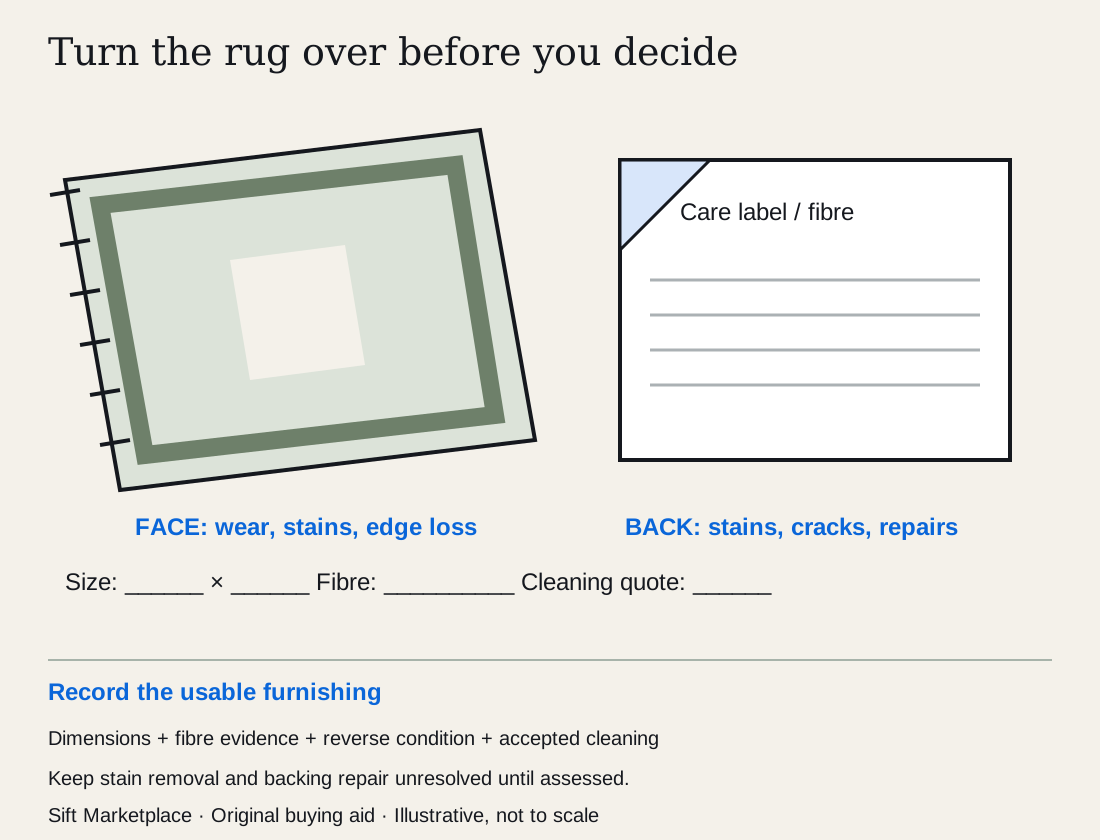
- Turn it over with help. Look for staining, patches, uneven repairs and backing separating from the rug.
- Flex gently where appropriate. Notice backing that cracks or sheds debris. Do not fold a stiff rug sharply.
- Assess odour without masking it. Strong fragrance can make this difficult. If damp or pet odour is unacceptable to you, do not assume cleaning will solve it.
Stop if you find signs of pests or mould. The useful buying choice is another rug, not a home treatment experiment.
| Finding | Next step |
|---|---|
| Small removable surface debris | Plan cleaning appropriate to the care label |
| Distinct stain of unknown origin | Ask a suitable cleaner before relying on removal |
| Worn-through pile | Decide whether visible material loss is acceptable |
| Loose edge binding | Obtain a repair quote |
| Brittle or separating backing | Investigate construction failure; cleaning is not a repair |
| Unknown fibre and no care information | Treat cleaning cost and outcome as unresolved |
Price a usable rug, including the pad
Make a record with actual dimensions, construction/fibre evidence, face damage, reverse/backing condition, edge work and the cleaning method a suitable provider accepts. Keep “material unknown” visible when there is no label; do not turn a guess into the basis of a cleaning quote.
Give the cleaner photos of both sides and the actual stain or odour history. Ask what the quote covers, whether removal is uncertain, and whether a repair must happen first. A cleaning price is not a promise that a stain, degraded backing or odour will disappear. Rug Doctor’s instructions are an example of machine-specific exclusions, not a general permission to wash every rug.
Compare like-sized useful alternatives. For illustration, Rug A costs $70, with $110 accepted cleaning, $45 edge repair, $35 compatible pad and $20 collection: $280. Rug B costs $160, with $60 cleaning, $35 pad and $20 collection: $275. These invented amounts do not value a collectible rug or guarantee a cleaning result. If A’s backing is separating, the repair plan remains unresolved even though the arithmetic is complete.
Check the floor and pad makers’ guidance before selecting the underlay. Measure the rolled package as well as the flat rug, and agree who will help lift it. Keep the collection route dry and protect the roll from dirt. Use the cost calculator for actual quotes and the listing comparison tool for dimensions and unresolved condition.
A useful message is: “Could you show the whole rug flat, both sides, the material/care label and close views of the stain and edges? I need a cleaning assessment before relying on it for this room.” If the seller will only display a folded corner, the hidden condition remains part of your decision.
Search by dimensions as well as style
Try actual dimensions, common rounded sizes, material and pattern terms separately. Sellers may use “carpet,” “area rug” or “runner” for different shapes. The search guide helps you widen the wording.
Sift’s Marketplace filters can keep nearby listings focused on useful terms. Once you shortlist a rug, the full unrolled inspection and realistic cleaning plan decide whether it is a saving.
Questions people ask
Can I clean any used rug with a rental carpet cleaner?
No. Material and construction matter. Rug Doctor’s instructions exclude several delicate and natural-fibre rugs from its machine process. Follow the rug’s own care label and ask a specialist when the fibre or dye stability is uncertain.
Is shedding always a sign of damage?
Not necessarily, but loose surface fibres and a backing that crumbles are different findings. Check the care information and construction. Inspect worn areas for thinning, exposed foundation and loose tufts before deciding what the shedding means.
Should I buy a rug with pet odour?
Only if you are comfortable with an uncertain cleaning result and have a suitable professional assessment. A seller’s promise that the smell will wash out is not evidence. If you would reject it in its current state, price and decide with that uncertainty visible.
Sources
- 01Rug Doctor Mighty Pro X3 cleaning instructions