What should you inspect before buying a used aquarium?
Quick answer
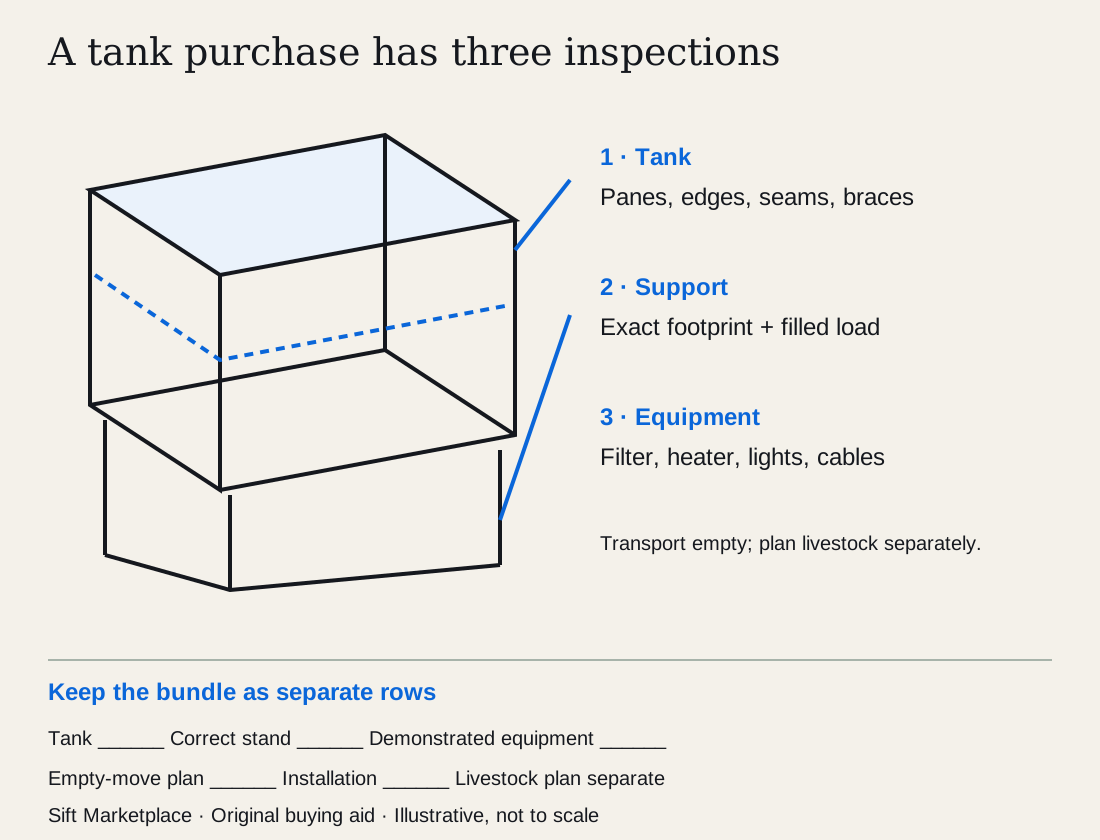
Inspect every pane, edge, seam and brace, then confirm the stand is suitable for the exact tank and its filled weight. Ask for a recent, safe water-holding demonstration and inspect the equipment separately. Do not move a filled tank or assume fresh silicone makes a repair sound. Cracks, damaged bracing or doubtful support are reasons to pause.
Identify the tank and support requirements
Ask for manufacturer, model, dimensions and whether the tank is glass or acrylic. “About 40 gallons” is not enough to identify the correct stand, lid or replacement brace. Photograph labels and measure the footprint.
Separate the aquarium from the furniture beneath it. Ask whether the stand was sold for that tank, modified or exposed to water. Check the maker’s support instructions, particularly for rimmed and rimless designs. Do not improvise a foam layer unless the manufacturer calls for one.
Aqueon’s setup guidance requires a sturdy, level location. That is a starting point, not a capacity certification for an unidentified cabinet. If the tank is unusually large or the floor support is uncertain, resolve the installation before buying.
 Enlarge diagram
What history should you request?
Ask when it last held water, whether it leaked, whether it was resealed, and whether it was used for fish, reptiles or another purpose. Ask what cleaners or treatments were used. A tank with unknown chemical history may not suit the animals you plan to keep.
Request photos of all corners, seams, braces and the underside or base where visible. Look for chipped edges, repaired cracks and missing frame sections. Clarify any fresh silicone, adhesive or added bracing rather than treating it as evidence of maintenance.
If livestock is included, arrange its care separately before collection. Buying a tank does not create a safe home for its occupants automatically. Do not use this equipment checklist as a stocking, cycling or animal-care plan.
Inspect before any water demonstration
- Examine panes and edges. Look for cracks, deep damage and chips near seams. Acrylic scratches and glass damage need different assessment.
- Follow the seams. Inspect continuity, separation, lifting edges and evidence of previous work. Do not pick at silicone.
- Check every brace and frame section. A missing brace may be structural rather than decorative.
- Inspect the stand. Look for swollen panels, loose joints, corrosion, sagging and altered supports.
- Check lids and covers. Confirm fit and account for openings needed by your equipment.
- Record unresolved damage. Stop the purchase process if you cannot establish whether the tank or support is sound.
Do not fill a visibly cracked or damaged tank to see whether it survives. A seller’s improvised repair deserves assessment before a demonstration.
What does a water-holding check prove?
For an apparently intact tank, arrange a demonstration in a suitable location on correct support, following the manufacturer’s setup instructions. Ask how long it has been holding water and inspect around the seams and base.
A recent continuous view or dated evidence may help you decide whether to travel, but it does not replace the tank in front of you. A short check can reveal an active leak; it cannot guarantee that a seam will never fail.
Do not move a filled aquarium. Plan to drain and transport the empty tank appropriately, with enough people and protection for its shape and weight. The stand needs its own transport plan. Large tanks may justify professional movers familiar with aquariums.
| Finding | Response |
|---|---|
| Crack or damaged structural brace | Pause; do not perform a fill test |
| Fresh sealant with no repair history | Ask exactly what was repaired and seek assessment |
| Swollen stand panels | Confirm structural suitability or replace the stand |
| Light cosmetic scratching | Decide whether visible appearance suits you |
| No demonstration of water holding | Treat condition as unverified |
| Incomplete filter plumbing | Identify each missing part and its cost |
Test accessories as separate items
Write down filter, heater, light and pump models. Check cables, plugs, housings and visible corrosion before any powered demonstration. Use each device only in the operating conditions its manual requires; an aquarium heater or pump may be damaged or hazardous if run dry.
Ask the seller to demonstrate normal operation safely. Look for leaks in filter connections and check whether tubing, media baskets, intake guards and mounting brackets are included. An impressive collection of loose parts may be less useful than one complete supported filter.
Used filter media is not a guaranteed ready-made biological system. Plan the tank’s preparation and cycling using suitable aquarium-care guidance for your intended livestock.
Compare a complete installed setup
Make an inventory with separate rows for tank, stand, lid, filter, heater, light and pump. For each, record model, required parts, observed condition, correctly demonstrated function and missing evidence. A bundle price should not force you to value every unidentified accessory as usable.
For example, a hypothetical $100 tank package needs a $140 confirmed suitable stand, $55 filter parts, $45 replacement heater and $30 collection: $370. A $270 complete package with the correct stand and $30 collection totals $300, subject to its own condition and appropriate demonstrations. These invented numbers exclude livestock and the ongoing setup/care budget. An unassessed seam repair is not made acceptable by allocating a small silicone allowance.
Aqueon’s aquarium catalog emphasizes an appropriately designed and sized aquarium stand. Keep the actual model’s support requirements with the record; “solid wood” and a furniture weight guess do not establish suitability. Confirm the final location and any uncertain building support with an appropriate professional before collection.
If the seller is keeping livestock, agree when the tank becomes empty and how you will inspect it. If livestock is included, settle its care and collection plan in advance through suitable aquarium guidance.
Plan an empty-tank move with protection appropriate to the model. Measure the tank, stand and access path separately; a stand may be the larger item. Agree which parts can be removed under their instructions and who will handle them. Use the cost calculator for confirmed amounts and the listing comparison tool for evidence gaps.
Ask: “Could you send the tank/stand identities, leak and repair history, accessory models and which items can be demonstrated under their proper operating conditions?” Search by actual dimensions as well as capacity so a large but unsuitable bundle does not dominate your shortlist.
Questions people ask
Is an empty aquarium proof that it does not leak?
No. A dry tank cannot demonstrate that it holds water. Ask about its history and arrange an appropriate water-holding check on suitable support if the tank has no visible damage. A brief demonstration still cannot guarantee future seam performance.
Can I use any sturdy-looking cabinet as a stand?
No. Confirm support requirements for the exact tank and the stand’s intended capacity. Water, substrate and equipment add substantial load. A level top alone does not establish adequate strength or the correct support pattern.
Is a resealed aquarium a good buy?
It depends on the tank, damage history and quality of the work. Fresh sealant is not evidence that a structural joint was correctly repaired. Ask what was done and by whom; seek a knowledgeable assessment or choose an intact tank with clearer history.
Sources
- 01Aqueon 15 Column aquarium setup guide
- 02Aqueon Jukebox aquarium setup guide