How do you check a used tool chest before buying?
Quick answer
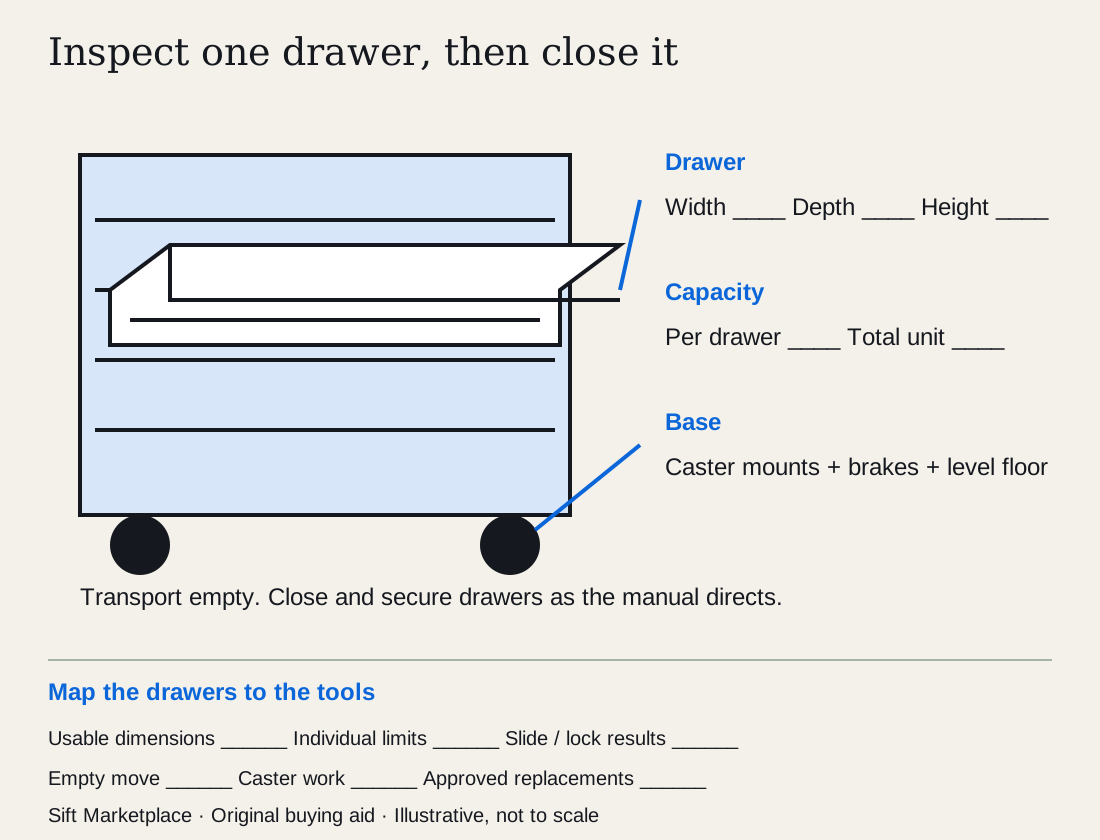
Inspect the chest on level ground, opening one drawer at a time. Check slides, drawer bottoms, caster mounts, brakes and locks, then verify the model’s total and individual-drawer load ratings. Measure usable drawer space and the transport route. Plan to move it empty and secured according to its manual; a heavy cabinet is not automatically a high-capacity one.
Measure the tools as well as the cabinet
Decide which tools will live in shallow drawers and which need deeper space. Measure your longest cases, socket trays and power tools. External cabinet width does not tell you usable drawer depth or clearance below the next drawer.
Ask for exact model, dimensions and whether it is one cabinet or a stack of separate pieces. Confirm the side handle, worktop, locks and any side cabinet are included. A photographed top chest may be listed separately.
Find the manual and rated capacities. The Husky workbench guide illustrates separate total and drawer limits. Use the actual model’s values; heavier-looking steel is not a capacity specification.
 Enlarge diagram
Check the cabinet before loading it
Inspect on a level surface with the brakes set as the manual directs. Keep children away and do not lean on open drawers. Ask the seller to remove contents so you can see the bottoms and test operation without hidden loads.
Look along the cabinet sides and top for distortion. Uneven gaps, a twisted frame or drawers that rub in the same area can indicate more than a damaged slide. Ask whether it was dropped, overloaded or modified.
Inspect the base from a safe position without tipping it over. Check caster mounting plates, visible fasteners, corrosion and cracks. A shiny replacement wheel does not establish that the structure holding it is sound.
Work through every drawer
- Open one drawer normally. Check travel, rubbing and whether it sits level.
- Inspect the bottom and corners. Look for sagging, splits, heavy rust and liquid residue under liners, with permission.
- Check slides and stops. Confirm the drawer stays supported through its intended travel. Do not force it past a stop.
- Close it fully. Check that any latch engages, then move to the next drawer.
- Test the lock with all drawers closed. Confirm which compartments the key controls.
- Inspect the worktop and handle. Look for loose attachment, damage and modifications.
- Check brakes and ordinary rolling. Keep drawers closed and secured and use a level clear surface.
Do not test rated capacity by loading heavy tools into an unknown drawer. Verify the specification and judge visible condition; serious uncertainty calls for assessment rather than a stress test.
| Finding | What to establish |
|---|---|
| Scratched finish | Cosmetic preference and corrosion underneath |
| One rough slide | Exact replacement pair and fitting cost |
| Sagging drawer bottom | Damage extent and replacement availability |
| Several drawers misaligned | Possible frame distortion |
| Missing key | Correct lock or key replacement |
| Cracked caster mount | Structural repair assessment, not just a wheel price |
Confirm parts and electrical accessories
Replacement slides are not interchangeable simply because their length matches. Check the chest model, mounting pattern, load class and drawer arrangement. A proprietary lock bar or latch can also be harder to replace than expected.
If a power strip, charging drawer or light is included, inspect cords, plugs and housings before any demonstration. Do not energise damaged electrical equipment. Confirm that built-in accessories are original or properly specified for the unit.
Ask what the sale excludes. Tool chests are often photographed full, and the tools may not be included. If tools are part of the bundle, itemise them separately rather than paying an undefined premium for a filled cabinet.
Plan an empty, controlled move
Measure doors, lift capacity, vehicle opening and the path from workshop to vehicle. A chest may fit the truck bed but be impossible to load safely with the available equipment.
The cited Husky instructions require empty transport and proper securing. Follow the exact model’s method, including any separation of stacked units. Close and secure drawers, remove loose items and use suitable moving equipment and help.
Do not rely on the drawer lock as the only transport restraint, or assume caster brakes secure a cabinet inside a moving vehicle. If the route includes stairs or a steep slope, obtain appropriate moving assistance before purchase.
Compare usable storage cost
Make a drawer map for the tools you own: usable width/depth/height, drawer load limits, required dividers and the clear floor area needed to open it. Compare cabinet and individual drawer ratings separately. A broad “heavy duty” description does not tell you whether the deepest drawer suits your tools.
Record the result for each drawer, its lock, slides, caster/brake condition and all included keys. Follow the actual manual’s stability rules; do not open every drawer at once as a test. The Husky use guide is one model-specific example of capacity and safe use instructions.
In an invented comparison, Chest A costs $170, needs $70 confirmed slides/lock parts and $90 moving: $330. Chest B costs $250 with $50 moving: $300. If replacement slides cannot be identified, A’s repair remains open; its overall width does not compensate for unusable drawers.
Plan an empty move with suitable equipment and help, using the maker’s transport guidance. Tools pictured inside are not included unless listed. Use the cost calculator for real quotes and the listing comparison tool for the drawer map. Ask: “Could you send usable drawer measurements, model/rating labels, keys and every known slide or caster issue?” Search by layout as well as cabinet width.
Questions people ask
Can I test a chest by opening every drawer?
No. Multiple open drawers can create a tipping hazard. Follow the model’s instructions and inspect one at a time with the chest on a level surface and brakes set as appropriate.
Does the total weight rating apply to each drawer?
No. Individual drawers can have lower or different limits, and the worktop may have its own allowance. Read the exact model’s specification. Do not infer load capacity from steel thickness, size or brand alone.
Can I transport it full of tools?
Follow the manufacturer’s transport instructions. The cited Husky manual requires empty transport and securing the cabinet. Loaded drawers and an unsecured top chest create avoidable moving hazards; plan unloading before collection.