How do you inspect a used snowblower before buying?
Quick answer
Choose a snowblower suited to your surface and storage space, identify its exact model, and inspect the housing, controls, guards and service history. Ask the seller for a normal outdoor demonstration following the operator’s manual. Keep inspection external and stay clear of the auger and chute; a running engine alone does not prove snow-clearing performance.
Match the machine to the surface
Write down the area you clear, surface type, slopes, storage opening and how much machine you can comfortably manoeuvre. A single-stage machine intended for paved surfaces may be unsuitable for your gravel area; check the exact manual rather than relying on the category name.
Ask for the manufacturer, model and serial label, plus engine details for a petrol machine or battery and charger labels for cordless equipment. The operator’s manual should match the actual unit.
Toro’s Power Clear manual, for example, identifies specific models and states their operating limits. It is a useful example of why one snowblower’s instructions should not be applied to another.
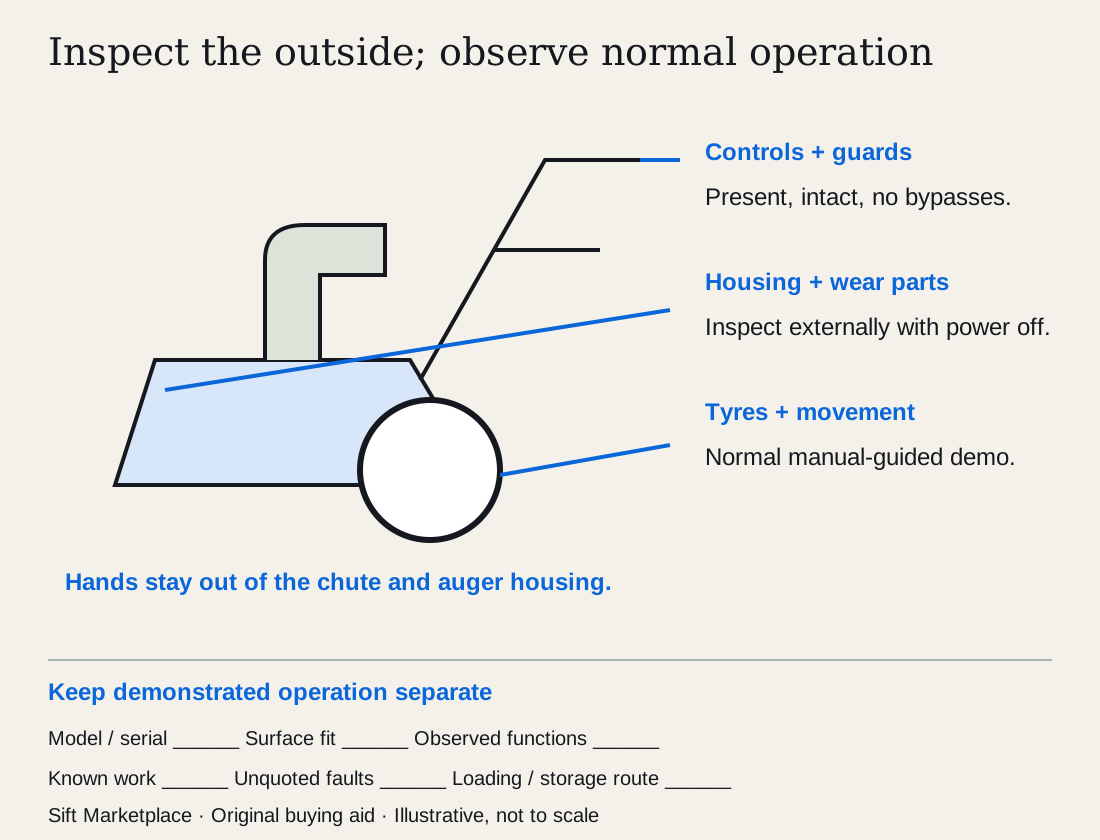 Enlarge diagram
Ask about storage and service
Find out when it last cleared snow, what maintenance was done and whether it has suffered an impact or blockage. Ask for service receipts and a list of replaced parts. A newly painted housing does not establish the condition beneath it.
For a petrol machine, ask the seller not to run it before you arrive if a cold-start demonstration is practical. Use the proper starting procedure; do not require an arbitrary number of pulls as a pass criterion.
For battery models, identify every pack and charger. Ask about age, storage and runtime experience, but distinguish the seller’s estimate from a capacity test. A full indicator does not prove how long it will clear heavy snow.
Keep the first inspection external and powered off
- Read the labels. Confirm model identity and look up the proper manual and any applicable manufacturer safety notices.
- Check housing and chute exterior. Look for severe corrosion, cracks, bent edges and damage around mountings.
- Inspect handles and controls. Look for loose joints, frayed visible cables and controls tied or held in position.
- Check guards and safety parts. Missing or bypassed equipment must be resolved before operation.
- Look at tyres, wheels or tracks. Check obvious damage, retention and condition without reaching into mechanisms.
- Check visible wear items. Compare scraper, skid or paddle wear with the model’s guidance only where safely visible.
- Look for leaks or damaged electrical parts. Do not proceed with a demonstration if the setup is unsafe.
Do not remove covers, tilt an unfamiliar machine or reach into the auger housing as a buyer’s test. Have a qualified service provider assess internal or uncertain condition.
Watch a normal demonstration
The seller should follow the operator’s manual outdoors in an appropriate clear area, with bystanders away and discharge directed safely. Petrol engines must not be demonstrated inside a garage or enclosed space.
Observe startup, ordinary running, chute adjustment and the controls the manual permits you to test. Check propulsion if fitted. Stop for abnormal vibration, persistent concerning smoke, leaks or controls that fail to release normally.
Keep hands and feet clear of moving parts and the discharge opening. If a blockage occurs, the seller must use the manual’s complete shutdown and clearing procedure with a proper clean-out tool. Never use a hand to clear a chute.
Without snow, record that clearing performance is untested. Do not substitute gravel, leaves or objects to create a load. A running engine and moving auger do not establish how well the machine handles your winter conditions.
| Observation | Buying response |
|---|---|
| Normal start and controls demonstrated | Useful evidence, with load performance still separate |
| No snow available | Keep clearing ability marked untested |
| Engine does not start | Treat as non-running until diagnosed |
| Safety control tied back | Require proper repair before use |
| Heavy housing corrosion | Seek structural assessment or pass |
| Battery powers a brief run | Capacity under snow load remains uncertain |
Price the machine and its unresolved work
Keep the machine’s exact model/serial, intended surface, demonstrated functions, known wear and service quote in one record. A normal summer demonstration can reveal some operation, but it cannot establish how the machine will handle your snow. Keep that limit visible instead of treating “runs” as a complete result.
Use the exact manual to identify wear parts and transport requirements. The Toro Power Clear manual is a model-specific example, not a parts or procedure guide for every snowblower. A seller’s “just needs a carb clean” is an unconfirmed diagnosis; have the issue assessed or compare it as a project.
In a hypothetical example, a $180 machine needs $140 confirmed service, $60 wear parts and $40 transport: $420. A suitable $340 machine plus $40 transport totals $380. An unquoted drive fault or unavailable battery leaves the total incomplete. Enter actual quotes in the cost calculator.
Measure gate, shed and loading access before payment. Arrange suitable transport and follow the machine’s instructions; do not improvise ramps or reach into the chute for a buying check. Ask: “Please send the model/serial, service history and known faults; can we observe normal permitted operation in a suitable location?” Search for the kind of machine your surface requires and keep repair projects visibly distinct.
Questions people ask
Can I judge a snowblower in summer?
You can inspect its exterior, controls, startup and normal operation, but without suitable snow you cannot fully demonstrate clearing performance under load. Record that limitation rather than replacing it with an improvised test using leaves, gravel or other material.
Is ‘just needs a carburetor clean’ a cheap fix?
It is an unverified diagnosis until a qualified person establishes the cause. A non-running machine may have other faults. Obtain a service estimate or compare it as a project, not as a working snowblower with a guaranteed small repair.
Should I reach into the chute to check the auger?
No. Keep hands out of the chute and moving assemblies. For any blockage, follow the exact shutdown and clearing procedure in the operator’s manual and use the specified clean-out tool. Buying inspection does not require reaching inside.