How do you buy used luggage that is ready to travel?
Quick answer
Measure the suitcase including wheels and handles, then test its wheels, telescoping handle, zippers and locks with a light load inside. Match it to your airline’s current allowance and your transport needs. Check the exact model before pricing repairs: a wheel that looks replaceable may need a specific assembly that is no longer available.
Choose the trip before choosing the case
Decide whether you need a cabin suitcase, checked bag, train-friendly roller or soft duffel. A case that fits an overhead allowance can still be awkward on stairs; a large hard shell can protect its shape while taking up more storage space at home.
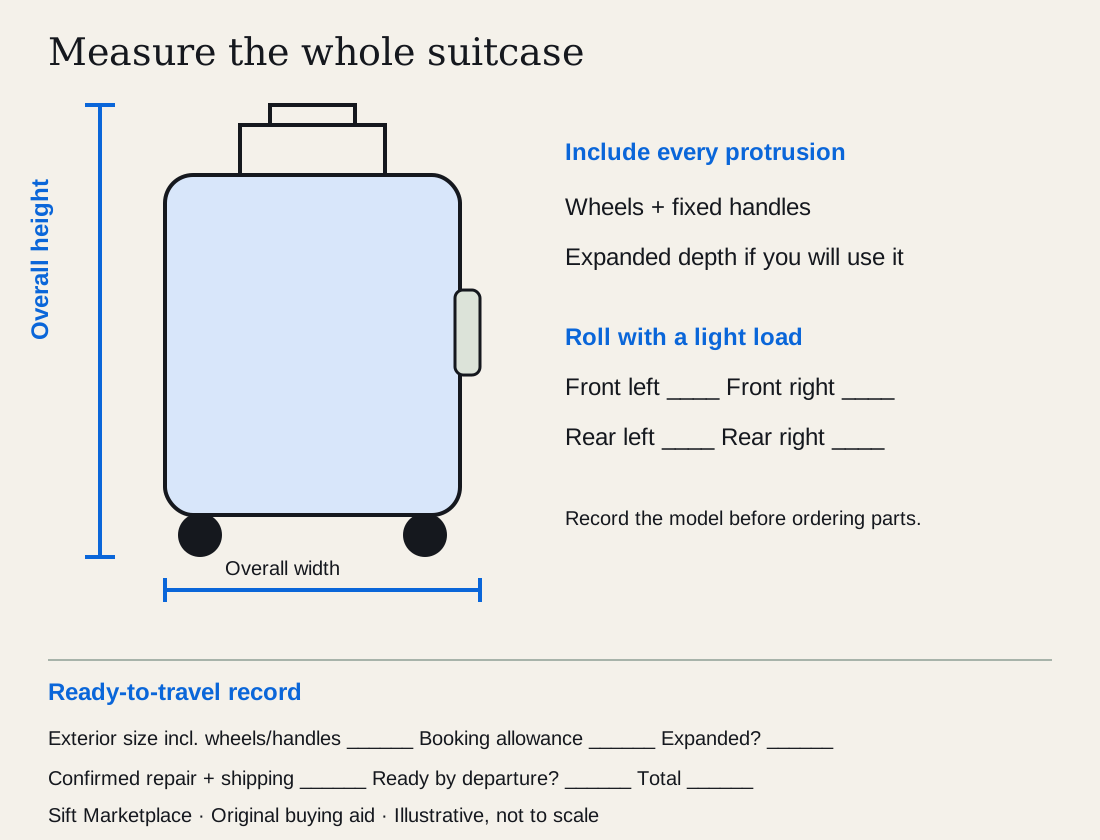
For air travel, check your airline’s current baggage allowance for the booking you intend to make. Measure the actual item, including wheels, handles and pockets. Do not rely on “international carry-on” in a title or the seller saying they have never been stopped.
Ask for the model label and dimensions in its normal and expanded configurations. An expandable zipper gives extra volume but can also push the loaded case beyond the size you planned around.
 Enlarge diagram
What photos save an unnecessary trip?
Request all sides, the wheel housings, extended handle, opened interior and model label. Ask whether the case has been repaired, whether a wheel or handle was replaced and whether any lock is stuck.
Inspect interior photos for torn divider mesh, loose straps and stains near seams. Look at the outside for distorted corners or a crack continuing around a wheel mount. Surface scratches tell you about appearance; a split at a loaded attachment point has a different consequence.
Parts are model-specific. Samsonite’s FAQ asks buyers seeking wheels to distinguish left and right, front and rear. Its repair guidance also shows why a repair may involve service and shipping, not simply buying a wheel from a shelf.
Give it a light-load demonstration
Bring clean, soft items or use an agreed light load. Do not pack it beyond its normal use or ask the seller to drag it over damaging ground.
- Roll in several directions. Spinners should turn and track without a jammed wheel. Try a smooth surface and an ordinary floor transition.
- Check each wheel separately. Look for flat spots, split tyres, missing fasteners and cracks where the housing joins the case.
- Extend the handle fully. Try its intended positions and release button. Some side movement is normal; a handle that collapses unexpectedly or will not latch needs attention.
- Operate all zippers. Open the main compartment, expansion section and pockets. Watch for teeth separating behind the slider or fabric caught in a damaged track.
- Demonstrate locks. The seller should open them normally. Agree on a combination reset using the maker’s procedure.
- Check carrying handles and interior straps. Look for separating stitching and broken adjusters. Lift only the agreed load.
A bright shell and smooth empty-case roll do not answer how it behaves once packed. The light-load test gives you a more relevant impression without claiming to reproduce an airline trip.
| Finding | What to establish |
|---|---|
| Shell scuffs | Whether appearance matters to you |
| Wheel rattles or binds | Exact replacement assembly and fitting cost |
| Split shell near a handle | Whether an authorised repair is practical |
| Zipper separates after closing | Repair estimate; do not call it a cosmetic flaw |
| Telescoping handle slips | Whether replacement parts exist |
| Persistent odour or damp interior | Whether you are willing to accept uncertain cleaning results |
Check the inside as carefully as the outside
Open all compartments and look into lining folds and seams. Check for debris, dampness, powdery residue, sticky spills and signs of pests. If you see evidence of infestation, choose another case rather than planning to bring the problem home.
Ask permission to move removable liners, but do not cut or undo structural fasteners. A concealed repair or stain is worth understanding before purchase. Cleaning methods depend on shell and lining materials; follow the manufacturer’s instructions after buying.
Do not assume a seller’s fragrance means a clean interior. If odour is a concern, assess it with the case open, away from scented sprays. A washable organiser cannot remove odour from the suitcase itself.
Put dimensions, repairs and departure on one record
A case must be ready for the trip you have booked, not merely repairable eventually. Record the dimensions you measure, including protruding parts, beside the allowance for that specific booking. Write down whether the case was expanded and whether it held the agreed light load.
| Field | Candidate A | Candidate B |
|---|---|---|
| Actual exterior dimensions | Measure wheels, handles and pockets | Measure the same way |
| Intended booking allowance | Check current airline/fare terms | Use the same trip requirement |
| Wheels and handles under a light load | Observed result | Observed result |
| Repair | Exact part, fitting and shipping quote | Exact part, fitting and shipping quote |
| Ready date | Confirmed or uncertain | Confirmed or uncertain |
| Cash needed | Price + collection + confirmed completion work | Same scope |
Imagine a $40 case needing $35 in confirmed wheel work and $20 shipping, for $95 before collection. A $75 local case with sound wheels and $10 collection totals $85. These numbers are hypothetical. If the first repair will not be ready before departure, its lower original asking price is irrelevant to this trip.
Samsonite’s repair policy makes assessment, repairability and shipping part of the service process. Do not treat a famous brand as a promise of free service for a second-hand case. Ask the service provider about this specific model, damage and ownership situation before assigning a warranty benefit.
A useful seller question is: “Please show the model label, all wheel mounts and the extended handle. What are the outside dimensions including wheels and handles, and can we try the case with a light load? I need it ready by [date], so any repair or lock issue matters.”
Compare the ready-to-travel total
Add confirmed repair costs, replacement locks or straps and travel to the asking price. Include the inconvenience if a repair requires shipping the case away before your departure. A working case you can use now is a different offer from one waiting for a proprietary part.
An illustrative decision: two cases have the same asking price, but one needs an unavailable handle while the other has ordinary scuffs. The scuffed case may be the only usable option. That is a compatibility decision before it is a negotiation.
Use the listing comparison tool to record dimensions, weight if known, repairs and departure timing. The fair-price guide helps put seller expectations in context.
Search model names and ordinary terms such as “spinner suitcase” separately. Sift’s Marketplace filters work on a computer to keep relevant local options together. Carry-on compliance, cleanliness and condition still need your own checks.
Questions people ask
Is a suitcase labelled carry-on accepted by every airline?
No. Check the current allowance for your airline, fare and route, then measure the actual suitcase including protruding wheels and handles. A product name or seller’s past trip does not establish that it qualifies for your next flight.
Can I replace a broken suitcase wheel?
Sometimes, but match the exact model and wheel position. Samsonite’s parts guidance distinguishes front, rear, left and right wheels. Confirm availability and fitting cost before buying; a generic-looking wheel may not fit its housing.
Does a TSA-style lock come with a master key?
A traveller generally uses the combination or their own supplied key, depending on the lock. Do not expect a security-agency master key. Ask the seller to demonstrate normal opening and reset the combination using the luggage maker’s instructions.
Sources
- 01Samsonite Frequently asked questions
- 02Samsonite Service and repairs