Will a used tonneau cover fit your truck bed?
Quick answer
Match the cover’s exact part number and generation to your truck’s year, bed and rail arrangement, then inventory the complete mounting system. Inspect fabric or panels, rails, hinges, latches and seals. Nominal bed length, apparent width and a matching brand name do not establish compatibility, security or watertightness.
Record the truck configuration and daily use
Write down the truck’s year, model, cab/bed configuration, factory track or rail system, bedliner and existing accessories. Photograph the bed edges, bulkhead and tailgate. Include a toolbox, bed rack, sport bar or tailgate accessory that might conflict with the cover.
Measure using the cover maker’s stated method and compare with the exact application list. Do not substitute an outside body measurement for an inside bed measurement. “Fits a six-foot bed” is a discovery clue, not a fit result. Trucks with similar advertised bed lengths can require different covers and mounting pieces.
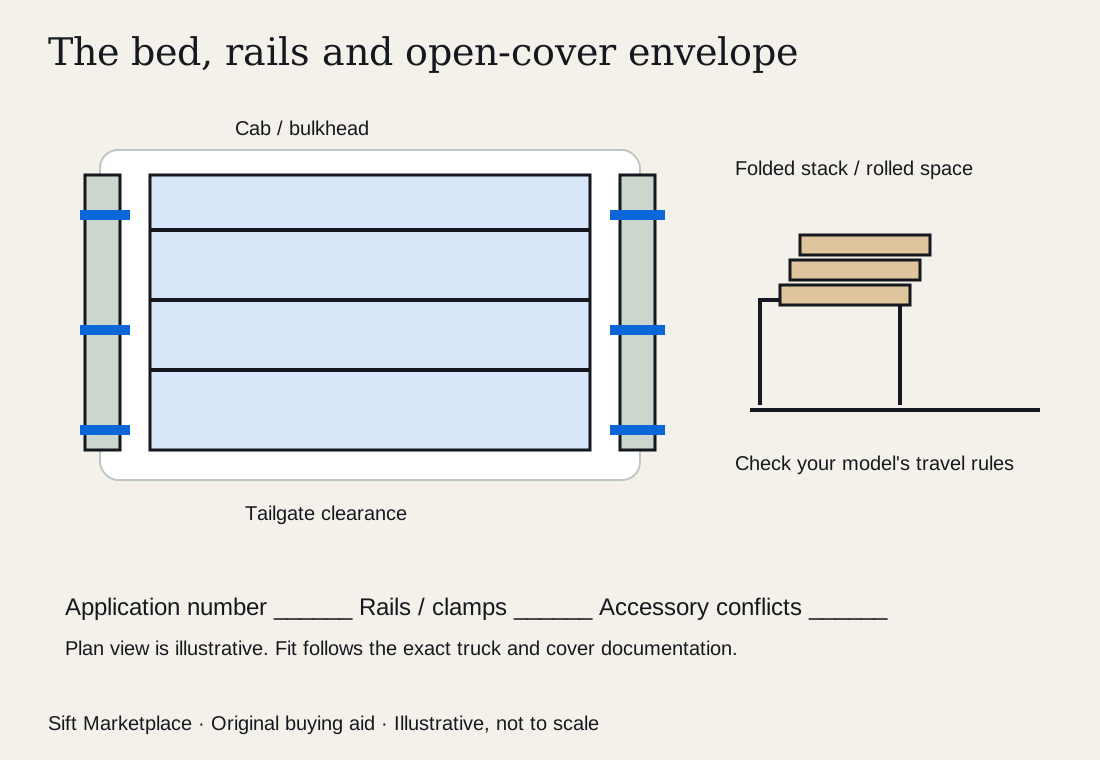
Decide how you use the bed. A retractable canister occupies front space; a folded stack or rolled bundle occupies another envelope. Check whether your ordinary tall cargo, toolbox and rearward view suit the actual open position. Ask which positions the manufacturer permits during travel.
 Enlarge diagram
Identify the cover before ordering replacements
Request the part/serial label, model and generation, the truck it came off and the manual. The donor vehicle is useful context, but the cover’s application identity is the evidence to compare. A familiar product name may span revisions.
The current RealTruck TruXport page identifies a GEN 2 version and lists cover, rails, clamps and a hardware kit separately. That is one example of why a used bundle must be checked against its own instructions rather than today’s product photo. Do not assume earlier and later rails or latch parts interchange.
Ask for the entire kit laid out: driver/passenger rails, cover assembly, clamps or brackets, seals, corner pieces, fastening parts, keys and straps, plus drain fittings/tubes or support pieces where the model requires them. Mark each as present, approved replacement confirmed, or unresolved.
Do not assign a transferable warranty value without reading the actual policy. RealTruck’s displayed TruXedo terms limit the warranty to the original purchaser and exclude used products. Other makers’ terms need their own check; a seller’s original receipt does not automatically give the buyer coverage.
Inspect normal opening, closing and attachment
View the cover on a correctly fitted bed if possible, then inspect loose components when available. Ask the seller to show normal operation using the manual. Do not force a frozen or misaligned latch. Check whether the tailgate and cover can be operated in the required order without interference.
For soft covers, examine fabric, stitching, edge fastenings, bows, straps and attachment points. Note tears, shrinking or distorted edges and brittle areas. For hard folding covers, inspect panel edges, hinges, underside, hinge seals and supports. For retractable covers, note smooth travel, slat condition and the canister/drain arrangement without dismantling it.
Check rails for bends, damaged clamp surfaces, corrosion and unauthorized holes. Inspect each clamp and latch component against the parts list. A replacement skin does not resolve damaged rails; new seals do not fix a warped panel. Ask about previous repairs, leakage, impacts and how the cover was stored after removal.
An ordinary dry viewing cannot establish weather resistance. A lock or latched tailgate does not make a soft cover resistant to cutting, and a hard cover’s appearance does not establish theft protection. Choose according to the maker’s actual design and the condition you can assess.
| Finding | Response |
|---|---|
| Exact application and complete sound kit | Compare operation and installed total |
| Correct cover, missing approved clamps/seals | Confirm exact replacement availability and price |
| Similar length but uncertain part number | Resolve with the maker before paying |
| Bed rack or toolbox conflict | Obtain a supported combination or choose another cover |
| Cracked panel, bent rail or uncertain repair | Obtain assessment rather than assuming seals solve it |
| Seller cannot demonstrate operation | Keep the mechanism condition unverified |
Price the installed result and collection
A hypothetical $180 cover plus $110 confirmed rails/hardware, $45 seals and $60 fitting totals $395. A complete compatible cover at $320 plus $60 fitting totals $380. If the first cover’s rails are unavailable, its total is unresolved; an estimate for generic clamps is not a complete solution.
Use the cost calculator for confirmed parts, fitting and collection. Plan how to move long rails and protect panels or fabric. Do not drive home with a loosely attached cover as a temporary transport arrangement.
Can I buy a cover without rails? Only after confirming the complete compatible rails and hardware can be obtained at a sensible total. A bare cover is not a ready-to-fit kit.
Does it need to be installed to inspect it? Installed operation is useful, but labels, underside condition and an off-truck parts inventory answer different questions. If essential operation remains unseen, price that uncertainty honestly.
Ask: “Could you send the application label, rail and clamp photos, every included part, and a video of normal opening and closing? My truck has this bed/track configuration and these accessories.” Keep those exact application details in your search notes so nearby candidates remain comparable.