How do you know used roof crossbars fit your vehicle?
Quick answer
Record your vehicle’s exact year, body and roof type, then match the bars, feet and vehicle-specific fit kit to current manufacturer guidance. Inventory pads, brackets, fasteners, locks and instructions. Bars that can be clamped onto a roof are not necessarily an approved or complete rack.
Identify the roof before the rack
Start with vehicle year, make, model, body style and the actual roof arrangement. Photograph raised rails, flush rails, fixed points or the bare roof as appropriate. Factory rails and crossbars are different parts. A seller’s rack from the same model name may have come from another body generation or roof option.
Use the rack maker’s vehicle fit lookup and your vehicle manual. Save the result with the date and roof selection. If no supported fit is listed for the combination, ask the maker rather than inferring approval from photographs of another car.
This guide concerns buying the rack assembly. After it fits, a roof box or bike carrier needs its own mounting, clearance and load checks. A broad bar channel does not make every accessory compatible.
 Enlarge diagram
Match a complete set of part numbers
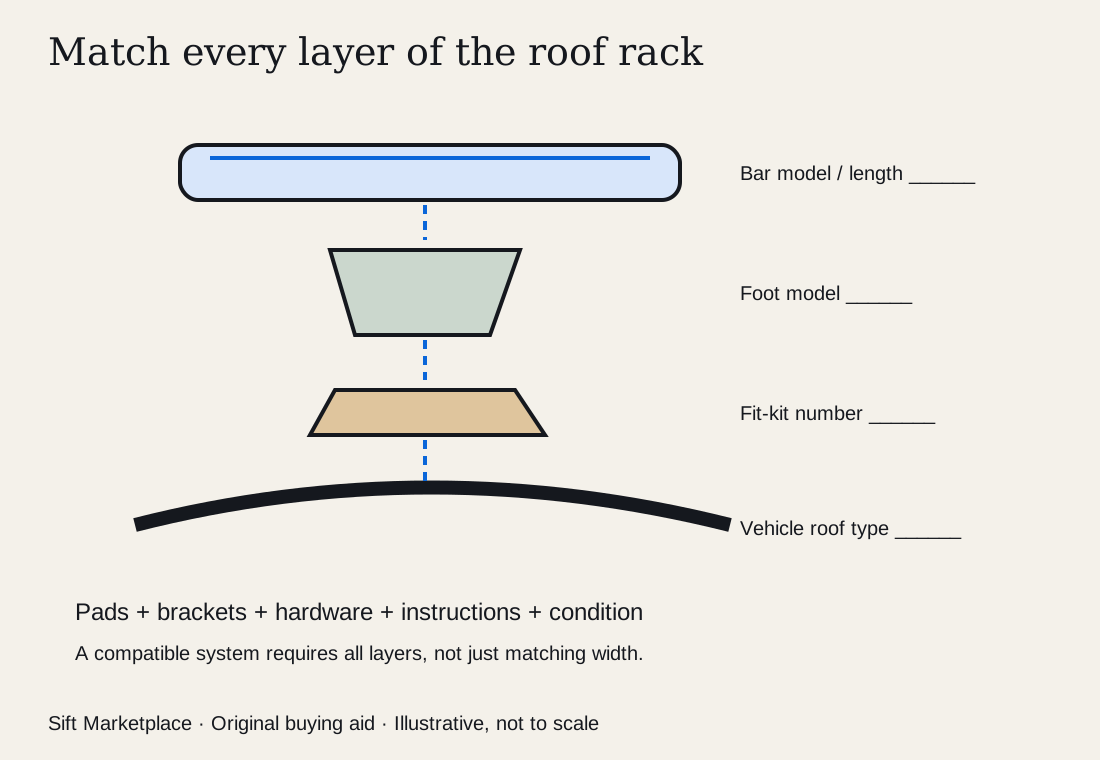
Ask for labels and molded or stamped numbers from the bars, feet and fit kit. Record bar length, foot model, kit number, and which numbered components go at each vehicle position. A bag of four similar pads may contain front and rear parts that must not be interchanged.
Thule’s reuse guide separates the bar, foot and kit; changing vehicles can require changing some or all of them. Use this as a way to organize evidence, not permission to mix generations or brands. A pair of bars is only a bargain if the supported remaining parts can actually be obtained.
Ask the seller to lay out all feet, pads, brackets, end caps, covers, channel inserts, specified tools, fasteners and keys. Compare quantities and identities with the exact instructions. Locks can be convenient, but they do not replace mounting components. Missing contact pads or uncertain brackets matter more than a tidy carrying bag.
If labels have gone, request maker identification before purchase. A guessed part number copied from a visually similar online listing is not a verified fit. Record unresolved items as missing evidence rather than silently filling the record with assumptions.
Inspect the surfaces and load path
View each component separately with the seller’s permission. Look for bent bars, cracks, deep gouges, corrosion, distorted feet, damaged threads, perished contact material and signs of modification. Inspect the areas hidden by covers and where the foot grips the bar. Ask about collisions, overloading and previous repairs.
Check ordinary lock and adjustment operation without forcing seized parts. If a fastener or foot is damaged, obtain an approved replacement and a condition assessment where needed. Do not repair a crack with glue, redrill a bracket, or substitute a hardware-store bolt because it appears to thread in.
Look for cut-down bars or missing end stops. The overall length and permitted installation positions must still match the supported system. A rack fitted tightly by the seller can hide incorrect pads or positioning; the opportunity to inspect off the vehicle is useful.
| Record | What must agree |
|---|---|
| Vehicle identity | Exact year/body/roof selection in fit guidance |
| Bar model and length | Supported foot system and vehicle fit |
| Foot and kit numbers | Correct generation and numbered positions |
| Hardware inventory | Exact instructions, with no improvised pieces |
| Condition | No unresolved damaged load-carrying part |
| Accessory plan | Approved attachment, clearances and permitted load |
Keep load and installation questions separate
Read the vehicle and rack instructions for applicable limits and how weight is counted. Thule’s rack guidelines use the lower applicable limit and include the rack, accessories and load in roof-load accounting. A number printed on a bar is not the available cargo allowance on every vehicle.
For illustration only, if the applicable total roof allowance is 70 kg and the rack weighs 6 kg, 64 kg remains before adding an accessory. A 16 kg box would leave 48 kg under that allowance, still subject to its own limits and all instructions. These invented figures are not specifications or a roof-tent assessment.
Follow the exact installation sequence, positions and specified settings from the manuals, or have a suitable installer fit the rack. Keep this purchase record with the instructions. A seller demonstrating that the assembly sits on your car does not confirm installation quality or future load capacity.
Compare the complete fit rather than the bar price
In a hypothetical example, used bars at $100 need $130 feet, a $85 confirmed fit kit and $25 missing parts: $340 before collection or installation. A complete compatible set at $280 plus $30 fitting costs $310. Reuse only the parts the maker permits, and use actual quotes in the cost calculator.
Can I reuse a rack from a similar car? Possibly, but check every component against the exact destination vehicle. Similar roof width is not enough.
Are missing keys a reason to reject it? First establish the maker’s correct replacement or lock-removal route and the resulting cost. Do not let an easy key replacement distract from an unverified fit kit.
Ask: “Please send the bar, foot and fit-kit numbers and a photo of all parts off the car. I am checking the complete combination for my vehicle and roof type.” Search those confirmed parts rather than the vehicle model alone.
Sources
- 01Thule Find the right gear for your vehicle
- 02Thule How to reuse your roof rack
- 03Thule Rack guidelines