How do you check a used bike rack for your car?
Quick answer
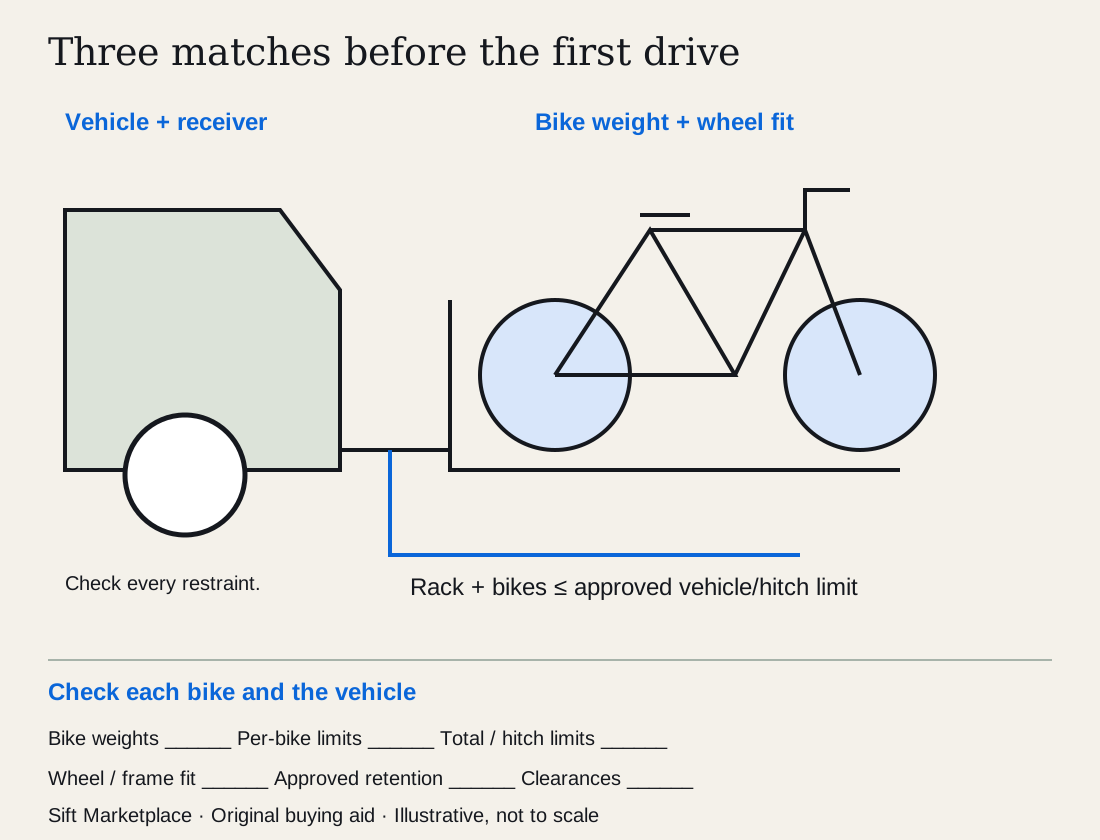
Verify the exact rack against your vehicle and bicycles before inspecting its condition. Check receiver or roof-bar fit, each bike’s weight and dimensions, total load, clearance and approved contact points. Inspect every restraint, mount and locking mechanism. A rack holding the seller’s bike does not prove it can safely carry your different bike or fit your car.
Identify the carrier type and exact model
A hitch rack, trunk rack and roof carrier have different fit requirements. Record model, generation and all included hardware. A similar-looking revision may use different arms, straps or mounting parts.
For a hitch rack, confirm receiver size and required clearance. Thule’s fit guidance shows why receiver size alone is insufficient: pin-hole location, bumper clearance and vehicle projection also matter. Consult the rack’s fitting document and the vehicle or hitch instructions.
For a trunk rack, use the exact vehicle fit list. For a roof carrier, check approved crossbars and whether the bike attaches by wheel, frame or fork. A fork mount may require a specific axle adapter, and a wheel mount has its own tyre and wheelbase limits.
 Enlarge diagram
Write down each bicycle’s requirements
Record each bike’s actual transport weight, wheelbase, tyre width, wheel size and frame material. Check which accessories remain fitted during transport. Do not assume an e-bike becomes suitable merely because its battery can be removed.
Read both total and individual-bike limits. The Thule carrier instructions treat these separately and require following the approved fitting sequence.
Check permitted contact points for carbon frames, unusual frame shapes and bikes with fenders. A clamp that reaches the frame is not proof that clamping there is approved. If you need an adapter, identify the exact approved part before valuing the listing as complete.
Inspect the rack while empty
- Check the label and parts list. Confirm the model and count all pins, bolts, straps, pads, trays and keys.
- Look at structural joints. Inspect welds, pivots and mounting points for cracks, distortion, serious corrosion or unauthorised repairs.
- Operate the folding and tilt mechanisms. Follow the manual and keep clear of pinch points. Confirm every latch engages.
- Inspect restraints. Look for split straps, worn ratchets, missing hooks and damaged wheel cups.
- Check locks separately. Security locks and structural retaining pins may do different jobs. Both must be present where required.
- Inspect the vehicle attachment. Check receiver insert, trunk hooks or roof clamps for damage and substitutions.
Ask about collisions, being struck while parked and use on a trailer or motorhome. Those conditions may have separate restrictions. A rack permitted on a passenger vehicle is not automatically approved on a towed vehicle.
Arrange a proper fit demonstration
If practical, bring your car and a representative bicycle. Follow the manufacturer’s mounting procedure with the seller, using the correct hardware and specified tightening method. Do not improvise a test installation with missing parts.
Check clearance from bumper, tailgate, exhaust, lights and the ground as the instructions require. Confirm the bicycle is restrained at all intended points and does not interfere with another bike. Test any folding or access feature only in the configuration permitted by the manual.
A parking-lot demonstration is not permission to drive with an incomplete installation. If something does not fit, stop and resolve it before transport.
| Finding | Why it matters |
|---|---|
| One bicycle exceeds its individual limit | Spare total capacity does not solve it |
| Required adapter is unavailable | The advertised bundle is not usable for you |
| Strap or hook has been substituted | Approved restraint is uncertain |
| Crack at a hinge or weld | Structural condition needs assessment |
| Rack fits receiver but strikes bumper | Receiver size alone did not establish fit |
| Seller’s bike fits, yours was not checked | Your wheel and frame requirements remain open |
Calculate the load and complete cost
Record each bike separately: actual weight in its intended transport configuration, wheel/tire dimensions, wheelbase, frame/contact restrictions and any required approved adapter. Then record the exact carrier’s total and per-bike limits, supported mounting method and vehicle/hitch conditions. A total rating divided by the number of trays does not necessarily establish the allowance for each bike.
Thule’s hitch fit guidance distinguishes receiver versions and points to product-specific clearance information. Use the actual rack manual and vehicle/hitch documentation. Do not assume a receiver adapter preserves capacity or that a longer shank solves all clearance and projection requirements. Trunk and roof carriers need their own approved vehicle/contact arrangements.
Imagine two hypothetical bikes weighing 24 kg and 12 kg. Their combined 36 kg fits below a hypothetical 40 kg total carrier limit, but the heavier bike would still exceed an illustrative 20 kg per-bike limit. Those invented figures show why both checks matter; they are not rack specifications. Include the rack’s own weight wherever the vehicle/hitch guidance requires it, and confirm the entire setup rather than using a single rating.
Fit the actual bikes using the approved contact points and retention system. Check that clamps, straps and wheel supports suit them and that vehicle clearance can be achieved without unauthorized changes. A frame that a clamp physically grips may still prohibit that contact. Record any obstructed lights or plate and resolve applicable requirements with the relevant authority or a qualified installer.
In a hypothetical comparison, a $130 carrier needs $90 approved retention parts, $45 locks and $25 collection: $290. A complete suitable carrier at $250 plus $25 collection totals $275. Keep an unavailable cradle or unresolved cracked arm out of a cosmetic-wear allowance.
Use the listing comparison tool for each bike and the vehicle fit, and the cost calculator for known costs. Ask: “Please send the exact receiver/version label and all retention pieces; can we assess fit with my actual bikes under the manual?” Search the confirmed carrier family and version before responding to a cheap generic “bike rack” listing.
Questions people ask
Can a two-bike rack carry any two bikes?
No. Check individual-bike limits, total capacity, wheelbase, tyre width, wheel diameter and permitted frame contact. Two light road bikes and two heavier e-bikes can be very different loads. The vehicle and hitch limits also apply.
Can I use a receiver adapter to make it fit?
Only if the rack, adapter, hitch and vehicle instructions permit that combination, including any reduced load limit. Do not assume an adapter makes a one-size rack equivalent to the correct receiver version.
Is a used trunk rack universal?
No. Check the exact vehicle fit list and attachment instructions. Spoilers, glass, tailgate shape and approved strap points matter. Missing pads or substituted straps can invalidate an otherwise compatible setup.