Evaluate a Marketplace bundle by its usable contents
Quick answer
Value the usable pieces you need, include collection and unwanted-item handling, and assume zero resale first. Recalculate the whole bundle if an essential component fails inspection.
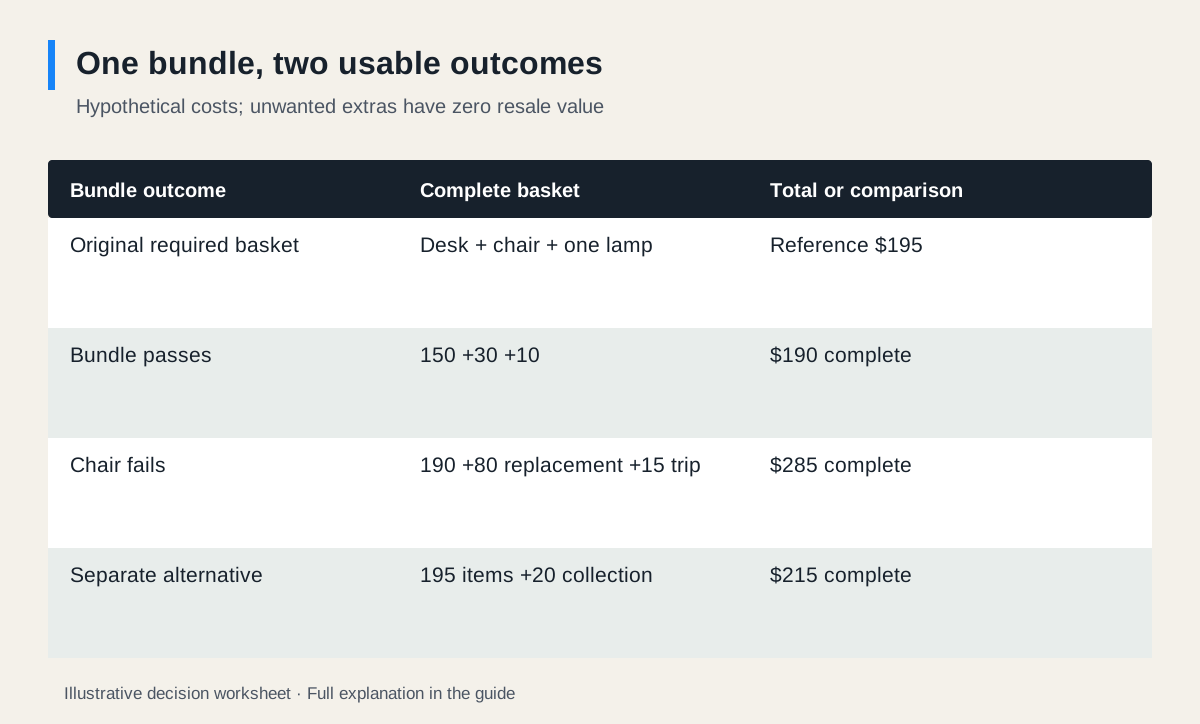 Enlarge diagram
Value the pieces you will actually use
A bundle can save time and money when its required pieces are usable together. Start with your own needs, then inventory the offered items. Seller retail totals, item counts and possible resale proceeds are not substitutes for a complete usable basket.
Here is a fictional desk-area bundle offered for $150. The buyer needs a desk, a suitable office chair and a working task lamp. All reference values below are illustrative amounts the buyer would otherwise consider paying for suitable separate items, not market appraisals.
| Component | Offered quantity | Useful quantity after inspection | Role | Separate-purchase reference |
|---|---|---|---|---|
| Desk | 1 | 1 | Required; fit and condition accepted | $90 |
| Office chair | 1 | 1 | Required; adjustments and fit accepted | $80 |
| Task lamp | 2 | 1 | One required; second visibly damaged and excluded | $25 for the useful one |
| Storage box | 1 | 1 | Optional; buyer does not need it | $0 to this purchase |
| Loose miscellaneous accessories | 1 lot | 0 wanted | Unwanted | $0 to this purchase |
The wanted-item reference total is $195. The damaged lamp is not tested or treated as a usable spare. Agree whether it will remain with the seller. If taking unwanted items is part of the offer, confirm an appropriate handling and disposal route before accepting them.
Complete the acquisition total
The buyer adds $30 collection and $10 for handling/disposal of accepted unwanted material. With no missing required pieces and no resale proceeds, the bundle costs $190 to obtain. That is only $5 below the $195 wanted-item reference, before comparing the collection cost of buying separately.
The separate route is not automatically $195 delivered. Suppose its actual collection costs total $20: the equivalent separate basket is $215, and the bundle’s advantage becomes $25. Compare the same endpoint and actual journeys.
Use the bundle price calculator for up to five component groups. Enter the actual bundle cost with any transport you choose to include, mark the wanted pieces and use your own relevant reference values. Add costs outside the tool separately if you have not included them already. Its purchase-price allocation is bookkeeping; it does not mean unwanted pieces have returned cash to you.
Recalculate when a required piece fails
At collection, suppose the chair’s height adjustment will not hold. The buyer no longer accepts it as the required usable chair. A suitable replacement costs an illustrative $80 with $15 additional collection. The original bundle route becomes $150 +30 +10 +80 +15 = $285, assuming the existing unwanted-item allowance still covers the remainder.
The separate complete basket remains $215 under the original assumptions. The bundle now costs $70 more. To match that alternative, the bundle price would need to be no more than $80: 215 −30 −10 −80 −15. That arithmetic is a comparison ceiling, not an entitlement to a discount. The seller can decline, and the buyer can pass.
If disposal of the failed chair adds another $20, the matching ceiling falls to $60. Do not retain the original saving after a component loses its useful role.
Inspect and agree the whole inventory
Ask whether all photographed pieces are included, whether the seller will split the bundle and what known faults exist. Inspect each essential item using its relevant category guide; a good desk does not establish that the chair or lamp works. For mixed lots, select a meaningful sample yourself, and acknowledge what remains unexamined.
The FTC’s marketplace guidance supports checking the description and purchase terms before paying. Confirm any revised inventory and price in the conversation. If you accept only the desk and working lamp, write that agreement rather than referring vaguely to “the bundle.”
Buy the lot when its usable contents, full cost and handling obligations meet your needs. If a required item fails, an optional extra does not automatically compensate. Run the zero-resale version first so the decision works without needing to become a seller yourself.