How do you check whether a used air compressor suits your tools?
Quick answer
Match your tool’s airflow and pressure requirement with the compressor’s documented output and duty cycle. Establish the tank’s identity and history, inspect accessible external condition and observe only normal manual-directed operation. Corrosion, modifications or uncertain pressure-vessel condition need qualified assessment; a tank that holds pressure briefly is not certified sound.
Choose the tool demand before the tank size
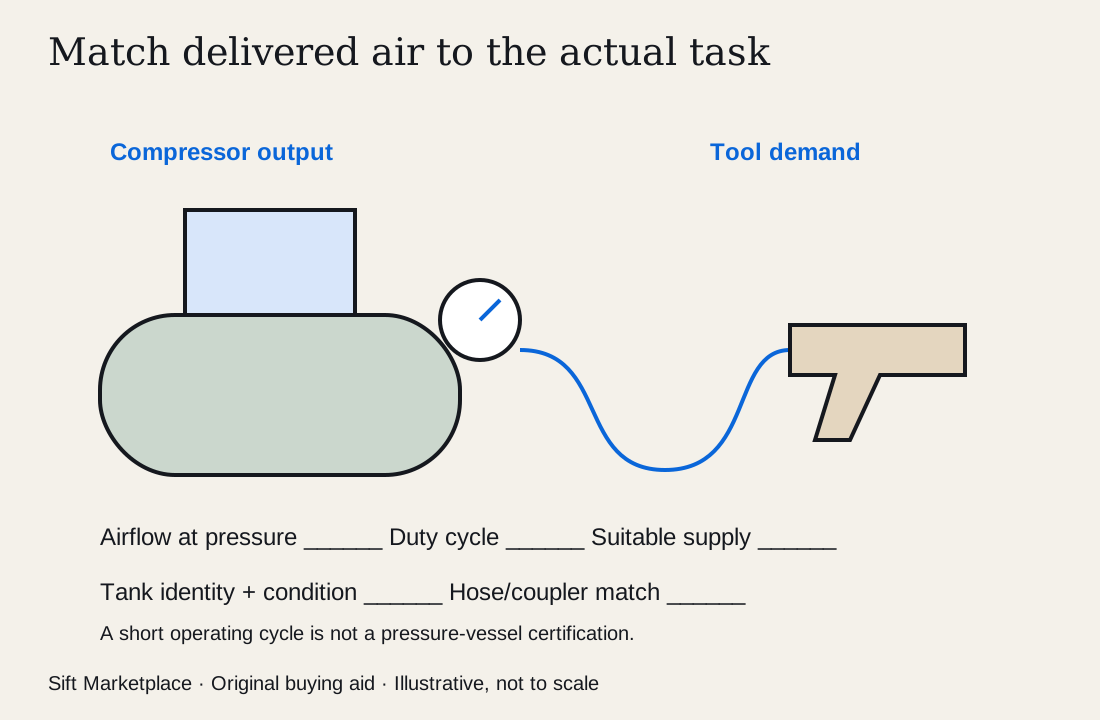
List the air tools you intend to run, their stated operating pressure and airflow requirement, and whether use is intermittent or sustained. A large tank stores air; it does not by itself establish that the compressor can keep up with a tool continuously.
California Air Tools advises checking the tool maker’s airflow requirement and its compressors’ applicable duty cycles. Use the exact model’s output at the relevant pressure, not a displaced-air figure or horsepower label. If multiple tools will run together, obtain a suitable system assessment rather than assuming a hobby compressor covers the combined task.
Record the available electrical supply, room, ventilation and transport arrangement. Do not plan an electrical conversion or adapter to make an incompatible unit usable. A qualified electrician can establish any required supply work before purchase.
 Enlarge diagram
Establish the compressor and tank identity
Request clear photographs of the compressor label, tank identification, gauges, regulator and accessible exterior. Ask for age information, service records, storage conditions and any tank, pressure-switch or relief-device changes. An unreadable or removed tank plate is a material uncertainty.
Look for visible corrosion, dents, damaged feet, leaks, altered fittings, damaged cords and evidence of welding or other repair to the pressure vessel. Do not scrape corrosion to invent a remaining-wall estimate or conduct a DIY proof test. Suspected tank damage requires qualified assessment; do not buy a vessel on the premise that you can weld it later.
The 20020CTR manual is one model’s operating reference. Obtain the corresponding manual for the sold unit, including its inspection, draining and service requirements. A history of ordinary draining is useful context, not proof that the tank interior is sound.
Inventory the connection to your actual tool
| Item | Confirm |
|---|---|
| Compressor output | Stated airflow at the required operating pressure |
| Duty cycle | Permitted work/rest pattern for this model |
| Tool demand | Maker’s airflow/pressure and expected use pattern |
| Regulator and gauges | Correct range, readable condition and ordinary operation |
| Hose and couplers | Compatible, suitably rated and undamaged |
| Application accessories | Required filtration or other equipment specified for the task |
| Power and placement | Correct supply and accessible operating space |
Do not assign value to an assortment of unidentified couplers. A tool that physically connects may still be mismatched to pressure, airflow or the application. This guide concerns ordinary suitable workshop use, not breathing-air systems or specialized hazardous applications.
Observe a normal operating cycle without tampering
If identity and condition support operation, have a competent seller demonstrate the machine according to its manual. Observe ordinary filling, controls, regulated output and a suitable tool task where practical. Keep guards in place, stay clear of moving parts and never bypass a relief device or pressure control.
Record the setup and what happened: startup, normal stopping behavior, output under the agreed task, unusual noise, leakage or unresolved errors. Do not use an arbitrary fill-time or pressure-loss threshold as a universal pass/fail test. Conditions and model specifications differ, and a short cycle cannot certify vessel integrity or remaining pump life.
If the machine cannot be used on the correct supply, mark function unverified. If it repeatedly trips, fails to operate normally or has an unexplained leak, obtain competent service assessment before pricing it as a working unit. “Needs a switch” is a seller’s explanation until diagnosed.
Compare complete capacity, not a cheap tank
Suppose a hypothetical compressor costs $180, with $45 confirmed hose/couplers, $25 regulator work and $30 transport: $280. A complete suitable candidate at $260 plus $20 collection has the same total. Neither is appropriate if its documented airflow cannot support your task.
An unknown tank condition must not become a small guessed repair allowance. Use the cost calculator for known costs only and compare the supported usable system. Ask: “Please send both labels, service and modification history, and the output specification at [tool pressure]. Can we observe normal operation on the correct supply?”
Plan a stable, manufacturer-appropriate move and follow its shutdown and transport instructions. For a broader cordless kit comparison, see used power tools; an air system adds the compressor, tank and connection requirements above.
Sources
- 01California Air Tools 20020CTR owner manual, November 2025
- 02California Air Tools Tool demand and duty cycle